Correctional Sergeant full preview

15 Correctional Officer Resume Examples

OtterCV

Written by The OtterCV Team

Updated: 1/8/2024•8 min read

See all resume examples in this guide, or generate your own resume example with your personalized prompt

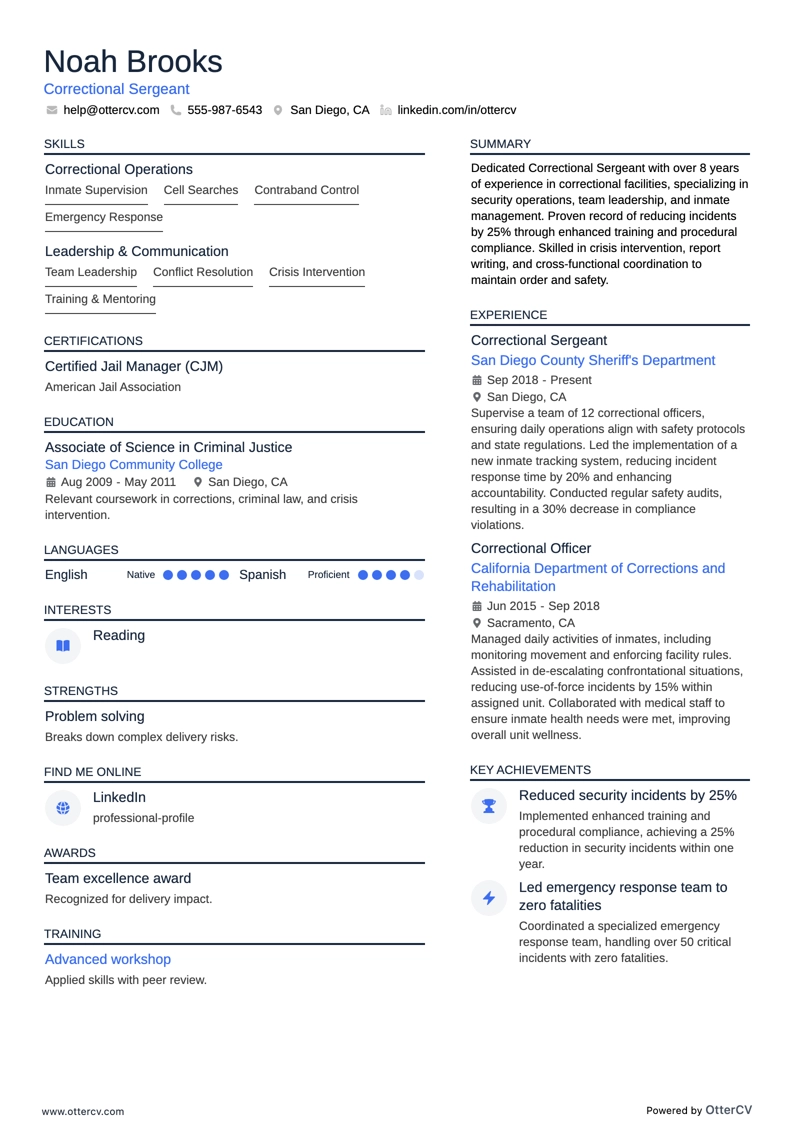
Correctional Sergeant resume example

Correctional Sergeant

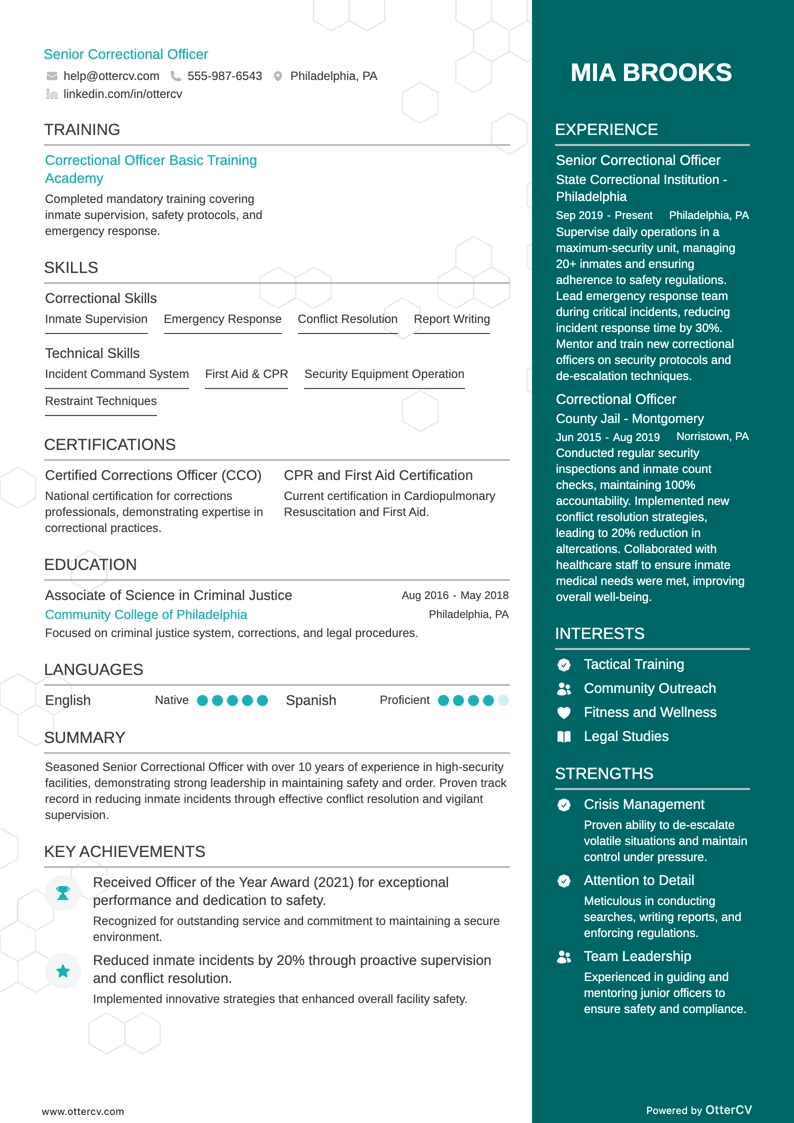
Senior Correctional Officer resume example

Senior Correctional Officer

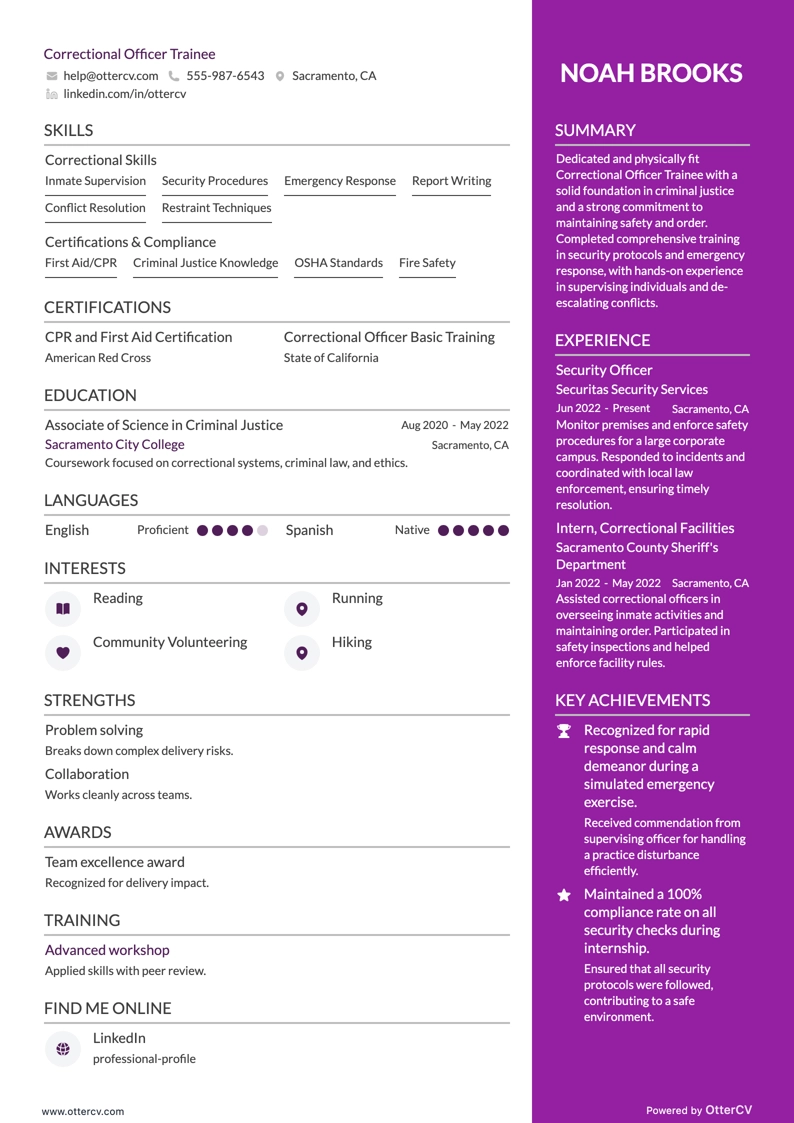
Correctional Officer Trainee resume example

Correctional Officer Trainee

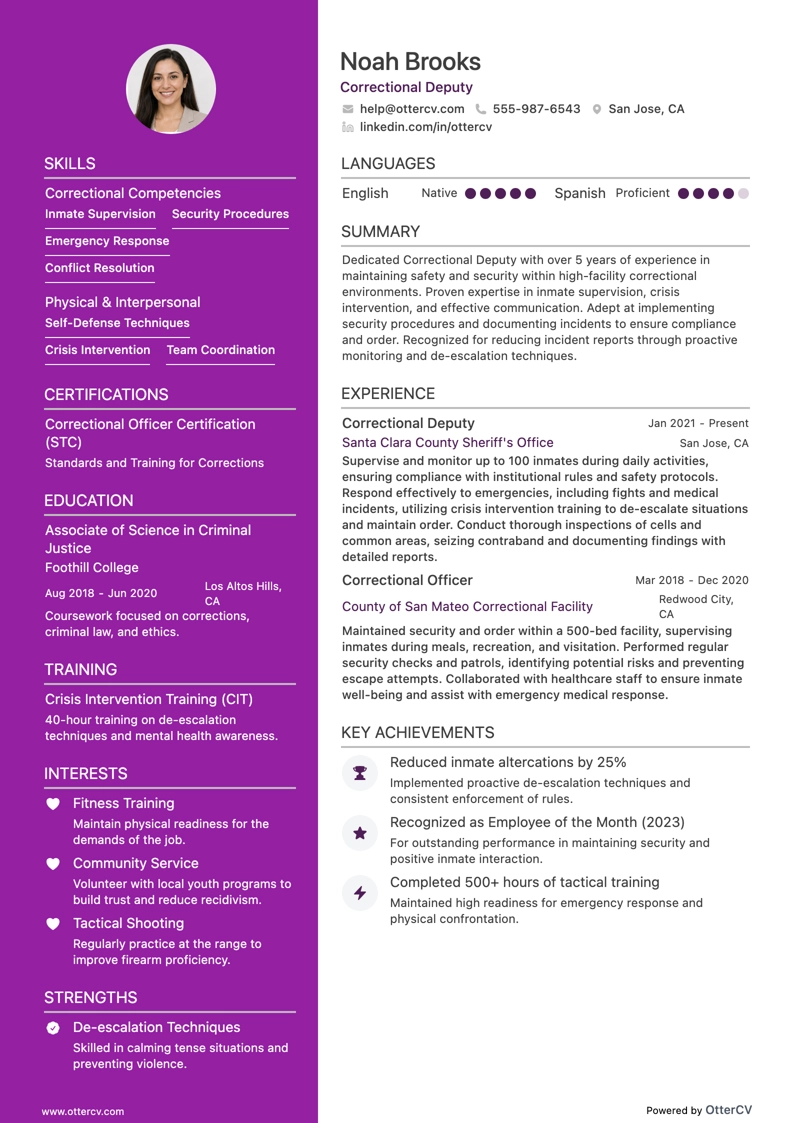
Correctional Deputy resume example

Correctional Deputy

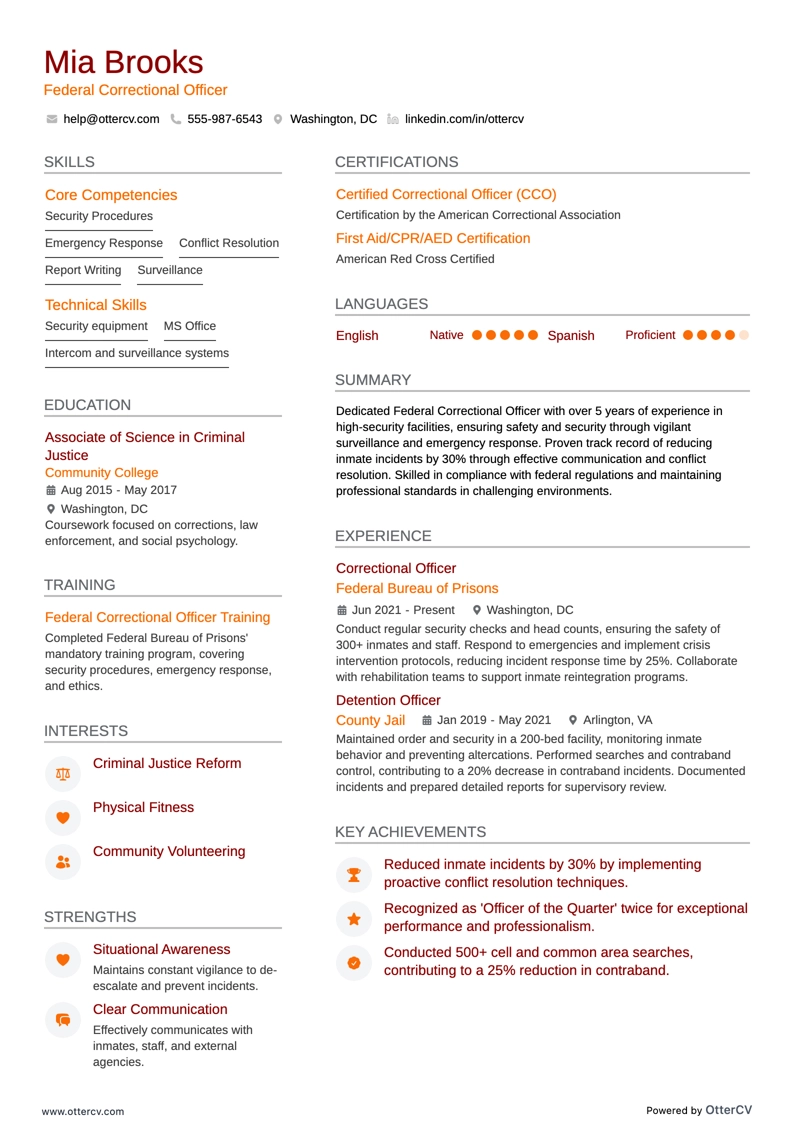
Federal Correctional Officer resume example

Federal Correctional Officer

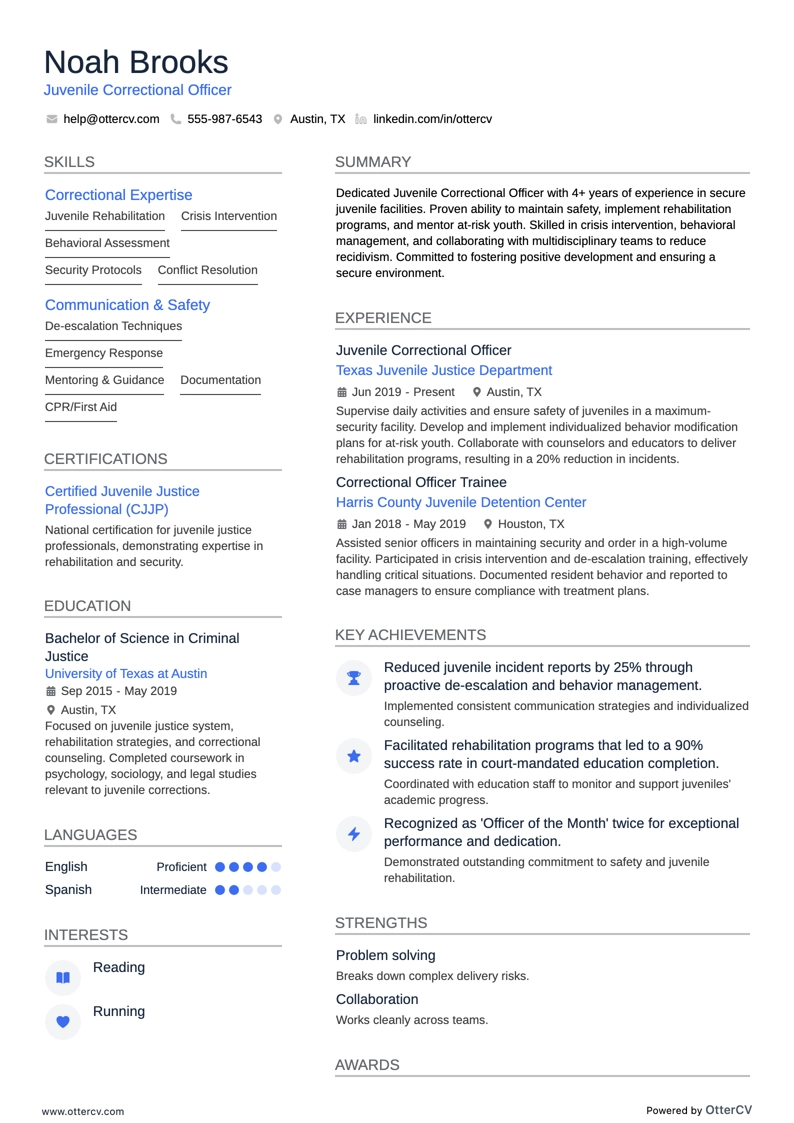
Juvenile Correctional Officer resume example

Juvenile Correctional Officer

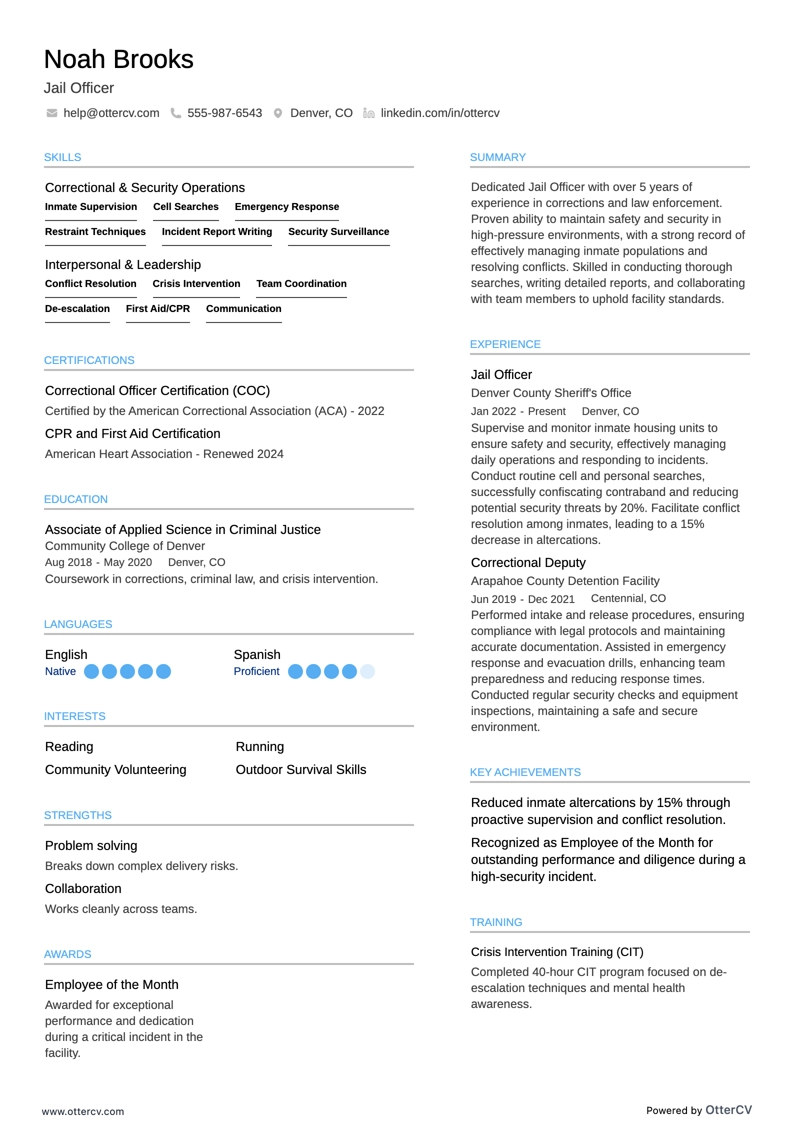
Jail Officer resume example

Jail Officer

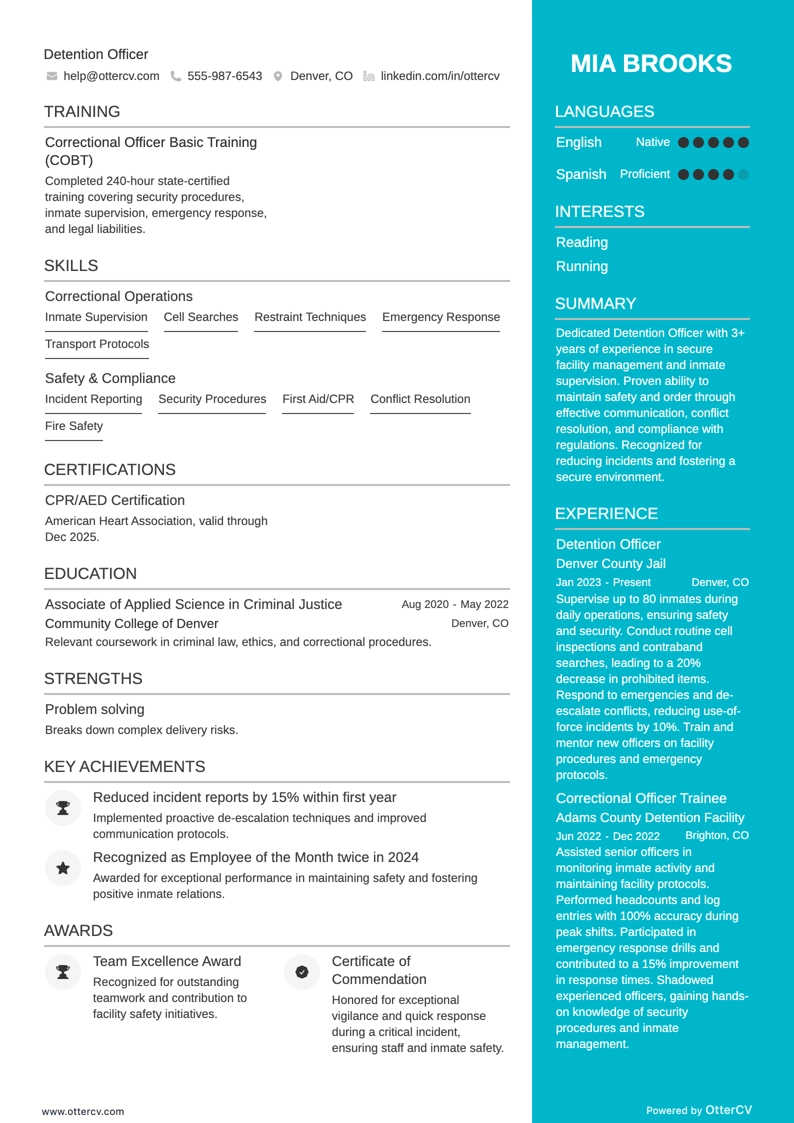
Detention Officer resume example

Detention Officer

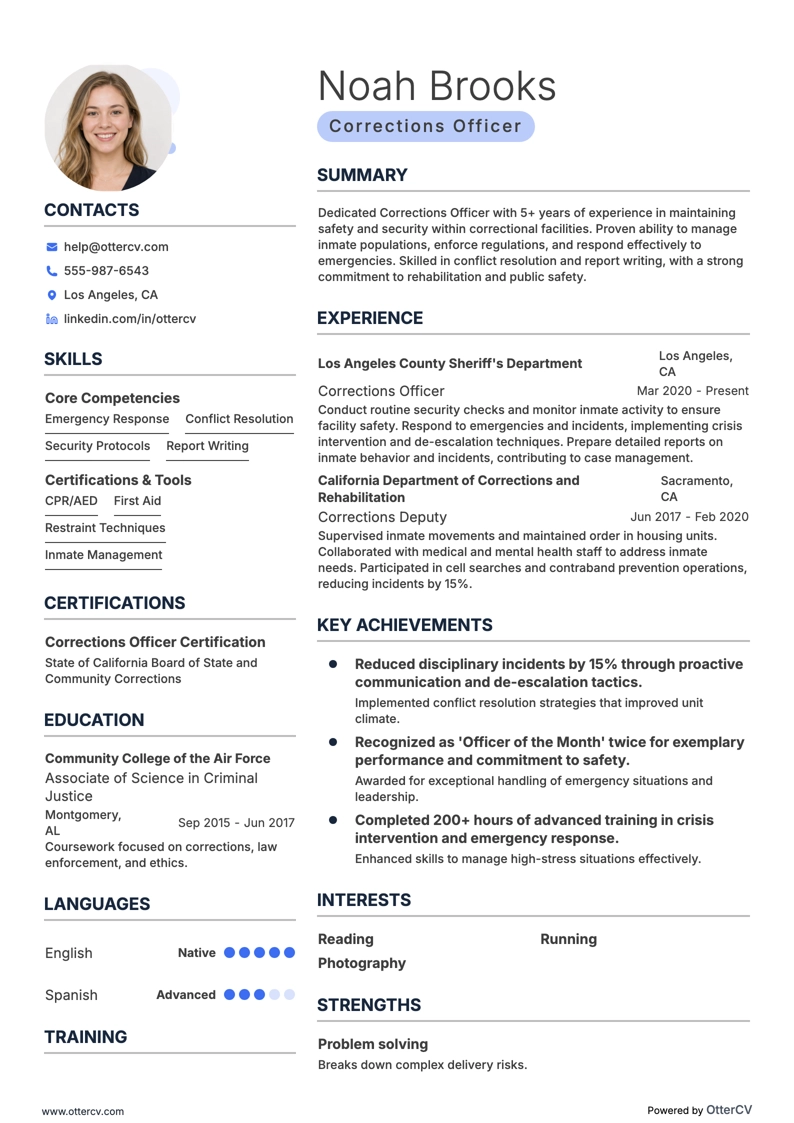
Corrections Officer resume example

Corrections Officer

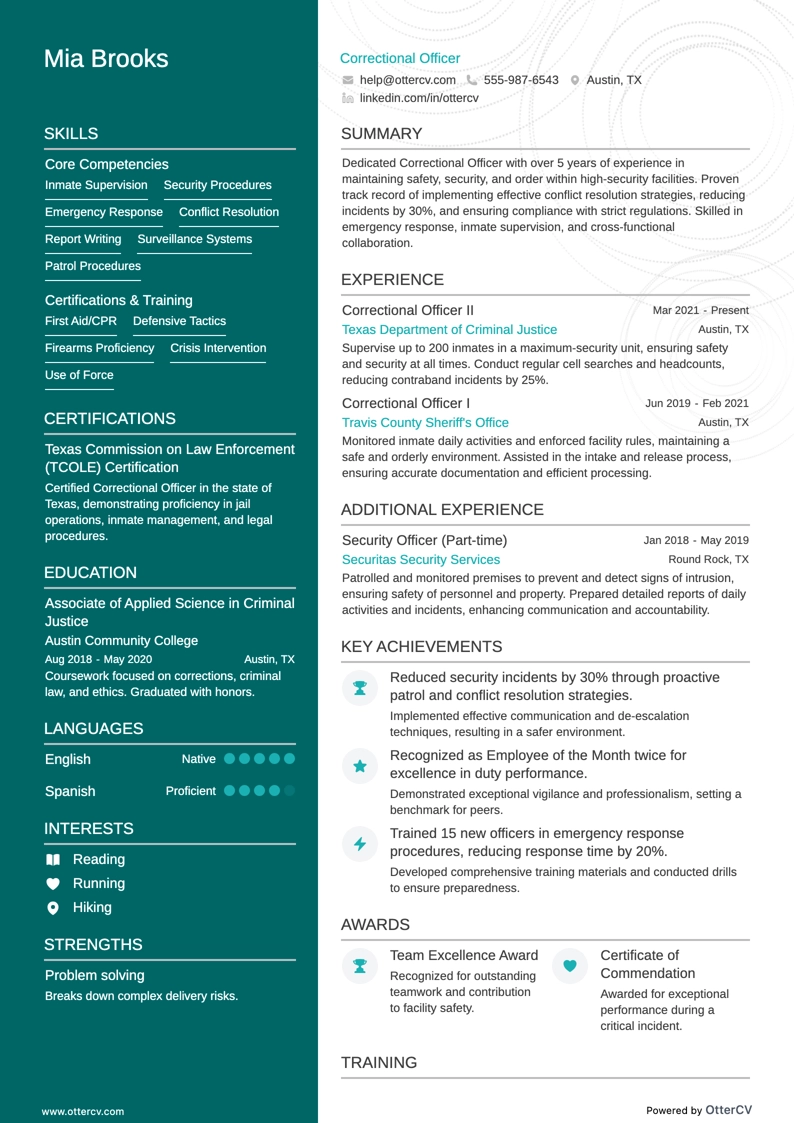
Correctional Officer resume example

Correctional Officer

Many correctional officer resumes fall short because they read like post orders instead of demonstrating safe, consistent decision-making under pressure. That creates a problem when an ATS (applicant tracking system) filters applications quickly and recruiters spend only seconds reviewing each resume.

A strong resume focuses on results, not just duties. Highlight reduced incident rates, completed de-escalations, contraband finds, accurate counts across units, report accuracy, and on-time inmate movement. Also show training impact, audit outcomes, and safety compliance. If you are not sure where to start, learning how to write a resume that emphasizes achievements over duties is the essential first step.

Key takeaways

  • Quantify safety outcomes in every bullet, including incident reduction, count accuracy, and contraband finds.

  • Use a reverse-chronological format if you are an experienced officer, and a hybrid format if you are changing careers.

  • Match the job posting’s exact terminology for systems, protocols, and facility types.

  • Show skills through measurable results in your experience section instead of listing keywords alone.

  • Place certifications above education when they are recent or required for the target role.

  • Write a three-to-four-line summary that highlights your facility type, core skills, and one key metric.

  • Use Echocv’s tools to tighten bullet language and align your resume with each posting more quickly.

Job market snapshot for correctional officers

We analyzed 629 recent correctional officer job ads across major US job boards to highlight regional hotspots, in-demand skills, and employer expectations at a glance.

What level of experience employers are looking for correctional officers

Years of ExperiencePercentage found in job ads
1–2 years2.4% (15)
3–4 years0.2% (1)
10+ years45.3% (285)
Not specified51.8% (326)

Correctional officer ads by area of specialization (industry)

Industry (Area)Percentage found in job ads
Government87.0% (547)
Healthcare7.2% (45)
Education3.5% (22)
Finance & Banking2.4% (15)

Top companies hiring correctional officers

CompanyPercentage found in job ads
State of Florida28.0% (176)
State of North Carolina15.9% (100)
Department Of Justice8.4% (53)
State of Washington4.1% (26)
CoreCivic4.0% (25)
State of Arizona3.7% (23)
State of Georgia3.0% (19)
State of Indiana2.9% (18)
State of Pennsylvania2.7% (17)
State of Tennessee2.5% (16)

Role overview stats

These tables outline the most common responsibilities and employment types for correctional officer roles. Use them to align your resume with employer expectations and better understand how the role is structured across the market.

Day-to-day activities and top responsibilities for a correctional officer

ResponsibilityPercentage found in job ads
Situational awareness2.7% (17)
Record keeping2.4% (15)
Conflict management1.7% (11)
Report writing1.7% (11)
Attention to detail1.6% (10)
Juvenile corrections1.6% (10)
Observation1.6% (10)
Reasoning1.6% (10)
Security1.6% (10)
Written communication1.6% (10)
Cpr1.4% (9)
Criminology/criminal justice1.4% (9)

How to format a correctional officer resume

Recruiters hiring correctional officers prioritize safety training, certifications, inmate management experience, and the ability to maintain order in high-pressure environments. A clean, well-structured resume format helps these critical qualifications stand out quickly in both human review and applicant tracking system (ATS) scans.

I have significant experience in this role—which format should I use?

I have significant experience in this role—which format should I use?

Use a reverse-chronological format to present your correctional experience in a clear, linear progression that highlights increasing responsibility.

  • Start with your most recent facility assignment, and specify unit size, security classification level, and the scope of your supervisory duties.
  • Include role-specific credentials such as use-of-force certifications, crisis intervention training, CPR/First Aid, and proficiency with restraint systems or surveillance technology.
  • Quantify results tied to safety, compliance, and operational efficiency to show measurable impact.

Example: “Managed daily operations for a 240-bed maximum-security housing unit, reducing inmate-on-inmate incidents by 31% over 18 months through revised contraband search protocols and improved shift handoff procedures.”

I'm junior or switching into this role—what format works best?

I'm junior or switching into this role—what format works best?

A hybrid format works best because it lets you lead with relevant skills and training while still showing a concise work history for context.

  • Place a skills section near the top of the page featuring competencies such as conflict de-escalation, emergency response, report writing, and institutional policy compliance.
  • Include any transitional experience—military service, security work, law enforcement internships, or criminal justice coursework—that connects directly to correctional duties.
  • Link every skill or action to a concrete result so hiring managers can see practical application, not just theoretical knowledge.

Example scaffold: Crisis de-escalation training → Mediated verbal altercations between detainees during a county jail internship → Prevented three potential physical confrontations from escalating over a 10-week rotation.

Why not use a functional resume?

Why not use a functional resume?

A functional resume removes the facility context, timeline, and supervisory structure hiring managers need to confirm you can handle the day-to-day demands of a correctional environment.

  • Career changers with no correctional experience: If you are moving from military police, private security, or another protective services role and need to emphasize transferable skills over an unrelated job history.
  • Candidates with significant employment gaps: If personal circumstances created a gap but you maintained relevant certifications or completed correctional officer training during that time.
  • Recent criminal justice graduates: If your work history is limited but you completed practicum hours, ride-alongs, or facility observation programs.

Because recruiters expect to see where, when, and under what conditions you performed your duties, a functional resume can raise red flags. Avoid this format unless your work history truly does not reflect your correctional qualifications, and always connect listed skills to specific projects, training outcomes, or documented results.

With the right format in place, the next step is filling each section with content that highlights your qualifications for the role.

What sections should go on a correctional officer resume

Recruiters want clear evidence that you can maintain safety, enforce policy, and document incidents accurately in a secure facility. Knowing what to put on a resume for correctional roles helps ensure you do not leave out critical details.

Use this structure for maximum clarity:

  • Header
  • Summary
  • Experience
  • Skills
  • Projects
  • Education
  • Certifications
  • Optional sections: Awards, leadership, volunteering

Strong experience bullets should highlight measurable safety outcomes, incident volume and severity, compliance results, and the scope of the units, shifts, and inmate populations you supported.

Once you’ve organized your resume with the right core components, the next step is to write your correctional officer resume experience in a way that supports those sections with clear, job-relevant detail.

How to write your correctional officer resume experience

Your work experience section should show that you can maintain facility security, manage inmate populations, and handle high-pressure situations with consistent professionalism. Hiring managers value demonstrated impact—such as measurable reductions in incidents, improved compliance outcomes, and effective use of correctional protocols—more than generic task descriptions.

Each entry should include:

  • Job title
  • Company and location (or remote)
  • Dates of employment (month and year)

Add three to five concise bullet points that explain what you owned, how you carried out the work, and what outcomes you delivered:

  • Ownership scope: the housing units, inmate populations, facility zones, or security operations you were directly responsible for during each shift or assignment.
  • Execution approach: the correctional procedures, restraint techniques, surveillance systems, crisis intervention methods, or reporting protocols you used to maintain order and ensure safety.
  • Value improved: changes to incident rates, contraband detection, inmate compliance, facility safety standards, emergency response times, or regulatory audit readiness resulting from your work.
  • Collaboration context: how you worked with fellow officers, administrative staff, medical teams, mental health professionals, legal personnel, or external law enforcement agencies to meet facility needs.
  • Impact delivered: outcomes tied to safer facility operations, reduced use-of-force events, stronger policy adherence, improved staff retention within your unit, or successful completion of accreditation requirements.

Experience bullet formula

Experience bullet formula

Action verb + technology + what you built or fixed + measurable result

A correctional officer experience example

Correctional Officer

Riverbend Correctional Facility | Nashville, TN

2021–Present

Medium-security state facility housing 1,200 incarcerated individuals with a focus on safety, rehabilitation, and reentry.

  • Enforced housing-unit security using direct supervision, handheld radios, and body-worn camera protocols, reducing contraband finds by 18% through targeted shakedowns and evidence-based search patterns.
  • Documented incidents, grievances, and use-of-force reports in the Offender Management System (OMS) and digital logbooks, improving on-time report completion from 82% to 97% and reducing supervisor rework by 25%.
  • De-escalated high-risk conflicts using Crisis Intervention Team (CIT) techniques and verbal judo, reducing Code responses in the assigned unit by 22% and lowering average response time by forty-five seconds through clearer radio traffic.
  • Coordinated inmate movement and counts with shift supervisors, medical, and classification staff using count sheets, key control logs, and CCTV monitoring, sustaining 99.8% count accuracy across 300+ daily movements.
  • Trained eight new officers on post orders, PREA (Prison Rape Elimination Act) reporting, and restraint application standards, decreasing first-ninety-day policy violations by 30% and improving field training sign-off rates to 100%.

Now that you’ve seen what a strong experience section looks like, the next step is adjusting those details to fit the specific correctional officer role you’re targeting.

How to tailor your correctional officer resume experience

Recruiters review your correctional officer resume through both applicant tracking systems and manual screening. Tailoring your resume to the job description helps your qualifications stand out in both.

Ways to tailor your correctional officer experience:

  • Match the specific security technologies or monitoring systems named in the posting.
  • Use the same terminology for facility protocols or operational procedures.
  • Reflect the inmate management metrics or performance benchmarks the employer mentions.
  • Include experience with the facility type or custody level specified.
  • Emphasize the compliance standards or regulatory frameworks highlighted in the job description.
  • Show the supervision model or team structure described in the posting.
  • Align your crisis intervention or de-escalation methods with those requested.
  • Highlight the report writing or documentation practices the employer prioritizes.

Tailoring means matching your real accomplishments to what the employer is asking for, not forcing in keywords that do not fit.

Resume tailoring examples for correctional officer

Job description excerptUntailoredTailored
Conduct routine security checks and inmate headcounts per facility protocol, maintaining accurate logs in the Offender Management System (OMS).Performed regular security duties and kept records.Conducted scheduled security checks and inmate headcounts across a 200-bed housing unit, logging all activity in the Offender Management System (OMS) with 100% documentation compliance over 12 months.
Respond to institutional emergencies, including use of restraint techniques and crisis intervention consistent with ACA standards.Handled emergencies and helped maintain order in the facility.Responded to 30+ institutional emergencies annually, applying certified restraint techniques and crisis intervention protocols aligned with American Correctional Association (ACA) standards, contributing to a 15% reduction in use-of-force incidents.
Supervise inmate movement and enforce facility rules while supporting rehabilitative programming and reentry services.Supervised inmates and enforced rules on a daily basis.Supervised daily movement of 150+ inmates across housing, dining, and program areas while coordinating with case managers to ensure 90% inmate attendance in court-mandated rehabilitative and reentry programs.

Once you’ve aligned your experience with the role’s priorities, quantify your correctional officer achievements to show the scope and impact of your work.

How to quantify your correctional officer achievements

Quantifying your achievements shows that you helped keep people safe and operations compliant. Focus on incident reduction, response time, contraband finds, accurate counts, and training or audit outcomes across your assigned units and shifts.

Quantifying examples for correctional officer

MetricExample
Incident reductionReduced inmate-on-inmate incidents by 18% in six months by tightening tier checks and coordinating de-escalation plans with mental health staff.
Response timeCut average emergency response time from four minutes to two minutes across two housing units by standardizing radio callouts and post coverage.
Contraband controlRecovered twenty-seven contraband items in one quarter using targeted cell searches, metal detector screening, and chain-of-custody documentation.
Count accuracyMaintained 99.8% count accuracy over twelve months by enforcing count procedures and reconciling movement logs during shift change.
Compliance auditsPassed three unannounced PREA compliance audits with zero major findings by updating logs daily and documenting rounds in the jail management system.

Once you’ve written strong bullet points for your experience section, it’s just as important to highlight the hard and soft skills that qualify you for a correctional officer role.

How to list your hard and soft skills on a correctional officer resume

Your skills section helps show that you can maintain safety and compliance under pressure. Recruiters and ATS (applicant tracking systems) also scan this section to confirm core capabilities, so aim for a hard skills-heavy mix supported by job-specific soft skills.

Correctional officer roles require a blend of:

  • Product strategy and discovery skills.
  • Data, analytics, and experimentation skills.
  • Delivery, execution, and go-to-market discipline.
  • Soft skills.

Your skills section should be:

  • Scannable with bullet-style grouping.
  • Relevant to the job post.
  • Backed by proof in your experience bullets.
  • Updated with current tools.

Place your skills section:

  • Above your experience section if you’re junior or switching careers.
  • Below your experience section if you’re mid- or senior-level with strong achievements.

Hard skills

  • Manage inmate counts and census control.
  • Conduct cell searches and detect contraband.
  • Follow restraint, handcuffing, and escort procedures.
  • Maintain compliance with the use-of-force continuum.
  • Prepare incident reports and disciplinary write-ups.
  • Use offender management systems and maintain case notes.
  • Apply radio codes and emergency communication procedures.
  • Handle key control and tool inventory logs.
  • Support intake, booking, and classification processes.
  • Follow suicide prevention monitoring protocols.
  • Carry out PREA compliance procedures.
  • Provide first aid and use CPR and AED skills.

Soft skills

  • De-escalate volatile situations.
  • Set and enforce boundaries.
  • Make rapid, defensible decisions.
  • Give clear, direct commands.
  • Stay calm under provocation.
  • Document objectively and neutrally.
  • Coordinate with shift partners.
  • Escalate risks early.
  • Maintain professional vigilance.
  • Follow the chain of command.
  • Resolve conflicts between inmates.
  • Communicate with medical and mental health staff.

How to show your correctional officer skills in context

Your skills should do more than appear in a bulleted list on your resume. Browse resume skills examples to see how correctional officers present their abilities effectively.

Show those skills in these sections:

  • Your summary (high-level professional identity)
  • Your experience (proof through outcomes)

Here’s how that looks in practice.

Senior correctional officer with 12 years of experience in maximum-security environments. Skilled in crisis de-escalation, inmate classification systems, and contraband detection protocols. Reduced facility incident rates by 31% through proactive behavioral monitoring and staff coordination.

  • Clearly reflects senior-level experience
  • Mentions role-specific tools and methods
  • Includes a measurable outcome
  • Highlights leadership and soft skills

Experience example

Senior Correctional Officer

Riverside State Correctional Institution | Harrisburg, PA

March 2017–Present

  • Supervised a 240-bed housing unit and coordinated with case managers, reducing inmate grievances by 27% over two years.
  • Implemented updated contraband screening procedures using body scanner technology, increasing detection rates by 43%.
  • Mentored eight junior officers in de-escalation tactics, contributing to a 19% facility-wide drop in use-of-force incidents.
  • Every bullet includes measurable proof.
  • Skills appear naturally through outcomes.

Once you’ve shown your relevant skills through specific examples and results, the next step is applying that same approach to a correctional officer resume when you don’t have direct experience.

How do I write a correctional officer resume with no experience

Even without full-time experience, you can still show that you’re prepared for the role through:

  • Criminal justice coursework and labs
  • Campus security or patrol shifts
  • Volunteer crisis intervention hotline
  • CERT emergency response training
  • Ride-alongs with local sheriff
  • Conflict de-escalation workshop facilitation
  • Chain-of-custody evidence handling
  • Report writing for student organization

Focus your resume on:

  • Safety procedures and incident reporting
  • Policy compliance and documentation accuracy
  • De-escalation training with outcomes
  • Shift-based reliability and attendance

For a deeper guide to building your application from scratch, see how to write a resume without work experience.

Resume format tip for entry-level correctional officer

Resume format tip for entry-level correctional officer

Use a combination resume format to put training, certifications, and relevant projects ahead of work history so recruiters can quickly spot job-ready skills.

  • Add a Training and Certifications section near the top.
  • Write bullet points that show tools, tasks, and results.
  • Mirror job posting keywords such as counts and reports.
  • Include shift availability and cleared background status.
  • Quantify your work with hours, incidents, or accuracy.

Example project bullet:

  • Completed forty hours of CERT training, ran three incident simulations, and improved team accountability time by twenty percent using standardized checklists and radio protocols.

Even without direct experience, your educational background can strengthen your candidacy, so it’s important to present it clearly on your resume.

How to list your education on a correctional officer resume

Your education section helps hiring teams quickly confirm that you have the foundational knowledge needed for correctional officer work.

Include the following:

  • Degree name
  • Institution
  • Location
  • Graduation year
  • Relevant coursework for juniors or entry-level candidates
  • Honors and GPA if 3.5 or higher

Skip the month and day, and list only the graduation year.

Here’s a strong education entry tailored for a correctional officer resume.

Example education entry

Bachelor of Science in Criminal Justice

Florida Atlantic University, Boca Raton, FL

Graduated 2021

GPA: 3.7/4.0

  • Relevant coursework: Correctional Systems, Criminal Law, Crisis Intervention, and Offender Rehabilitation
  • Honors: Magna Cum Laude; Dean's List (six consecutive semesters)

How to list your certifications on a correctional officer resume

Certifications on your resume show your commitment to learning, your proficiency with safety tools and procedures, and your relevance to correctional officer standards and regulations.

For each certification, include:

  • Certificate name
  • Issuing organization
  • Year
  • Optional: credential ID or URL

Placement depends on how important the certifications are to your target role:

  • List certifications below education when they are older, less relevant, or when your education should lead your qualifications.
  • List certifications above education when they are recent, highly relevant, or required for the correctional officer role you are targeting.

Best certifications for your correctional officer resume

  • CPR and AED certification.
  • First Aid certification.
  • Crisis Intervention Team (CIT) certification.
  • OC Spray (Pepper Spray) certification.
  • Firearms Qualification certification.
  • Defensive Tactics certification.
  • PREA (Prison Rape Elimination Act) training certification.

How to write your correctional officer resume summary

Once you’ve presented your credentials in a clear, easy-to-scan format, use your resume summary to show how those qualifications make you a strong fit for the role.

Your resume summary is often the first thing a recruiter reads. A strong summary quickly shows that you’re qualified and prepared to help maintain facility safety.

Keep it to three to four lines and include:

  • Your job title and total years of correctional or law enforcement experience.
  • The type of facility you’ve worked in, such as county jails, state prisons, or federal institutions.
  • Core skills like inmate supervision, conflict de-escalation, emergency response, and report writing.
  • One or two measurable achievements, such as incident reduction rates or successful audit results.
  • Soft skills connected to real outcomes, such as communication that resolved housing disputes or teamwork that improved unit safety.

PRO TIP

At the entry or mid-level, focus on your hands-on skills, relevant certifications, and early job successes. Mention specific tools you have used, such as booking systems or surveillance equipment.

Avoid vague phrases like “passionate about public safety” or “hardworking team player.” Instead, tie each detail to a clear responsibility or measurable result.

Example summary for a correctional officer

Correctional officer with three years of experience in a 500-bed county facility. Skilled in inmate supervision, crisis intervention, and incident reporting. Reduced housing unit infractions by 18% through consistent protocol enforcement.

Now that you’ve written a summary that highlights your qualifications, make sure the header above it presents your contact details clearly so recruiters can reach you.

What to include in a correctional officer resume header

A resume header includes your main identifying and contact details. For a correctional officer, it improves visibility, credibility, and recruiter screening speed.

Essential resume header elements

  • Full name
  • Tailored job title and headline
  • Location
  • Phone number
  • Professional email
  • GitHub link
  • Portfolio link
  • LinkedIn

A LinkedIn link helps recruiters verify your experience quickly and supports screening.

Do not include a photo on a correctional officer resume unless the role is explicitly front-facing or appearance-dependent.

Match your header job title to the posting, and keep your contact details consistent across your resume, LinkedIn, and background check records.

Example

Correctional officer resume header

Jordan M. Rivera

Correctional Officer | Facility Security, Inmate Supervision, Incident Reporting

Phoenix, AZ

(602) 555-78XX

your.name@echocv.com

github.com/yourname

yourwebsite.com

linkedin.com/in/yourname

Once your contact details and role information are in place at the top, add supporting sections to strengthen your correctional officer resume with relevant details.

Additional sections for correctional officer resumes

Extra sections can help you stand out when your core qualifications are similar to those of other applicants. Focus on sections that support your credibility, physical readiness, or specialized training for correctional environments.

  • Languages — listing language skills on your resume can be a major asset in multilingual facility environments.
  • Certifications and licenses
  • Volunteer experience
  • Professional affiliations
  • Physical fitness achievements
  • Continuing education and training

Once you’ve strengthened your resume with relevant additional sections, pair it with a strong cover letter to give hiring managers a fuller view of your qualifications.

Do correctional officer resumes need a cover letter

A cover letter is not required for every correctional officer role, but it often helps. It can be especially useful for competitive postings, agencies that expect one, or situations where your resume needs added context. If you’re unfamiliar with the format, start by learning what a cover letter is and how it supports your resume.

Use your cover letter to add details your correctional officer resume cannot fully show:

  • Explain your fit for the role and team by aligning your experience with the facility type, shift needs, and custody level listed in the posting.
  • Highlight one or two outcomes, such as reducing incidents, improving compliance, or strengthening documentation accuracy through a specific change you led.
  • Show that you understand the facility’s users and context, including inmate populations, safety priorities, and how policy shapes daily operations.
  • Address career transitions or less obvious experience by connecting prior work to core correctional officer skills such as de-escalation, observation, and report writing.

Even if you choose to include a cover letter to add context beyond your resume, AI can still help you improve your correctional officer resume faster and more effectively.

Using AI to improve your correctional officer resume

AI can improve your resume’s clarity, structure, and impact. It can tighten your language and bring more attention to relevant experience. But overusing it can make your resume feel less authentic. Once your content is clear and aligned with the role, step away from AI. If you’re wondering which AI is best for writing resumes, choose tools that refine your words rather than replace them.

Here are 10 practical prompts to strengthen specific sections of your correctional officer resume:

Strengthen your summary

Strengthen your summary

Rewrite my correctional officer resume summary in two sentences to highlight facility security experience, inmate supervision skills, and measurable outcomes.

Quantify experience bullets

Quantify experience bullets

Add specific metrics to your correctional officer experience bullets, such as inmate counts supervised, incident reduction rates, or training hours completed.

Tighten action verbs

Tighten action verbs

Replace weak or passive verbs in your correctional officer experience section with stronger action verbs that fit law enforcement and detention work.

Align skills section

Align skills section

Compare my correctional officer skills section with this job posting and identify any missing keywords related to security, compliance, or crisis intervention.

Improve certification details

Improve certification details

Reformat my correctional officer certifications section so it clearly lists credential names, issuing agencies, and expiration dates in a consistent format.

Refine education entries

Refine education entries

Edit my correctional officer education section to emphasize coursework or training related to criminal justice, emergency response, or institutional security.

Clarify project contributions

Clarify project contributions

Rewrite my correctional officer project descriptions to clearly specify my role, the facility outcome, and any measurable improvements to safety or operations.

Remove redundant phrasing

Remove redundant phrasing

Identify and remove repeated or filler language throughout my correctional officer resume while preserving meaningful details about duties and accomplishments.

Target a promotion

Target a promotion

Adjust my correctional officer resume bullets to highlight leadership responsibilities, mentorship of junior staff, and experience implementing policy.

Fix inconsistent formatting

Fix inconsistent formatting

Standardize date formats, bullet structure, and heading styles across all sections of my correctional officer resume to create a clean, professional appearance.

Conclusion

A strong correctional officer resume highlights measurable results, role-specific skills, and a clear structure. Use numbers to show impact, such as fewer incidents, faster counts, or stronger compliance. Emphasize safety, de-escalation, documentation, and teamwork.

Keep each section easy to scan and clearly aligned with the correctional officer role. This approach signals readiness for today’s hiring market and near-future needs, helping employers quickly understand your impact, judgment, and fit.

Correctional Officer resume examples

Explore additional Correctional Officer resume samples and guides and see what works for your level of experience or role.

By Experience

Correctional Sergeant

Correctional Sergeant resume preview

Senior Correctional Officer

Senior Correctional Officer resume preview

Correctional Officer Trainee

Correctional Officer Trainee resume preview

Correctional Officer resume examples

Explore additional Correctional Officer resume samples and guides and see what works for your level of experience or role.

By Role

Correctional Deputy

Correctional Deputy resume preview

Federal Correctional Officer

Federal Correctional Officer resume preview

Juvenile Correctional Officer

Juvenile Correctional Officer resume preview

Jail Officer

Jail Officer resume preview

Detention Officer

Detention Officer resume preview

Corrections Officer

Corrections Officer resume preview

Correctional Officer

Correctional Officer resume preview