Specialty Contractor full preview

19 Contractor Resume Examples

OtterCV

Written by The OtterCV Team

Updated: 9/1/2023•8 min read

See all resume examples in this guide, or generate your own resume example with your personalized prompt

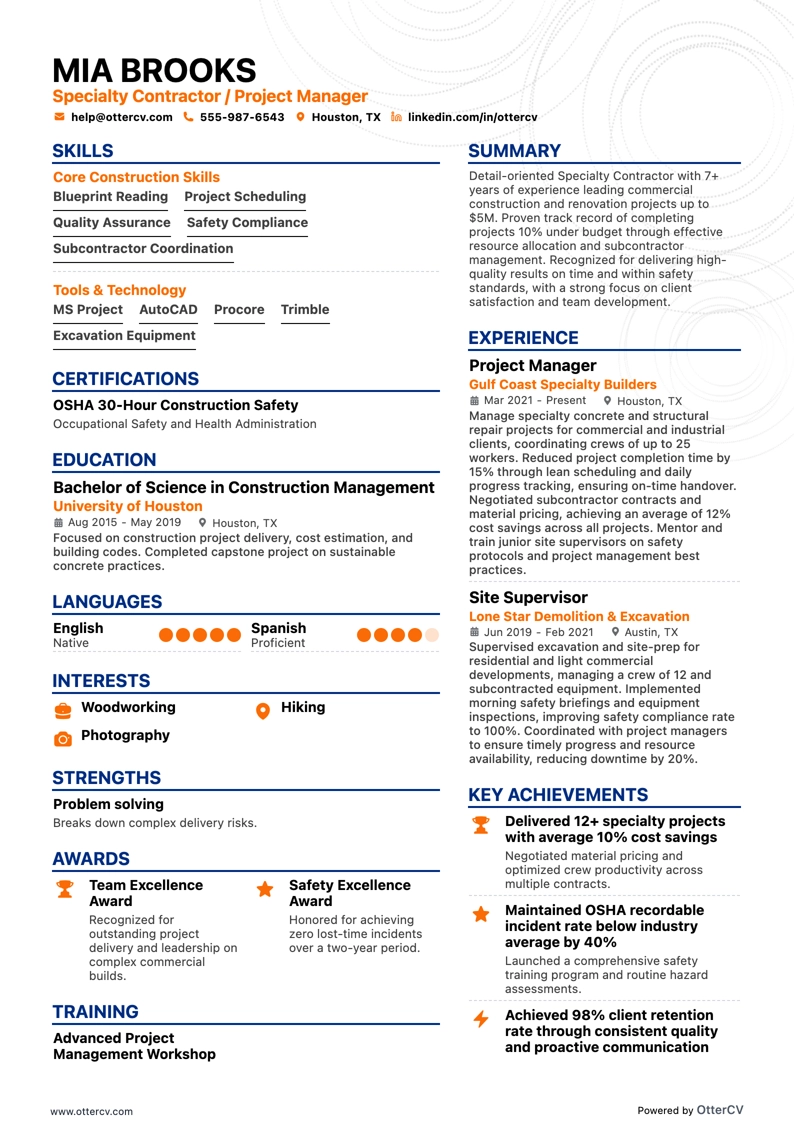
Specialty Contractor resume example

Specialty Contractor

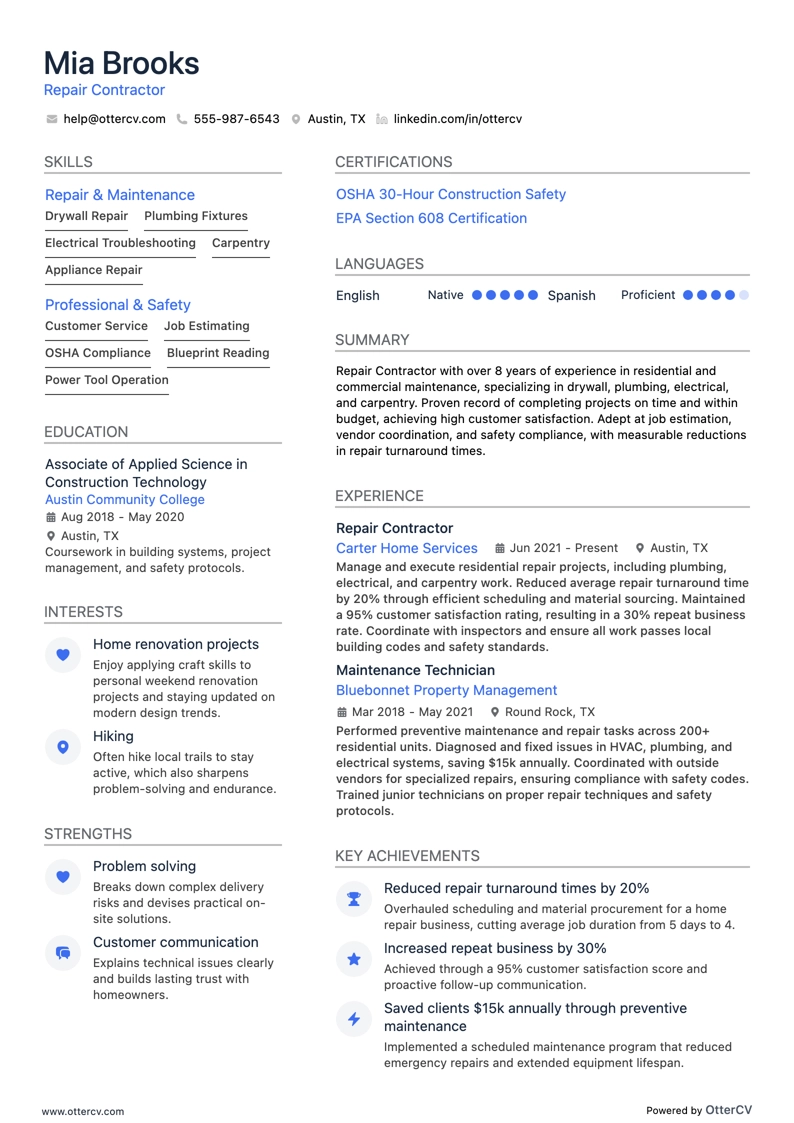
Repair Contractor resume example

Repair Contractor

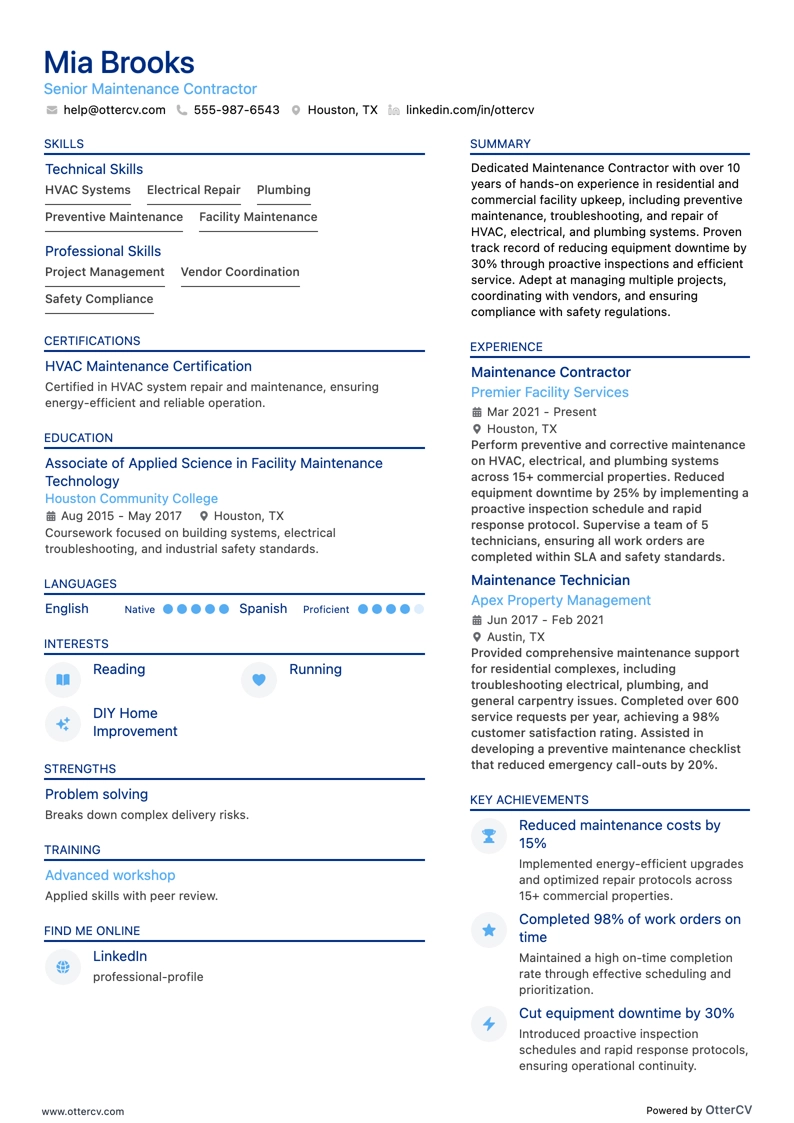
Maintenance Contractor resume example

Maintenance Contractor

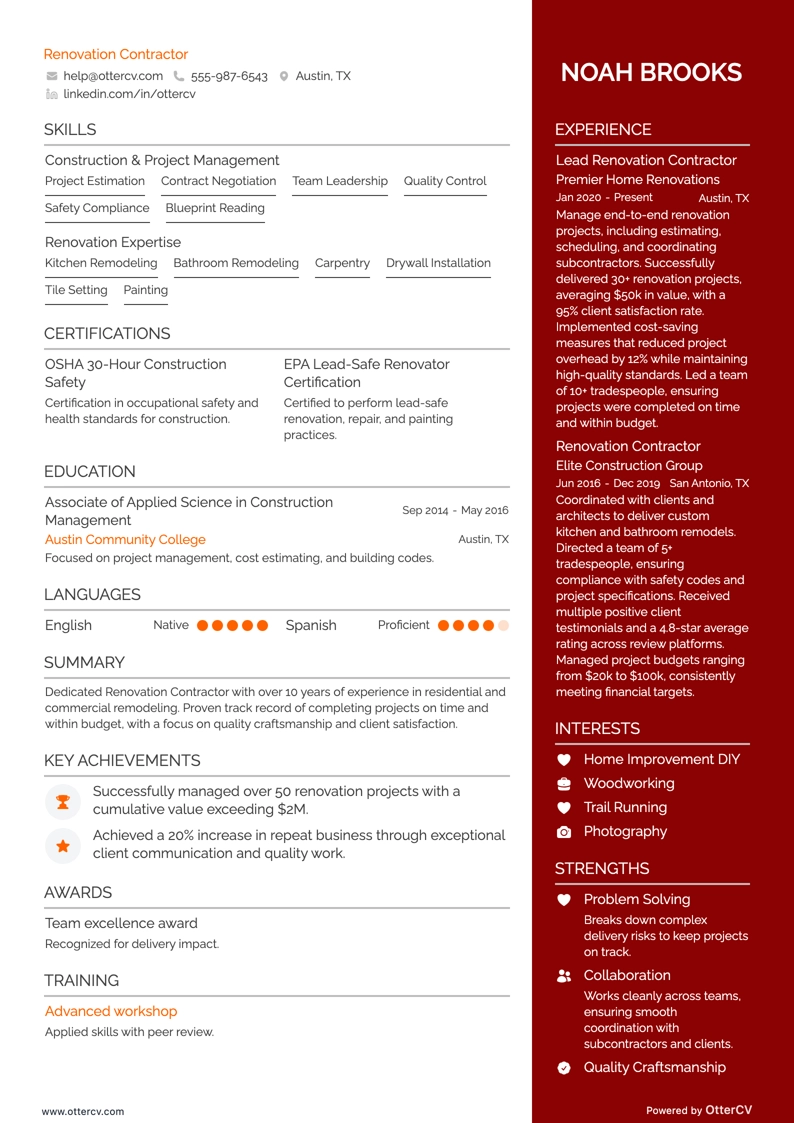
Renovation Contractor resume example

Renovation Contractor

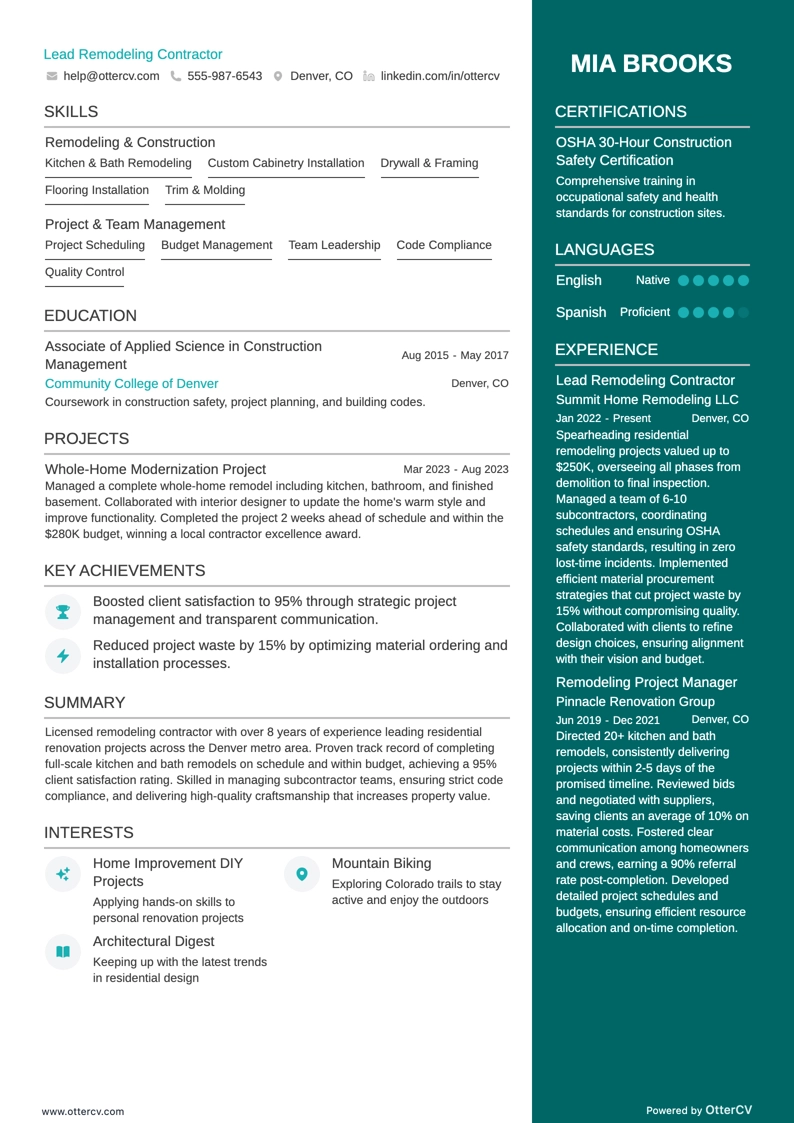
Remodeling Contractor resume example

Remodeling Contractor

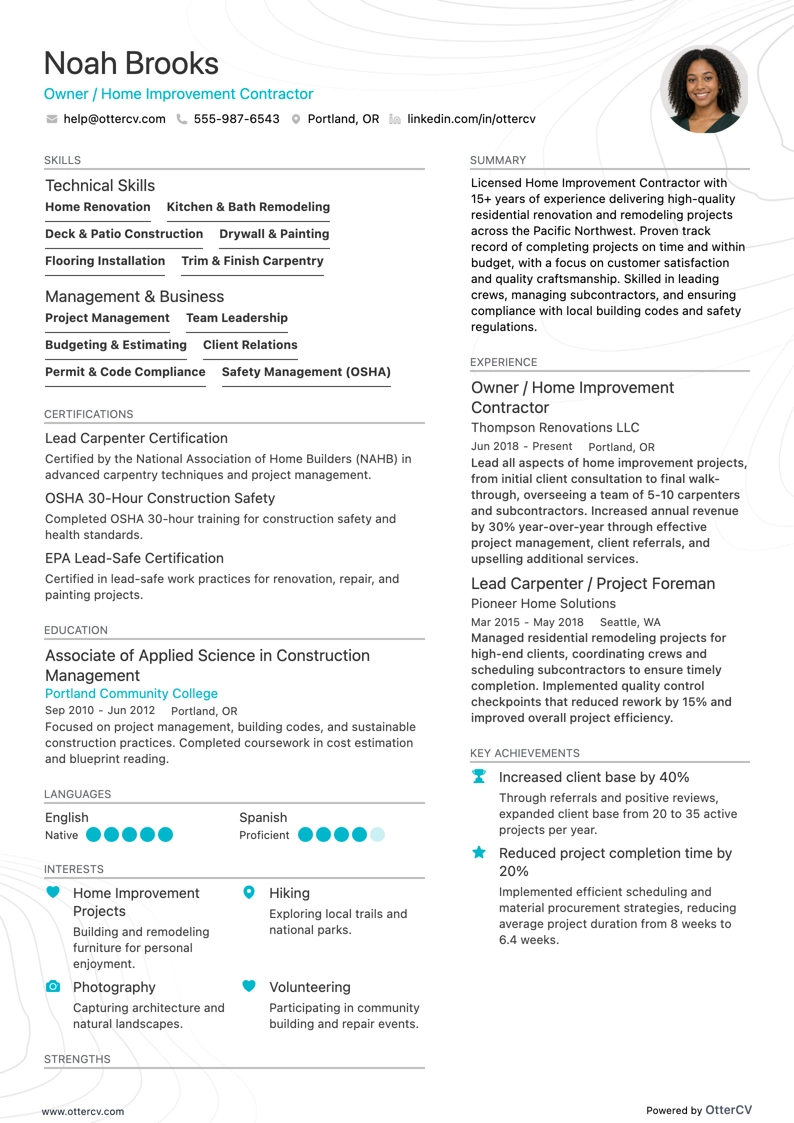
Home Improvement Contractor resume example

Home Improvement Contractor

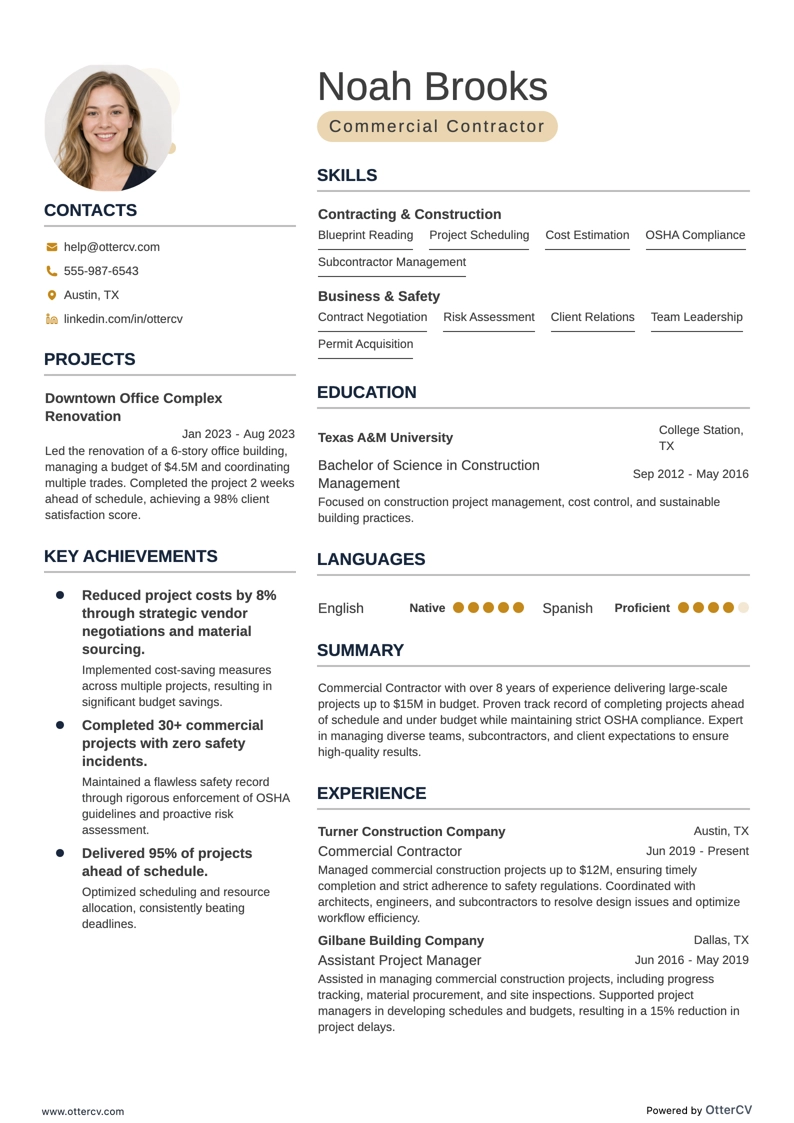
Commercial Contractor resume example

Commercial Contractor

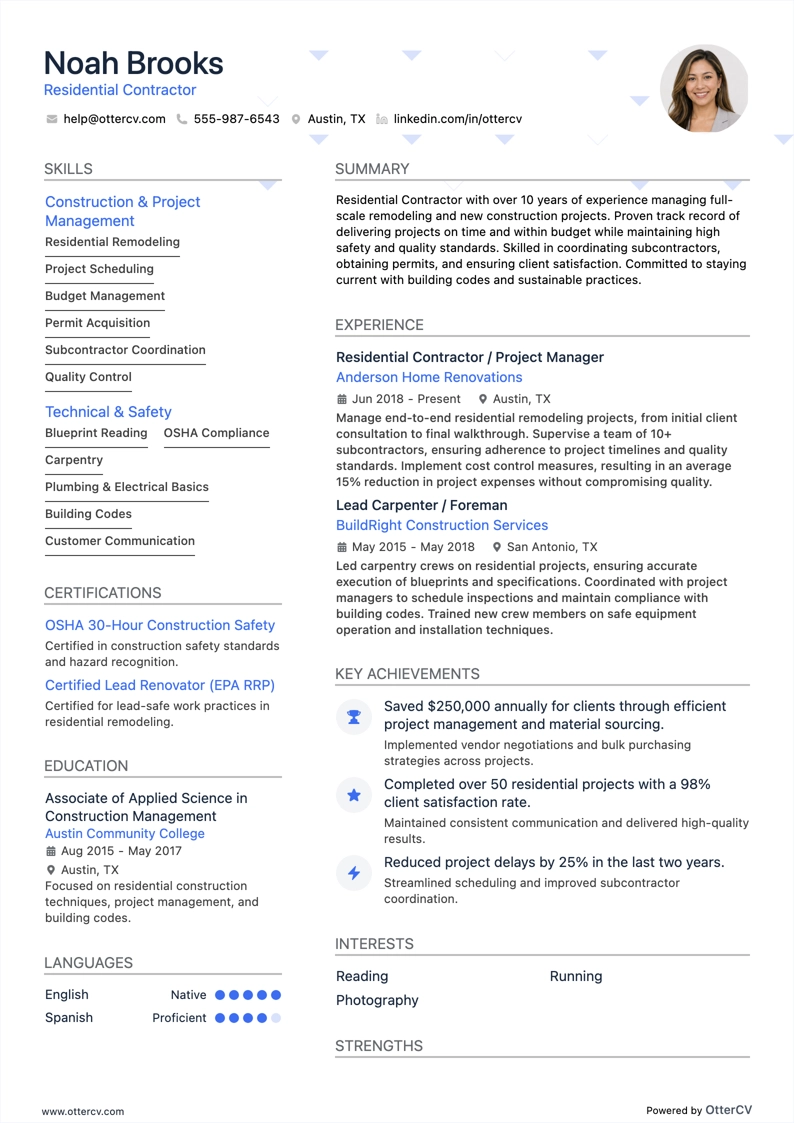
Residential Contractor resume example

Residential Contractor

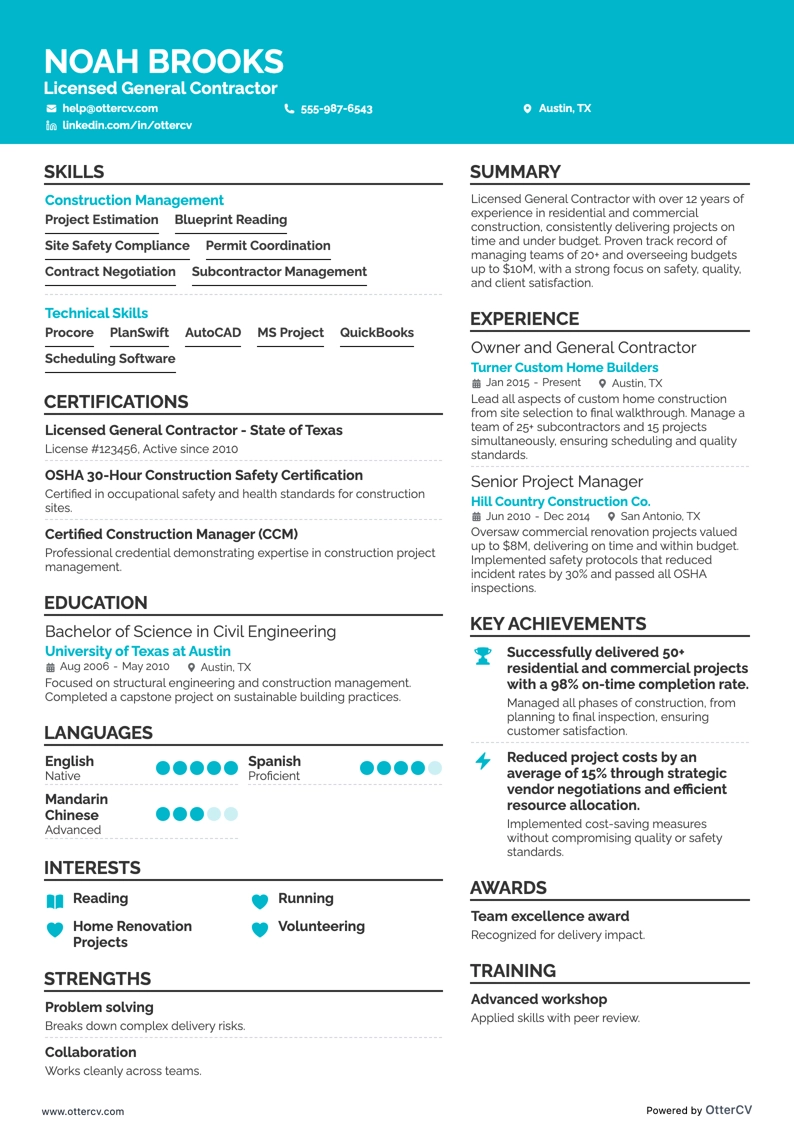
Licensed General Contractor resume example

Licensed General Contractor

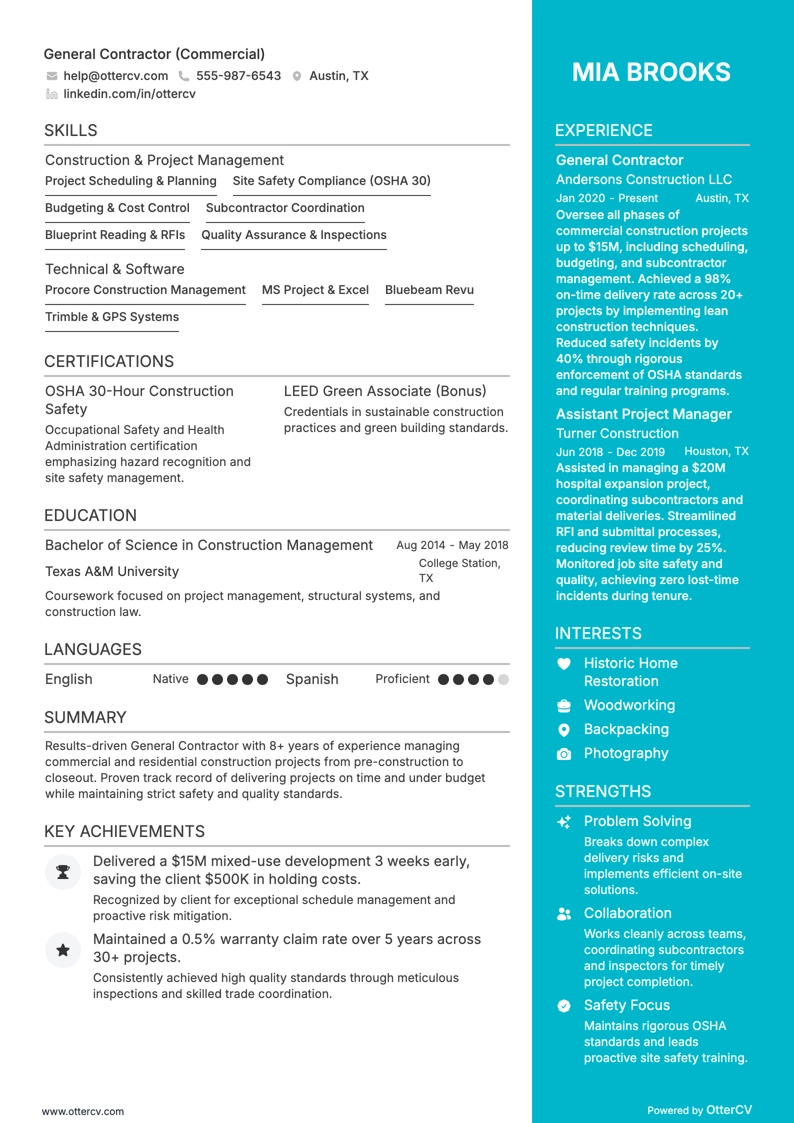
General Contractor resume example

General Contractor

In the competitive building and renovation industry, a contractor resume can be a valuable tool for earning the trust of clients and hiring managers.

This Houzz Industry Report suggests that homeowners value experience most when hiring a contractor. How you present your experience and professional skills can therefore give you an edge over other applicants.

This guide covers the key components that help a contractor resume stand out in the blue-collar workforce.

Key takeaways

  • List your contractor experience in reverse-chronological order.

  • Quantify your accomplishments with metrics such as cost savings and budgeting results.

  • Use a functional resume format if you lack experience.

  • Include your training and certifications with accurate completion dates.

  • Show career progression if you are applying for a higher-level role.

Let’s review the contractor resume example we prepared and look at what makes it effective.

Contractor Resume Sample

We created a contractor resume sample for a candidate with eight years of professional experience. Pay close attention to how the experience section presents the information.

Gregory Greenwood

General Contractor

(512) 555-0198 | gregory.greenwood@echocv.com | @LinkedIn | Austin, TX

Summary

Dedicated and detail-oriented contractor with over five years of experience in home improvement, property maintenance, and renovations. Skilled in carpentry, plumbing, and electrical work, with a strong record of delivering high-quality projects on time and within budget. Known for clear communication and a collaborative approach that supports customer satisfaction throughout project planning and execution.

Experience

Residential Renovation Contractor

Renovate Now, LLC – Austin, TX

April 2020 – Present

  • Planned and executed over 50 residential renovation projects, including kitchen remodels, flooring installation, and roofing repairs.
  • Managed project budgets ranging from $5,000 to $100,000, achieving cost savings of up to 15% through supplier negotiations.
  • Supervised subcontractors and work crews, ensuring compliance with safety regulations and on-time project completion.
  • Collaborated with clients to understand their needs and provide clear cost estimates and timelines.
  • Resolved on-site issues to minimize delays while maintaining client satisfaction scores of 95% or higher.

Junior Contractor

Fix-It Pros – Denver, CO

June 2017 – March 2020

  • Assisted with property maintenance and renovations for residential and small commercial buildings.
  • Performed hands-on work including drywall installation, painting, and basic electrical tasks under supervision.
  • Developed skills in blueprint reading and worksite material preparation.
  • Contributed to team performance, helping increase annual project completion rates by 20%.

Certifications

  • CPR and First Aid Certified, 2022
  • OSHA 30-Hour Certification, 2021
  • EPA Lead-Safe Certified Renovator, 2020

Education

Degree in Construction and Building Technology

Denver Community College – Denver, CO

Graduated: May 2017

Skills

  • Carpentry
  • Plumbing
  • Electrical work
  • Blueprint interpretation
  • Project budgeting
  • Material sourcing

Languages

  • English (Native)
  • Spanish (Conversational)

How to Format a Contractor Resume

One of the first things a hiring manager or client will notice is how your resume is formatted—in other words, its overall appearance and structure.

You may have heard that resume format used to matter mainly because of ATS (applicant tracking systems). That is no longer the main concern.

Recent advances in AI have made most ATS software much better at accurately processing and sorting resumes. As a result, your main formatting goal should be to make your resume easy for hiring managers to scan and read.

Recommended resume format for contractors

Reverse-chronological resume: Most clients prioritize experience when hiring a contractor, so this widely accepted format is usually the best choice.

It lets them quickly review your most recent projects and suggests that you are transparent and confident in your workmanship.

Resume design tips

  • Resume margins: Use margins between 0.5 and 1 inch on each side to improve readability and give your resume a clean, orderly look.
  • Colors: Your resume colors should reflect the seriousness and professionalism expected from a contractor. Black and white is a safe choice, with subtle accents like gray or dark blue if needed.
  • Fonts: Classic resume fonts such as Arial, Calibri, or Times New Roman in 10–12 size work well.
  • Length: In most cases, clients and hiring managers focus on recent experience, so aim for a one-page resume. A two-page resume is also acceptable if you have over a decade of experience and want to show that you are a seasoned contractor.
  • Columns: For contractors, a one-page layout often works best with two columns—one for experience and one for skills and certifications.
  • Resume templates: To save time and make sure these details are handled well, check Echocv’s ready-made templates.

Contact information

File formatting

  • If you’re deciding between a resume in PDF or doc, keep in mind that PDF is the most widely used format. It locks your formatting and preserves it across devices.
  • Also, name the file so it’s easy to search for, for example: Gregory_Greenwood_Contractor_Resume.pdf

Top sections for a contractor resume

Here’s the structure your resume should focus on:

  • Contact Information
  • Resume Summary or Objective
  • Work Experience
  • Skills
  • Training and Certification
  • Education
  • Languages

Do you already have a resume? Try our AI-powered resume checker!

We’ll discuss each resume section in more detail below.

How to Write Your Contractor Resume Experience

Here are the key elements to include in your resume experience section.

  • List the roles you’ve held, starting with the most recent, and include the employment dates for each one.
  • Rather than only listing responsibilities, make your resume stand out by highlighting accomplishments with action verbs and numbers.
  • Mention the specific tools or technologies you have used.
  • If you’ve completed any notable projects, include details such as the scope, budget, or results achieved.

Why resume tailoring is important for recruiters

Don’t underestimate the value of tailoring your resume to the role description. It’s often overlooked, but it can give you a serious advantage over other candidates.

Here’s how it helps:

  • Shows that your experience matches the job requirements.
  • Signals that you understand the employer’s or client’s priorities.
  • Improves your chances of passing ATS screening by using relevant keywords from the job description.
  • Makes your resume more compelling by emphasizing measurable achievements.

To better illustrate this approach, let’s use a real-world job description.

General Contractor

General Contractor

Company Profile: HomeRevive Construction is a leading home improvement and renovation company focused on high-quality residential and commercial construction projects. With over 15 years of experience, the company is known for innovative solutions, exceptional craftsmanship, and strong customer satisfaction.

Responsibilities:

  • Plan, coordinate, and oversee renovation and construction projects from start to finish, ensuring work is completed on time and within budget.
  • Supervise subcontractors and workers, assign tasks, and monitor progress to maintain quality standards.
  • Develop project timelines, budgets, and schedules, and provide regular updates to clients and stakeholders.
  • Conduct on-site inspections to ensure compliance with safety regulations, building codes, and quality benchmarks.
  • Collaborate with clients to define project scope, requirements, and expectations while addressing concerns throughout the project.
  • Source and procure materials, negotiating with suppliers to achieve cost-effective solutions without compromising quality.
  • Resolve on-site issues, delays, and challenges promptly to keep projects running smoothly and maintain client satisfaction.
  • Maintain accurate records of project progress, expenses, and reports for stakeholders and company management.

Requirements:

  • Proven experience as a contractor or in a similar role, with at least 5 years in residential or commercial renovations.
  • Proficiency in project management tools such as AutoCAD, Procore, or Buildertrend.
  • Strong knowledge of construction techniques, safety standards, and local building codes.
  • Excellent communication and organizational skills, with a focus on client satisfaction.
  • Certification in OSHA 30-Hour Construction Safety or similar safety training.
  • Bachelor’s degree in Construction Management or a related field is a plus, but not required.
  • Ability to manage multiple projects simultaneously while maintaining attention to detail.

Now that we’ve covered what the general contractor role requires, the next step is tailoring the work experience entry to align with those expectations.

Here’s an example:

Experience

General Contractor

BuildRight Renovations | 03/2018 - Present | Denver, CO

  • Planned and managed over 50 renovation and construction projects, consistently delivering them on time and up to 15% under budget.
  • Supervised teams of subcontractors and workers while maintaining high-quality standards and strict compliance with safety regulations and building codes.
  • Developed project timelines, budgets, and schedules, and provided regular updates to clients and stakeholders to ensure transparency.
  • Conducted on-site inspections to identify and resolve issues, contributing to a 95% client satisfaction rate.

Junior Contractor

Precision Home Builders | 06/2015 - 02/2018 | Boulder, CO

  • Assisted with the planning and execution of residential renovation projects, gaining hands-on experience in project scheduling and team coordination.
  • Supported subcontractor teams in completing tasks efficiently while adhering to safety regulations.
  • Coordinated with suppliers and managed material procurement to optimize project budgets.
  • Collaborated with senior contractors to resolve on-site challenges and help minimize project delays.
RIGHT

As you can see, we used action verbs and specific examples to target the highlighted parts from the job description. This gives you an advantage by adding relevant keywords to your resume and making it ATS-friendly.

Another effective way to strengthen your resume is by using numbers.

How to quantify your experience on a resume

One of the most impactful ways to present your contractor experience is to quantify it using numbers.

Mention project timelines, budgets, cost savings, and client satisfaction rates. This shows your competence and makes your work more compelling and measurable.

Here are some examples of how quantified accomplishments can appear on your resume:

  • Increased client satisfaction by completing 95% of projects ahead of schedule and within budget over a two-year period.
  • Reduced material costs by 15% through efficient supplier negotiations and bulk purchasing strategies.
  • Managed 10+ subcontractors per project, ensuring 100% compliance with safety regulations and local building codes.
  • Completed renovations on properties totaling over 20,000 square feet, resulting in a 25% average property value increase.
  • Boosted team productivity by implementing new workflow processes, leading to a 30% reduction in project timelines.

But what if you don’t have any previous experience? Don’t worry, we’ve got you covered.

How Do I Write a Contractor Resume with No Experience?

A thoughtfully prepared resume is even more important if you’re just starting out as an apprentice or junior contractor and don’t have significant experience in the field.

Luckily, there are different resume types. In this case, focus on building what is usually called a functional resume.

A functional resume highlights hard skills and qualifications, making it a strong approach for entry-level roles.

What to include on your functional contractor resume

  • Highlight your technical abilities, such as carpentry, electrical work, and tool usage, to help offset limited in-field experience.
  • Use a resume objective to shift attention toward your professional goals rather than your lack of experience.
  • Include relevant certificates, such as OSHA 10 or 30-Hour Training and First Aid/CPR.
  • List construction-related coursework, vocational training, or related degrees.
  • Add hands-on experience from volunteering or personal projects.
  • Mention any additional languages you speak, especially if they are useful in your local job market.
  • Include up to three professional or educational references.

Tips for writing objectives

If you are new to the building and renovation sector, a resume objective can show your motivation to do strong work as a contractor.

  • Explain your contractor career goals in one or two sentences.
  • Mention the skills you want to apply in the role.
  • Show genuine interest in the industry.

Here’s a proper objective example:

Objective

Motivated and detail-oriented aspiring general contractor with hands-on experience from volunteer projects and relevant coursework in construction technology. Eager to contribute strong organizational skills, a commitment to safety, and a passion for quality craftsmanship to HomeRevive Construction while growing professionally in a dynamic team environment.

RIGHT

If you’re currently an apprentice or junior contractor and feel ready to move up the ladder as a general contractor, the next section is for you.

How to Show Career Progression on a General Contractor Resume

Your experience already gives you a strong foundation. The key is presenting it in a way that shows hiring managers you are ready for a higher-level role.

  • Show that you can take on more responsibility by highlighting times you supervised teams or subcontractors.
  • Explain your role in project planning, budgeting, and execution.
  • Use numbers to demonstrate your impact on timelines, client satisfaction, and costs.
  • Include the technical skills most relevant to the role.
  • Mention relevant previous positions, such as junior contractor, foreman, or project manager, to show clear career growth.
  • Support your qualifications with any advanced certificates.

Next, let’s look at the key skills that make a strong property renovation contractor.

How to List Your Hard and Soft Skills on Your Resume

To show that you are a good fit for the role, your resume should match the job description with the right mix of skills. If you are not familiar with resume terminology, hard skills are profession-specific abilities, while soft skills are personal qualities that shape how you work and communicate with coworkers and clients.

For contractors, a dedicated skills section focused on technical abilities is essential. Make sure every skill is spelled correctly so your application stays ATS-friendly.

Here’s what hiring managers usually look for in candidates:

Best hard skills for your contractor resume

  • AutoCAD is a valuable drafting and design skill for contractor resumes.
  • SketchUp is a useful 3D modeling skill for contractor work.
  • Revit is an important building design and BIM skill for contractors.
  • Microsoft Project shows project scheduling and planning expertise.
  • Procore highlights construction management software experience.
  • Buildertrend demonstrates knowledge of construction project coordination tools.
  • Bluebeam Revu reflects skill in document review and markup workflows.
  • PlanGrid shows experience with construction document management.
  • Sage 100 Contractor indicates familiarity with contractor-focused accounting software.
  • Trimble Field Link demonstrates field layout and positioning software knowledge.
  • Rhino 3D is a useful design and modeling skill for specialized contractor roles.
  • Primavera P6 highlights advanced project planning and scheduling ability.
  • OSHA Safety Software shows familiarity with jobsite safety management tools.
  • Fieldwire demonstrates experience with field collaboration and task tracking.
  • Autodesk BIM 360 reflects knowledge of cloud-based construction management tools.
  • QuickBooks Contractor Edition shows contractor-specific bookkeeping software experience.
  • SmartBid demonstrates familiarity with bid management software.
  • HeavyBid highlights experience with estimating and bidding tools.
  • JobNimbus shows knowledge of project and customer management software.
  • Fusion 360 demonstrates additional design and modeling software proficiency.

Some candidates are tempted to exaggerate their skills or even lie about them. But lying on your resume is never a good idea, because hiring managers can usually verify these claims later in the hiring process.

You do not need a separate section for soft skills on your resume. Instead, weave them naturally into your resume summary and work experience descriptions.

With that in mind, here is an extended list of interpersonal skills recruiters often appreciate in contractors.

Explaining how you gained your professional skills through training and certification is another important part of building an attention-grabbing resume.

How to List Your Certifications and Education on a Resume

For a contractor, certifications usually take priority over education on a resume. They show compliance with industry standards, help meet job requirements, and reassure employers of your technical qualifications.

List them clearly, and include the year of completion and the organization that issued each one.

Here’s an example:

Certifications

  • OSHA 30-Hour Construction Safety and Health Certification | 2022
    Occupational Safety and Health Administration (OSHA)

  • EPA Lead-Safe Certified Renovator | 2022
    Environmental Protection Agency (EPA)

RIGHT

We also researched which certifications stand out most in your line of work.

Certificates may take priority, but your educational background can still add significant value to a contractor resume.

Here’s how to structure your education section:

  • List the degree or diploma earned.
  • Include the full name of the educational institution.
  • Add your GPA only if it is above 3.5.
  • Include your attendance period; there is no need to list the months.
  • Mention your major or relevant coursework.

Here’s what that can look like on a resume.

Education

Associate's Degree in Construction Technology

Austin Community College

2020 - 2022

GPA: 3.5 / 4.0

  • Completed coursework in Construction Safety and Project Management

High School Diploma

Westlake High School

2016 - 2020

RIGHT

This is a strong example because the information is well organized, and the degree and coursework are relevant to contractor roles.

Education adds value to your resume, but your resume summary is where you can show recruiters exactly why you are the best fit for the job.

How to Write Your Contractor Resume Summary

Your resume summary should give a precise snapshot of why you are the right candidate. It should quickly capture the employer’s attention with a strong statement supported by clear achievements.

In three to five sentences, include:

  • Professional experience: The number of years you have worked in the field and the types of projects you have completed.
  • Specialized skills: Key competencies such as project management, blueprint interpretation, or other technical abilities.
  • Achievements: Measurable results, such as projects completed, cost savings achieved, or client satisfaction rate.
  • Value to employer: A clear statement showing how your expertise can support the employer’s goals.

Let’s examine a well-written example:

Summary

Results-driven General Contractor with 5+ years of experience managing renovation projects valued at up to $1M. Successfully led teams of 15+ workers, with 90% of projects completed ahead of schedule and a 95% client satisfaction rate. Skilled in budget management, reducing material costs by up to 20% through strategic procurement.

RIGHT

Here’s what makes this resume summary effective:

  • It’s concise, delivering impact in just three sentences.
  • It uses action-oriented language to show how results were achieved.
  • It includes quantified achievements, making accomplishments more tangible.
  • It is tailored to the specific requirements of the contractor role.

We’ve covered the key elements of a contractor resume. But is there anything else that could make your resume great and help you stand out even more as a candidate?

Here are a few examples.

Additional Sections for a Contractor Resume

Adding extra sections to your resume can be valuable, even if you are an experienced contractor.

These sections provide more context about your professional strengths and give employers more reasons to choose you over other candidates.

Consider including:

  • Volunteer work: Community involvement where you applied construction skills.
  • Projects: Details about scope, budget, and results.
  • Hobbies and interests: Include only those that relate to your work, such as woodworking or sustainable building practices.
  • Professional affiliations: Memberships in organizations like the National Association of Home Builders (NAHB) or Associated Builders and Contractors (ABC).
  • Language skills: Helpful when serving a diverse client base.
  • References: List 1-3 connections and note that they are available upon request.

Conclusion

A well-crafted resume can open many doors for a contractor. By tailoring your resume to the job posting and including measurable results, you are far more likely to make a strong impression and capture the interest of both clients and hiring managers.

Contractor resume examples

Explore additional Contractor resume samples and guides and see what works for your level of experience or role.

By Role

Specialty Contractor

Specialty Contractor resume preview

Repair Contractor

Repair Contractor resume preview

Maintenance Contractor

Maintenance Contractor resume preview

Renovation Contractor

Renovation Contractor resume preview

Remodeling Contractor

Remodeling Contractor resume preview

Home Improvement Contractor

Home Improvement Contractor resume preview

Commercial Contractor

Commercial Contractor resume preview

Residential Contractor

Residential Contractor resume preview

Licensed General Contractor

Licensed General Contractor resume preview

General Contractor

General Contractor resume preview