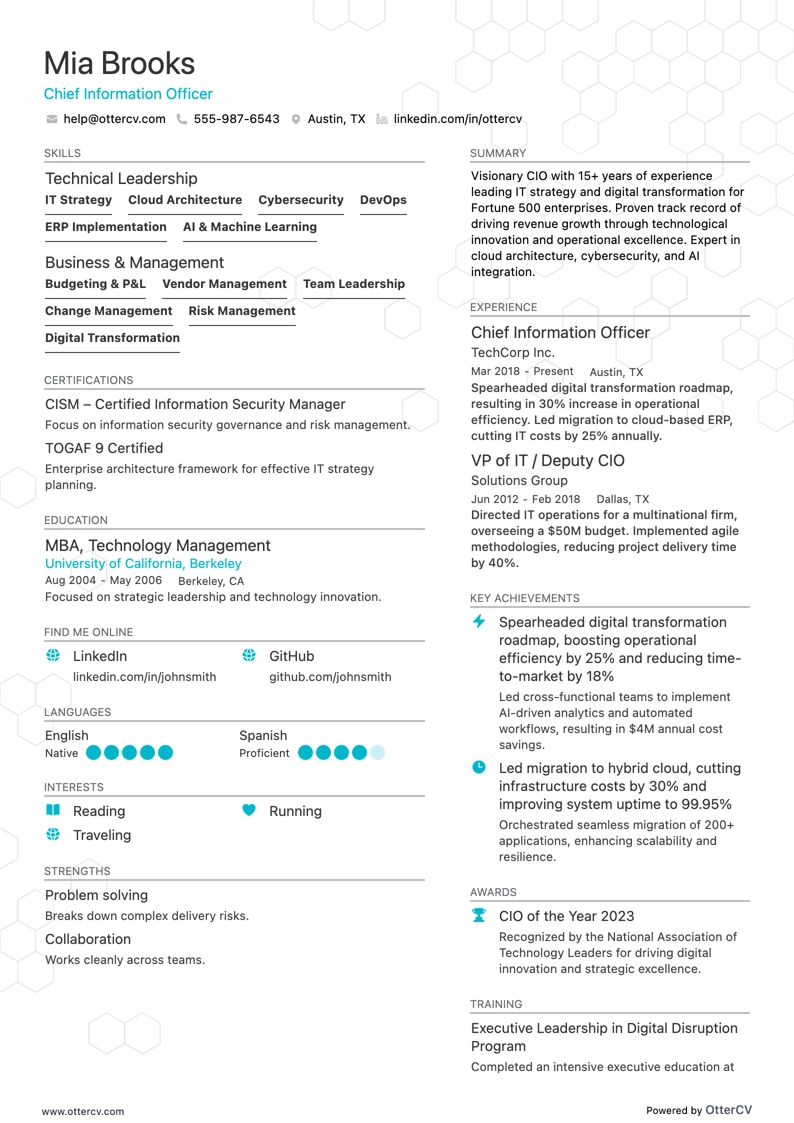
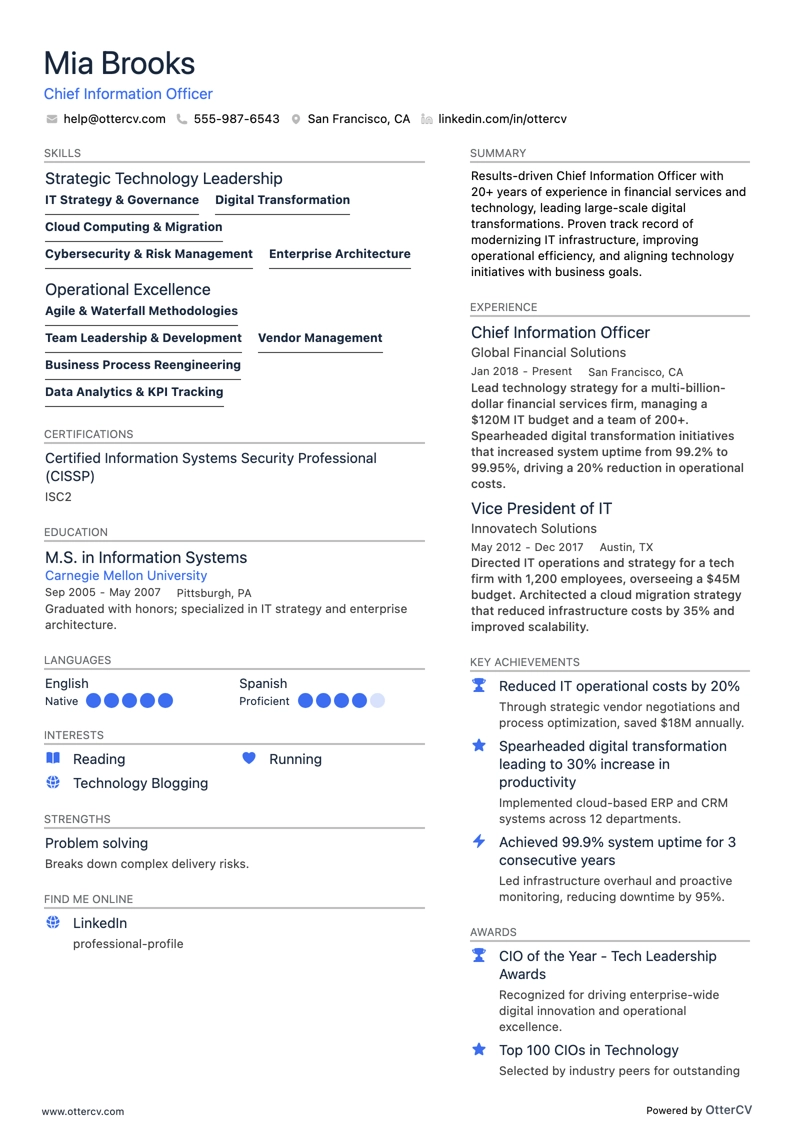
Chief Information and Technology Officer full preview

36 Chief Information Officer (CIO) Resume Examples

OtterCV

Written by The OtterCV Team

Updated: 6/5/2025•8 min read

See all resume examples in this guide, or generate your own resume example with your personalized prompt

Chief Information and Technology Officer resume example

Chief Information and Technology Officer

Chief Digital and Information Officer resume example

Chief Digital and Information Officer

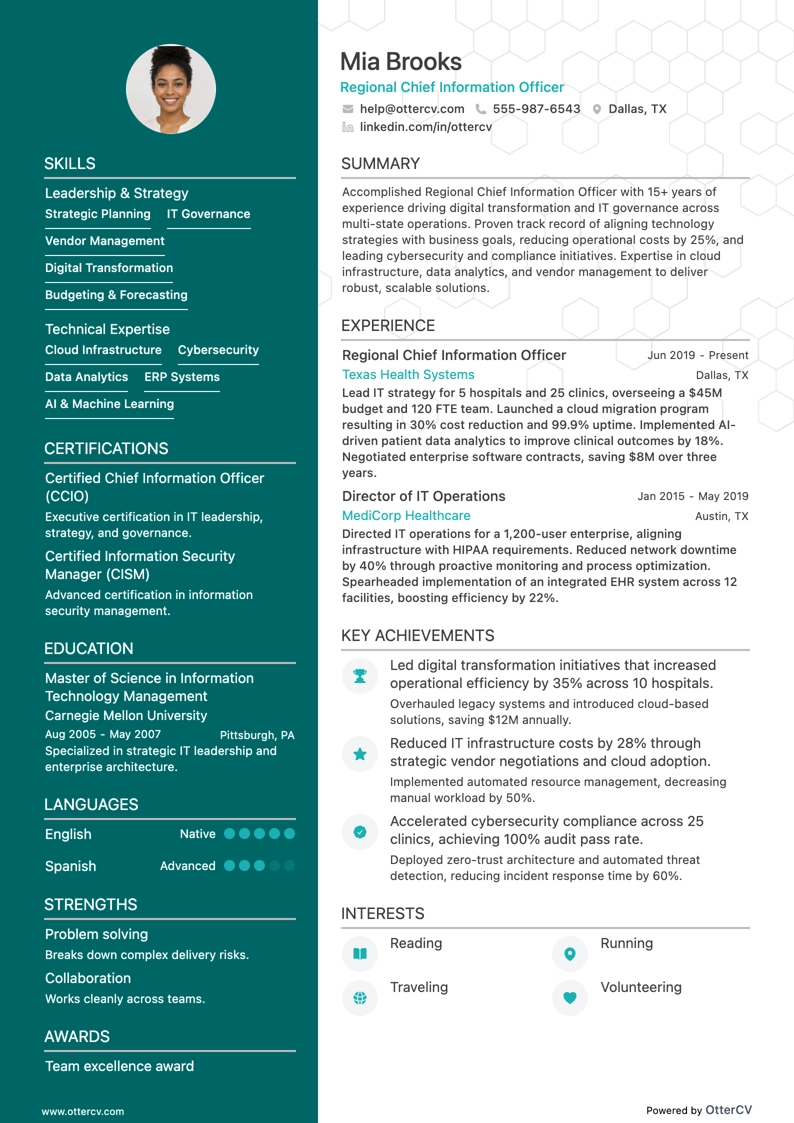
Regional Chief Information Officer resume example

Regional Chief Information Officer

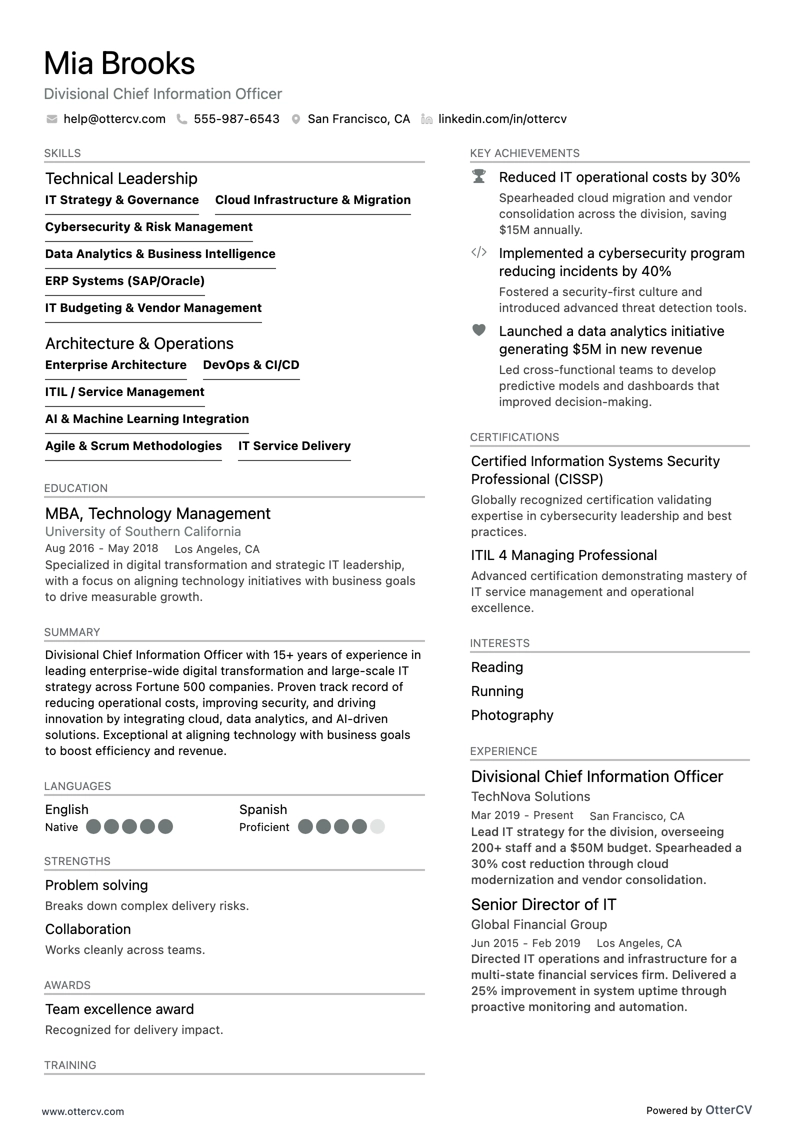
Divisional Chief Information Officer resume example

Divisional Chief Information Officer

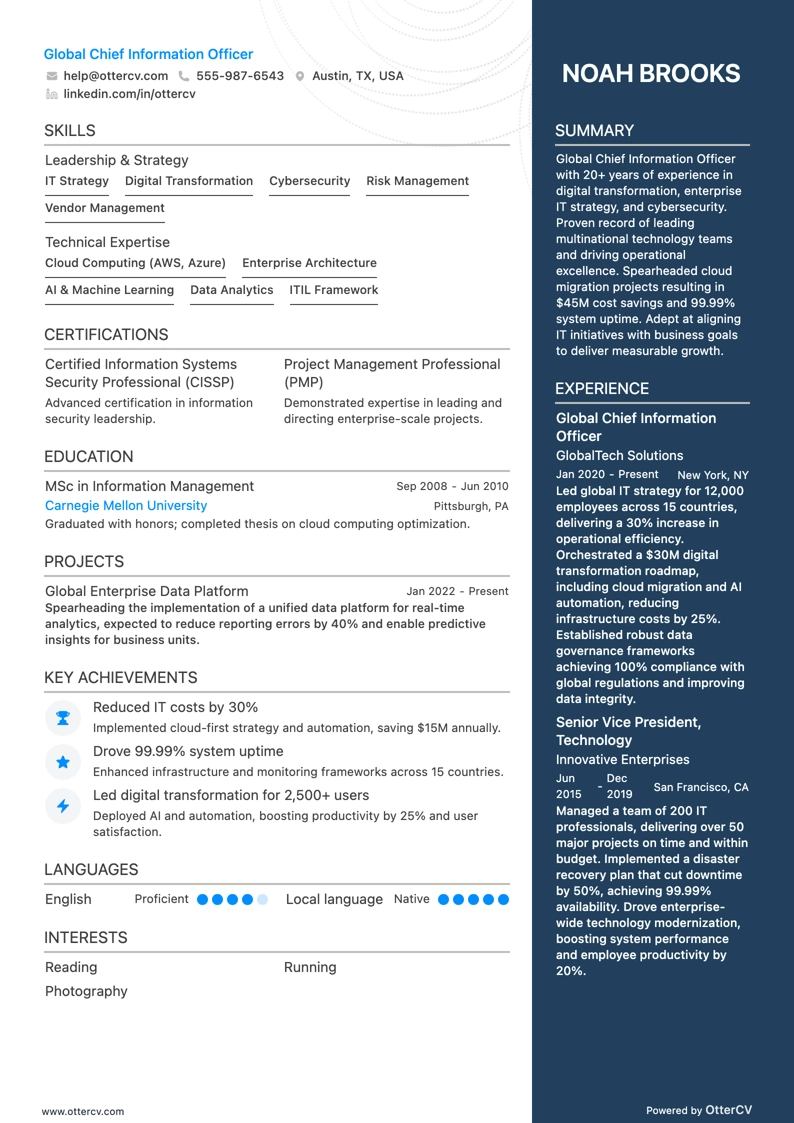
Global Chief Information Officer resume example

Global Chief Information Officer

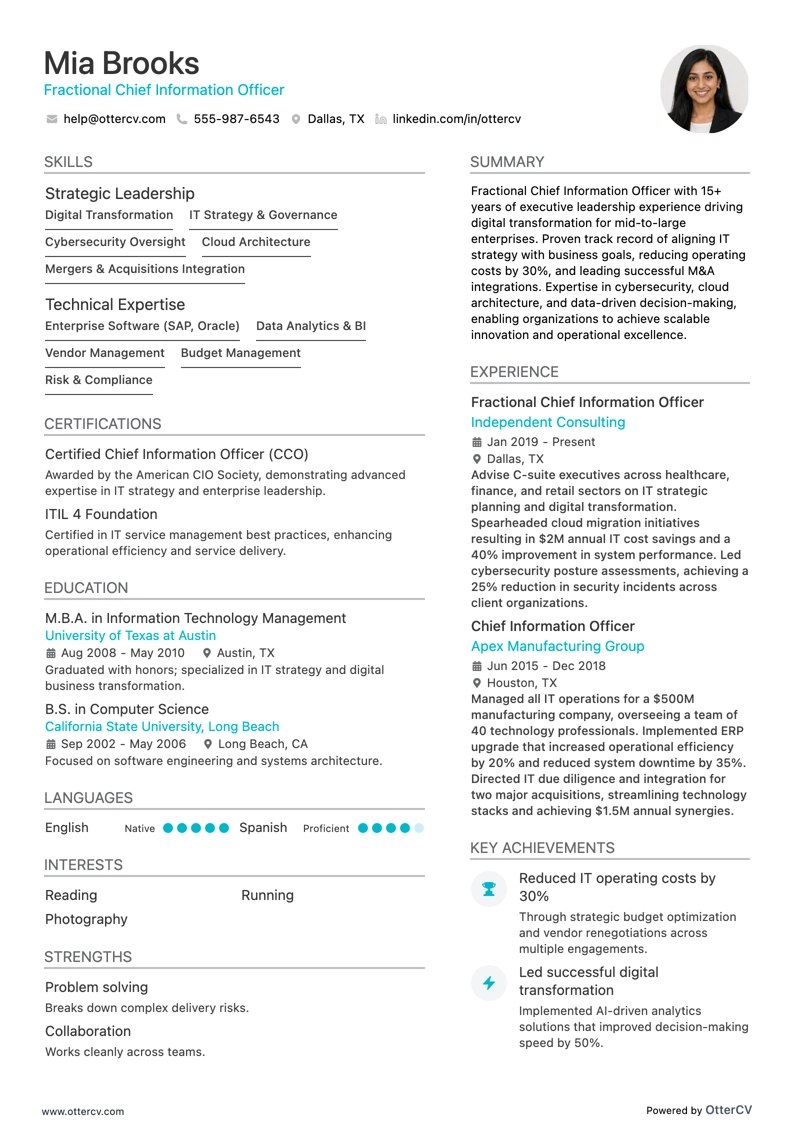
Fractional Chief Information Officer resume example

Fractional Chief Information Officer

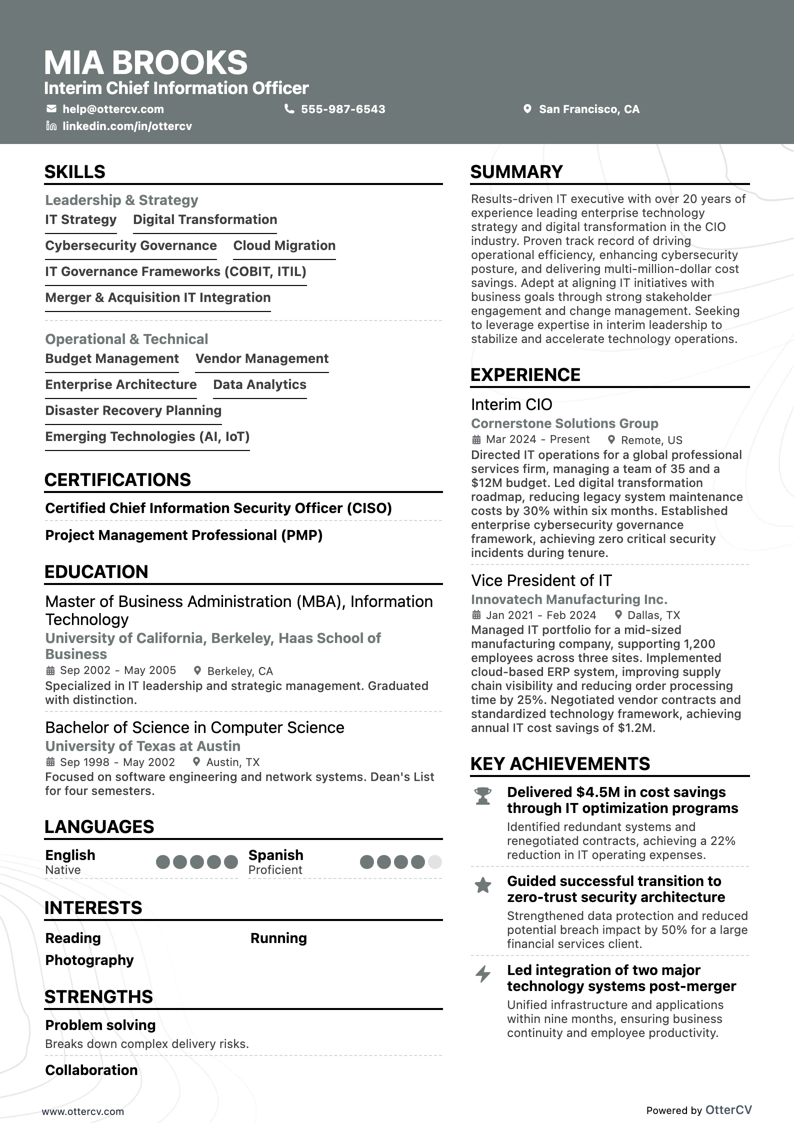
Interim Chief Information Officer resume example

Interim Chief Information Officer

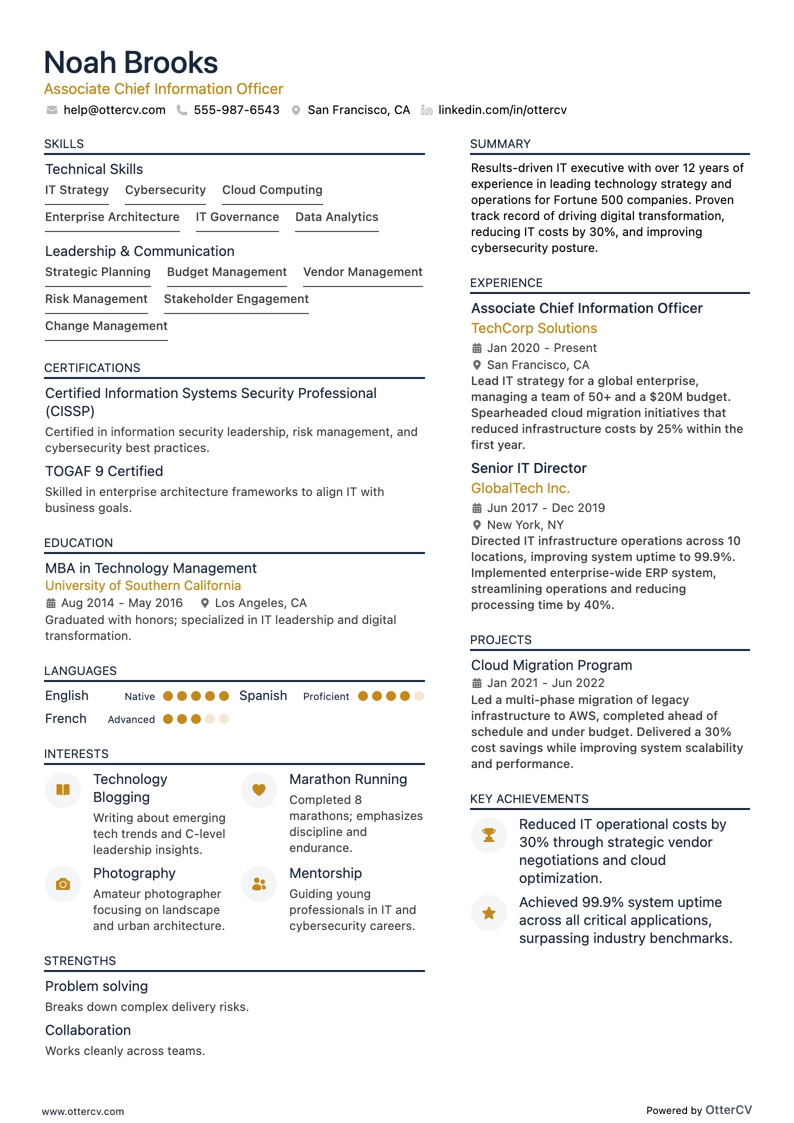
Associate Chief Information Officer resume example

Associate Chief Information Officer

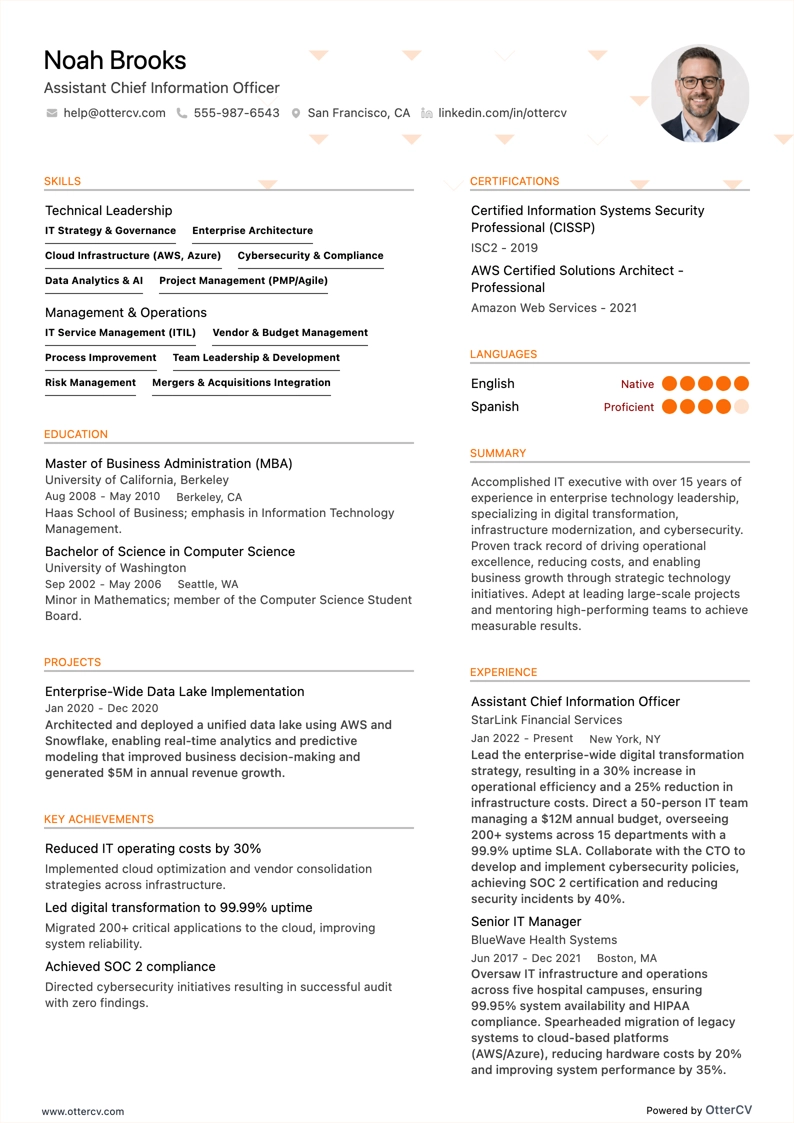
Assistant Chief Information Officer resume example

Assistant Chief Information Officer

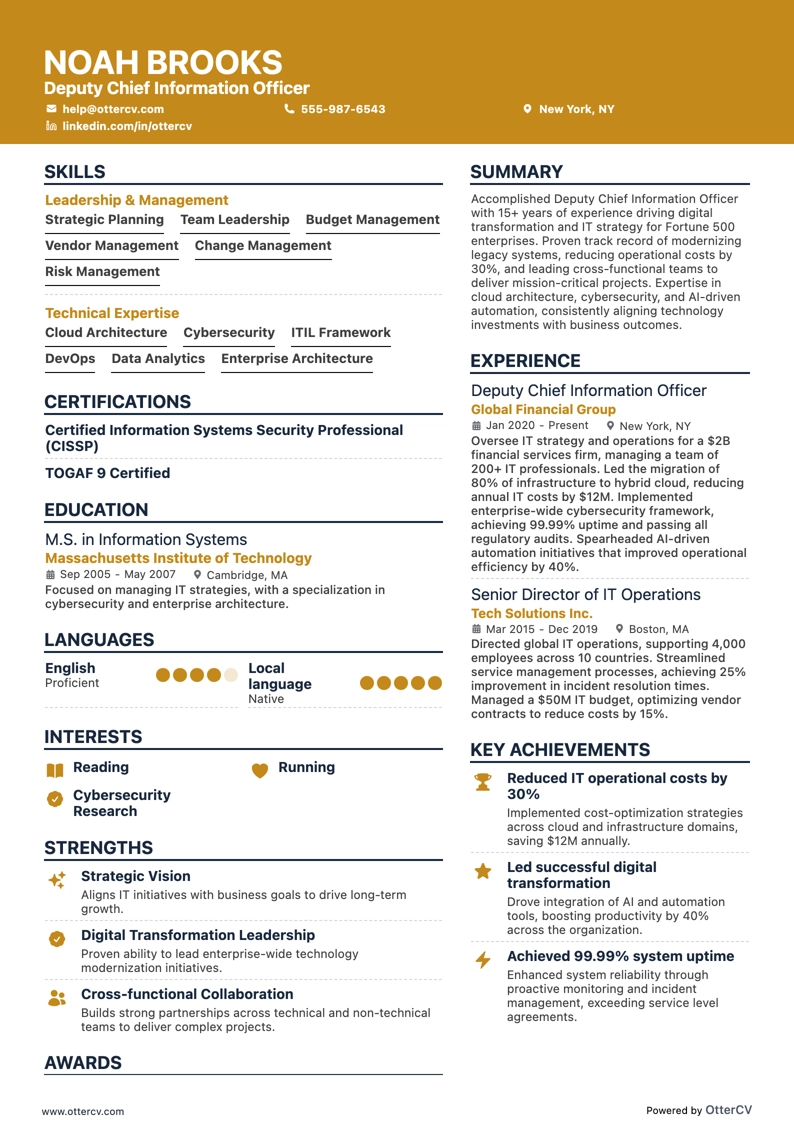
Deputy Chief Information Officer resume example

Deputy Chief Information Officer

CIO resume example

CIO

Chief Information Officer resume example

Chief Information Officer

As a CIO, you stay at the forefront of technological innovation, helping your company grow through advances in computer technology. While leading digital transformation initiatives, you also motivate and manage teams of technicians and IT professionals, giving them a clear, big-picture view of what success looks like.

You work hard to keep pace with innovation in the IT field, but your current resume may not reflect your commitment to learning and developing new skills. At Enhancv, we help people present their skills and experience with confidence. In this article, you’ll find CIO resume examples and guidance on:

  • How to shape your resume experience section to highlight your strengths
  • Strategies to make your resume stand out by emphasizing your skills and expertise
  • Tips for quantifying your impact on your resume

Chief information officer (cio) resume example

Chief Information and Technology Officer resume preview

Here’s what makes Peter’s resume stand out for a Chief Information Officer position:

  • Track Record of Success: Highlights achievements that show the ability to drive significant business growth. Examples from Peter’s resume include negotiating over $500 Million in partnership and product deals, turning around a failing startup to profitability within 12 months, and leading a startup to a $50 Million exit to Google.
  • Technical Expertise and Leadership: Emphasizes experience scaling technology infrastructure, especially within the relevant industry. Peter’s work developing and supporting complex infrastructure for fast-growing startups in the Talent Acquisition industry is a key strength, along with leadership experience in roles such as CIO and Head of Engineering.
  • Broad Technical Skill Set: Lists technical skills that align with CIO responsibilities, including DevOps, Data Migration, Infrastructure, Cloud, and Product Development.
  • Board and Advisory Roles: Demonstrates strategic influence and industry trust. Peter’s service on the Board of Directors and as an Advisor or Board Observer for various technology companies reflects his expertise and standing in the tech sector.

How to format a chief information officer (cio) resume

Whether you are communicating with shareholders who have limited technical knowledge or giving your team the data they need to succeed, information is most effective when it is easy to read. The same is true for your resume. The best resumes present complex information in a format that is simple to scan and understand.

Like refining code, small formatting improvements can make your resume more reader-friendly. Using columns can help separate key information and improve readability, making it easier to draw attention to your most important achievements and skills.

Below are a few helpful tips for formatting your resume:

  • Reverse chronological resume format: The reverse chronological format lists your most recent experience first. Employers often want to understand your career trajectory, including where you started and how you progressed toward your goals. Leading with your latest role helps show how far you’ve advanced.
  • Header, contact info, photo: Your header is a great place to include key contact details such as your phone number, email address, personal website, and LinkedIn profile. You may also choose to include a photograph of yourself, though it is not required.
  • How many pages: To reach a senior IT leadership role like CIO, you have likely built up extensive experience across multiple positions. Fitting all of that into one page can be difficult, and sometimes impossible without cutting important material. For senior management, a resume longer than one page can make sense, though one page is also acceptable.
  • PDF or Word Format: PDF is now the preferred file type for resumes because it is easy to send by email and helps prevent photos from shifting. Once you create a PDF file, you can feel confident it will display consistently.

The top sections on a Chief Information Officer (CIO) resume

  • Executive Summary gives a concise overview of your expertise and value.
  • Strategic IT Initiatives highlights your ability to drive business growth through technology.
  • Technical Expertise shows your familiarity with the latest technologies and platforms.
  • Leadership and Team Development showcases your ability to manage and develop teams.
  • Digital Transformation Efforts reflects your experience leading businesses through digital change.

What recruiters want to see on your resume:

  • Proven experience leading IT strategy and digital transformation initiatives that align with business goals.
  • Expertise in modern IT governance frameworks, risk management, and cybersecurity best practices.
  • A strong track record in budget management and vendor negotiations for complex IT projects and infrastructure investments.
  • Demonstrated leadership in managing diverse technical teams, driving innovation, and supporting a culture of continuous improvement.
  • Knowledge of emerging technologies and trends, including cloud computing, AI, IoT, and their business applications.

How to write your chief information officer (cio) resume experience

If you’re writing a CIO resume, start with the experience section. As the most important part of your resume, it highlights your key achievements and unique experiences throughout your career.

When writing your chief information officer resume experience section, include real-world data points, percentages, and dollar figures to support your claims about previous experience.

As a chief information officer, you likely have extensive experience. The key is to tailor this section to the job you’re applying for and include only relevant experience for the job. For example, being a fast food manager in high school has little relevance to a CIO role, so it’s best to leave it off your resume.

CIO resume experience samples

Experience

Chief Information Officer

High Tech Computers

05/2021 - 05/2023 · New York, NY

  • Reorganized the IT team with a focus on strategies to improve efficiency.
  • Supported the DevOps team in delivering a new infrastructure environment within 150 days, benefiting over 5000+ customers.
  • Developed a one-year roadmap that aligned the IT department with shareholders, management, and the board of directors.
  • Established and maintained a robust cybersecurity framework, reducing the organization's exposure to cyber threats.
WRONG

How does this resume experience section fall flat?

The main problem with this experience section is that it is too vague. It does not explain the strategies the person used to drive change at their previous company, and it does not provide real-world, quantifiable results to support its claims.

It also fails to use strong action verbs that show meaningful impact in a previous role. For example, the word "helped" suggests a secondary role and implies that the DevOps team handled most of the work. More active language would better demonstrate that the author made a major contribution.

Experience

Chief Information Officer

High Tech Computers

05/2021 - 05/2023 | New York, NY

  • Structured and reorganized IT teams of 100+ people, creating a more integrated workflow across technology projects.
  • Spearheaded an initiative with the DevOps team to deliver a new infrastructure environment within 150 days, benefiting over 5000+ customers.
  • Developed a one-year roadmap that aligned the IT department with shareholders, management, and the board of directors, resulting in a 20% increase in operational efficiency.
  • Established and maintained a robust cybersecurity framework, reducing the organization's exposure to cyber threats by 30% through advanced security measures and employee training programs.
RIGHT

What works in this section?

This resume experience section uses real data to help a hiring manager quickly understand the applicant’s responsibilities and impact. It shows the exact number of people they led and notes that a one-year roadmap increased operational efficiency by 20%. Specific figures like these make the candidate’s competence more credible.

In an interview, you may also be asked to explain the facts and numbers listed on your resume. Building that foundation of credibility can give you a meaningful advantage over other candidates.

How to quantify the impact on your resume

When a CEO asks for concrete information about a project, you would likely present timelines, dollar figures, and expected revenue. That kind of measurable data shows how the project supports company goals and contributes to success. The same principle applies to the claims you make on your resume.

Quantifiable data strengthens your claims and gives hiring managers something they can evaluate. Just as important, include context behind the numbers. Don’t list percentages or figures without explaining what they represent. Add background on how you achieved the outcome so employers can understand the scope and impact of your contribution. Make sure the percentages you include align with the priorities of the specific CIO role you are targeting.

Percentages

Whether you improved efficiency or streamlined your team’s workload, percentages can add credibility to your resume. Useful examples include:

  • Operational efficiency
  • Cost savings
  • Cybersecurity improvement
  • Revenue growth or cost avoidance
  • Employee satisfaction
  • Project success
  • System uptime or downtime reduction
  • Technology adoption

Dollar figures

Dollar amounts are strong proof points because they show the financial value of your work. If you led a successful product launch or initiative, include the precise revenue or savings it generated. Relevant figures may include:

  • Cost savings
  • Revenue generation
  • Return on investment (ROI)
  • Budget management
  • Contract negotiations
  • Project budget adherence
  • Employee productivity
  • Risk mitigation

Other data figures

Beyond percentages and dollar amounts, a CIO resume can include additional metrics that demonstrate impact across the organization, such as:

  • Project metrics
  • Technology metrics
  • Security metrics
  • Operational metrics
  • Strategic planning metrics
  • Team metrics
  • User engagement metrics
  • Customer metrics
  • Regulatory compliance metrics
  • Technology adoption metrics

Example of a good quality impact section

  • Include IT project budget figures: This shows the scale of budgets you managed and reflects financial judgment and trustworthiness.
  • Detail cost savings from IT initiatives: This highlights your ability to improve efficiency and optimize costs.
  • Highlight percentage uptime or system availability: High percentages show a focus on business continuity and minimal disruption.
  • Quantify the scale of IT infrastructure managed: Providing numbers on servers, databases, or user endpoints helps convey operational complexity and scale.
  • Specify the number of direct and indirect reports: Team size helps demonstrate leadership scope and people management ability.
  • Mention the percentage reduction in security incidents: This shows a proactive approach to risk management and data protection.
  • List the number of successful IT projects delivered on time and on budget: This supports your project management capabilities and business execution.
  • Quantify improvements in system performance or user satisfaction scores: These figures underline a commitment to system effectiveness and end-user outcomes.

How to list your hard skills and soft skills on your resume

There are two types of skills to include in your resume skills section. The first is hard skills, also called technical skills. These are skills developed through work or education and are usually closely tied to a specific function or field. As you progress to a CIO role, you will likely build hard skills in areas such as cloud computing, cybersecurity, and software development.

Throughout your experience section, you can reinforce these hard skills by pairing them with real percentages and data points. These skills often form the backbone of a CIO resume and support your ability to lead technical teams. In your skills section, hard skills will often appear near the top.

At the same time, CIOs also need soft skills, often called people skills. These include leadership and communication skills that help you work effectively with a wide range of people.

Your professional summary and cover letter are both strong places to highlight leadership and communication skills. In those sections, you can explain how you supported the teams you led and helped guide them toward success.

4-step process for listing skills on your resume

  1. List all the skills you possess: Include both the hard and soft skills you developed through previous experience.
  2. Separate hard skills and soft skills: Organize them clearly so employers can scan them easily.
  3. Review the job description: Identify the specific skills required for the role, since these are the ones employers are looking for on your resume.
  4. Edit the list for the most relevant skills: Tailor your list to the job you are applying for. Remove skills that do not fit. For example, if the company mainly provides cybersecurity services, you may decide to leave cloud computing skills off your resume.
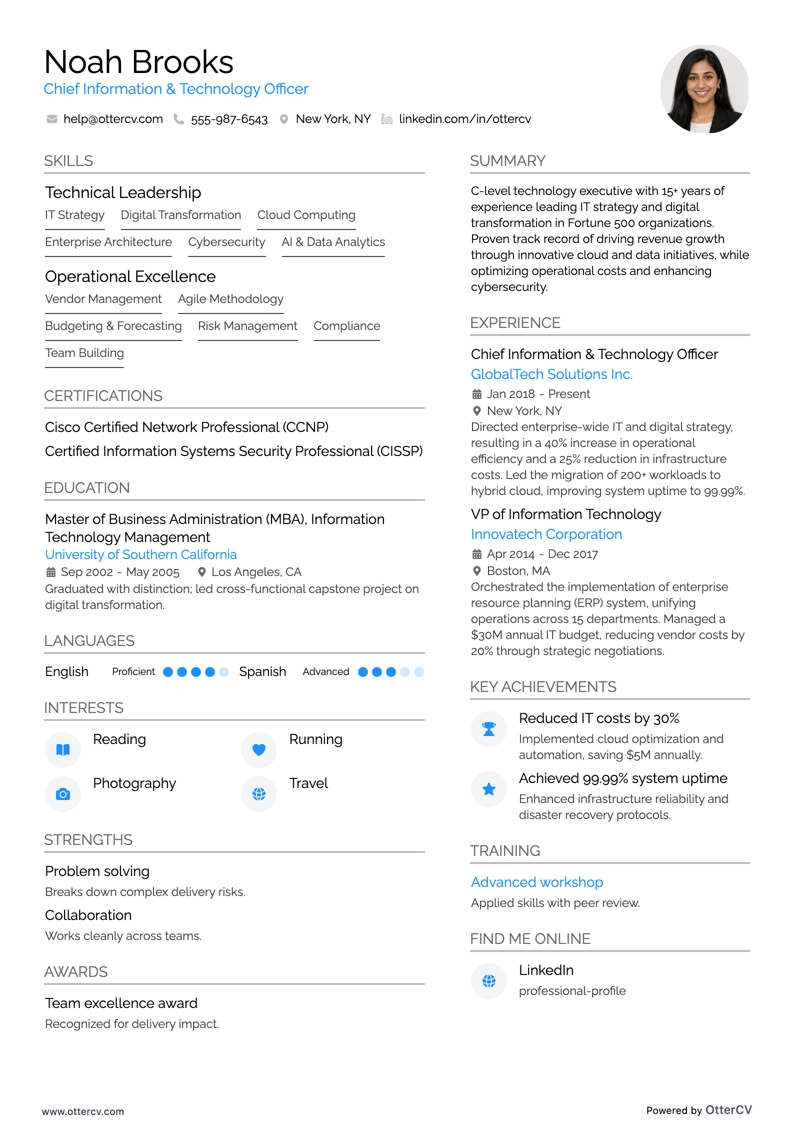
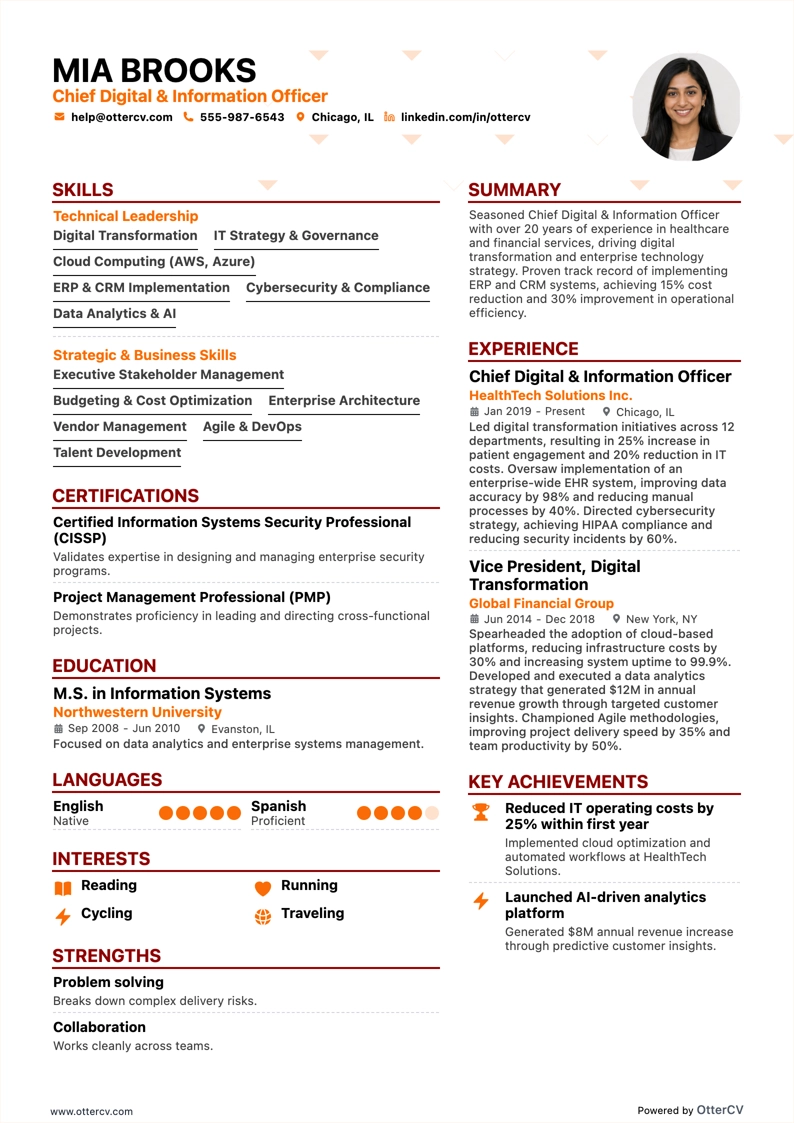
Best hard skills for your Chief Information Officer (CIO) resume

  • Enterprise Resource Planning (ERP) systems.
  • Cybersecurity and risk management.
  • Cloud computing and virtualization.
  • Business intelligence and data analytics.
  • IT governance and strategy development.
  • IT infrastructure and architecture.
  • Project management, including PMP and PRINCE2.
  • Software Development Lifecycle (SDLC).
  • Network management and optimization.
  • IT service management, including ITIL.
  • Digital transformation and innovation.
  • Artificial Intelligence (AI) and Machine Learning (ML).
  • Vendor management and contract negotiation.
  • Mobility and BYOD (Bring Your Own Device) strategies.
  • DevOps and Continuous Integration/Continuous Deployment (CI/CD).
  • Internet of Things (IoT) integration.
  • IT budgeting and financial planning.
  • Change management.
  • IT compliance and regulatory standards.
  • Unified communications and collaboration tools.

Best soft skills for your Chief Information Officer (CIO) resume

  • Leadership.
  • Strategic thinking.
  • Change management.
  • Communication skills.
  • Problem-solving.
  • Decision-making.
  • Emotional intelligence.
  • Team building.
  • Stakeholder management.
  • Business acumen.
  • Innovation and adaptability.
  • Risk management.
  • Visionary thinking.
  • Project management.
  • Negotiation skills.
  • Interpersonal skills.
  • Time management.
  • Conflict resolution.
  • Vendor management.
  • Ethical judgment.

How to list your certifications and education on your resume

Your education and the certifications you include on your resume can make a real difference in landing that coveted interview. This is especially true for upper management roles like CIO, where employers often look for candidates with strong academic credentials from distinguished universities. Sharing the same alma mater as a hiring manager can also help build rapport and serve as a natural icebreaker during the interview process.

But if you worked your way up through experience, there is no need to worry. You have likely built your qualifications through valuable certifications along the way. Every certification you list can help set you apart from other candidates, especially when it reflects specialized or unique skills. However you achieved your success, employers want to see the effort you invested in becoming the best employee you can be.

Education

Masters of Business Administration

Massachusetts Institute of Technology

02/2018 - 11/2020

GPA: 3.89 / 4.0

RIGHT

Best certifications for your Chief Information Officer (CIO) resume

  • Certified Information Systems Security Professional (CISSP) — ISC².
  • Certified Information Systems Auditor (CISA) — ISACA.
  • Certified Information Security Manager (CISM) — ISACA.
  • ITIL Foundation Certification — AXELOS.
  • Certified in Risk and Information Systems Control (CRISC) — ISACA.
  • Certified Data Management Professional (CDMP) — DAMA.
  • Certified Business Continuity Professional (CBCP) — DRI.
  • TOGAF 9 Certification — The Open Group.
  • AWS Certified Solutions Architect — Amazon Web Services.
  • Microsoft Certified: Azure Solutions Architect Expert — Microsoft.

How to write your chief information officer (cio) resume summary or objective

When applying for a job, one of the most important things you can do is show who you are, what you want to achieve, and the career goals you are working toward. Your resume summary or objective is the first place where you can give a hiring manager a clearer picture of what makes you unique. In your chief IT technician resume objective, you can highlight your achievements along with your professional goals and aspirations.

There is an important difference between a resume summary and objective. A resume objective is a short overview of your work experience. It is often used by candidates with less than 3 years of experience or by people applying for a role in a different field. It should be concise and focus on the value you can bring to the company.

A resume summary, also called a career summary, is tailored to a specific role and explains why you are the best candidate for the position. To strengthen that case, include a mix of hard skills, soft skills, and quantifiable experience. This helps show that you are a well-rounded candidate who can meet the expectations of a CIO role.

Summary

Highly motivated chief information officer with several years of experience in IT. Led digital transformation initiatives that increased company revenue while reducing IT expenses through budget management. With a background in cybersecurity, I am passionate about reducing threats for employers. I also value building a culture of innovation and collaboration and have worked with a wide range of employees to achieve diverse goals.

WRONG

This summary section shows potential, but it does not fully deliver. A reader would expect more detail about the digital transformation initiatives they led, especially the revenue those efforts generated for the company.

It also lacks clarity about the length of their career, relying only on the vague phrase “several years of experience.”

One positive is the mention of a passion for creating a culture of innovation. This signals to employers that the candidate is open-minded and able to work well with others. However, the summary does not go further to explain how they have actually built or supported that culture of innovation.

Summary

Accomplished Chief Information Officer with 15+ years of experience leading transformative IT initiatives for Fortune 500 companies. A strategic technology leader, I align IT strategy with organizational goals, delivering a 20% increase in operational efficiency. I have led digital transformation efforts that generated $2 million in additional revenue and improved customer engagement. My cybersecurity expertise reduced threat exposure by 30%, while effective budget management helped lower IT expenses by 15%. Committed to innovation, collaboration, and impactful technology solutions, I am a forward-thinking CIO dedicated to organizational success.

RIGHT

This summary works because it immediately highlights concrete, relevant data. It includes tangible results such as $2 million in revenue, a 15% reduction in IT expenses, 30% less exposure to cybersecurity threats, and a 20% increase in efficiency.

It also notes experience working with Fortune 500 companies, which encourages employers to move directly to the experience section to see which organizations the candidate has worked for. Overall, the summary makes the reader want to keep reading and learn more about the candidate.

Additional sections for a chief information officer (cio) resume

One of the most valuable sections to include on a CIO resume is a strategic initiatives section. It gives you space to provide more detail about the projects you implemented to help your company succeed.

Use this section to highlight major initiatives that went beyond traditional IT work, such as organizational restructuring, process improvements, or a company-wide digital transformation that impacted every department, not just IT.

Projects

Project Name

02/2000 - 11/2004

Short summary of your work

  • Led the planning and execution of a comprehensive digital transformation initiative to reshape the organization's technological landscape. Implemented cloud-based solutions, advanced analytics, and automation strategies to improve operational efficiency, foster innovation, and strengthen overall business agility. This initiative resulted in a 25% increase in productivity, a 20% reduction in IT expenses, and positioned the company as an industry leader in adopting cutting-edge technologies. Its successful execution demonstrated the ability to align IT with business goals and drive organizational growth through technological innovation.
RIGHT

Key takeaways

  • Include context for the quantifiable claims you make throughout your resume.

  • Make sure the header in your experience section is error-free and matches your cover letter.

  • Research the role you are applying for, then use those expectations to shape your skills section.

  • Tailor your experience section to the job and avoid vague or generic statements.

CIO resume examples

Explore additional CIO resume samples and guides and see what works for your level of experience or role.

By Role

Chief Information and Technology Officer

Chief Information and Technology Officer resume preview

Chief Digital and Information Officer

Chief Digital and Information Officer resume preview

Regional Chief Information Officer

Regional Chief Information Officer resume preview

Divisional Chief Information Officer

Divisional Chief Information Officer resume preview

Global Chief Information Officer

Global Chief Information Officer resume preview

Fractional Chief Information Officer

Fractional Chief Information Officer resume preview

Interim Chief Information Officer

Interim Chief Information Officer resume preview

Associate Chief Information Officer

Associate Chief Information Officer resume preview

Assistant Chief Information Officer

Assistant Chief Information Officer resume preview

Deputy Chief Information Officer

Deputy Chief Information Officer resume preview

CIO

CIO resume preview

Chief Information Officer

Chief Information Officer resume preview