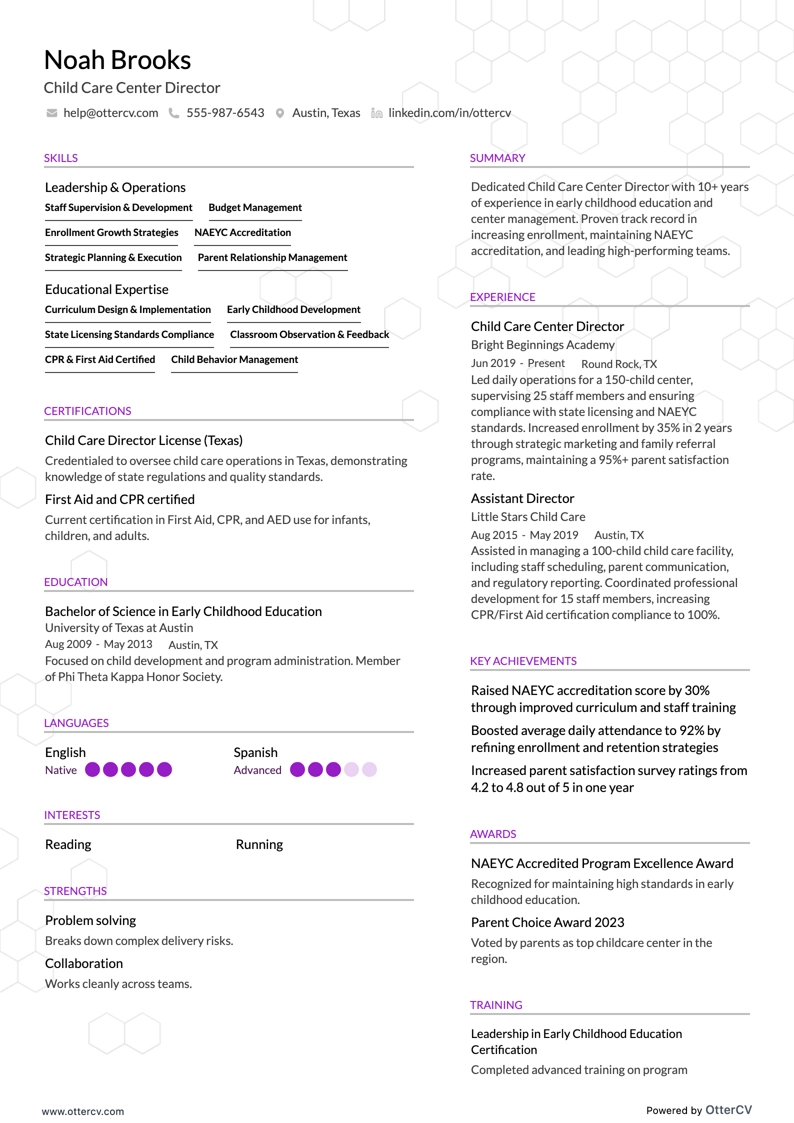
Child Care Center Director full preview

17 Child Care Resume Examples

OtterCV

Written by The OtterCV Team

Updated: 1/12/2025•8 min read

See all resume examples in this guide, or generate your own resume example with your personalized prompt

Child Care Center Director resume example

Child Care Center Director

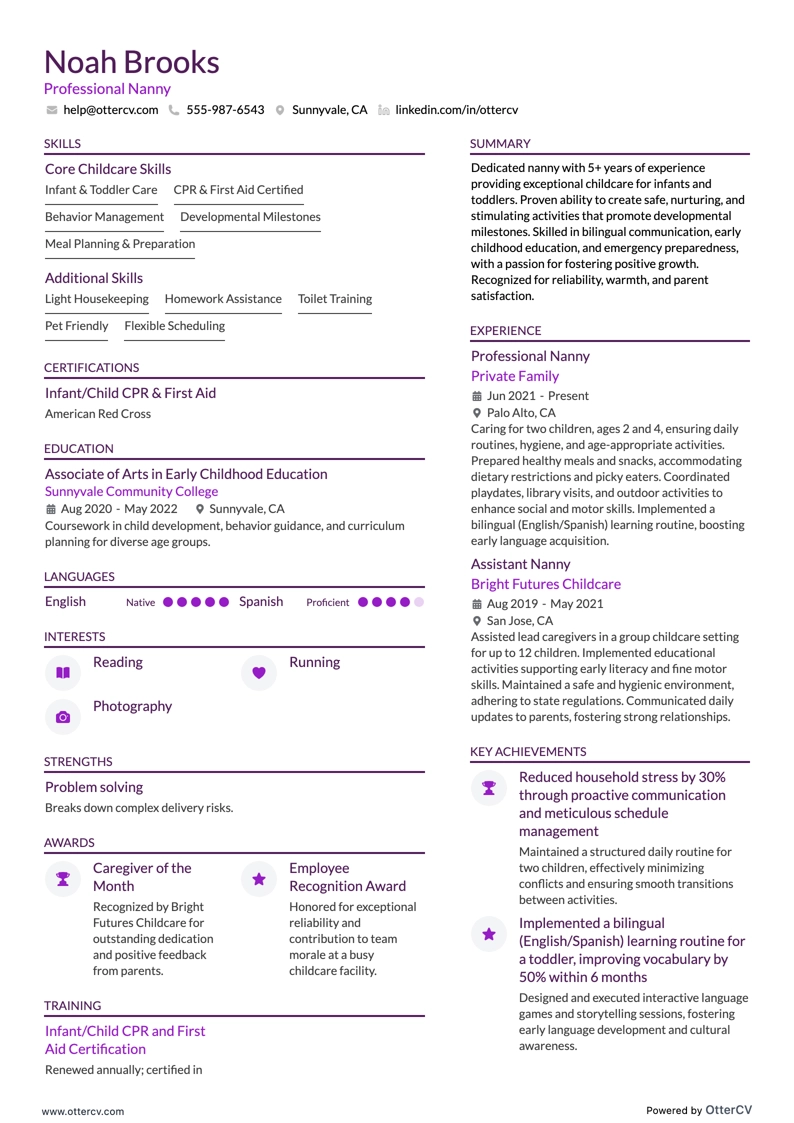
Nanny resume example

Nanny

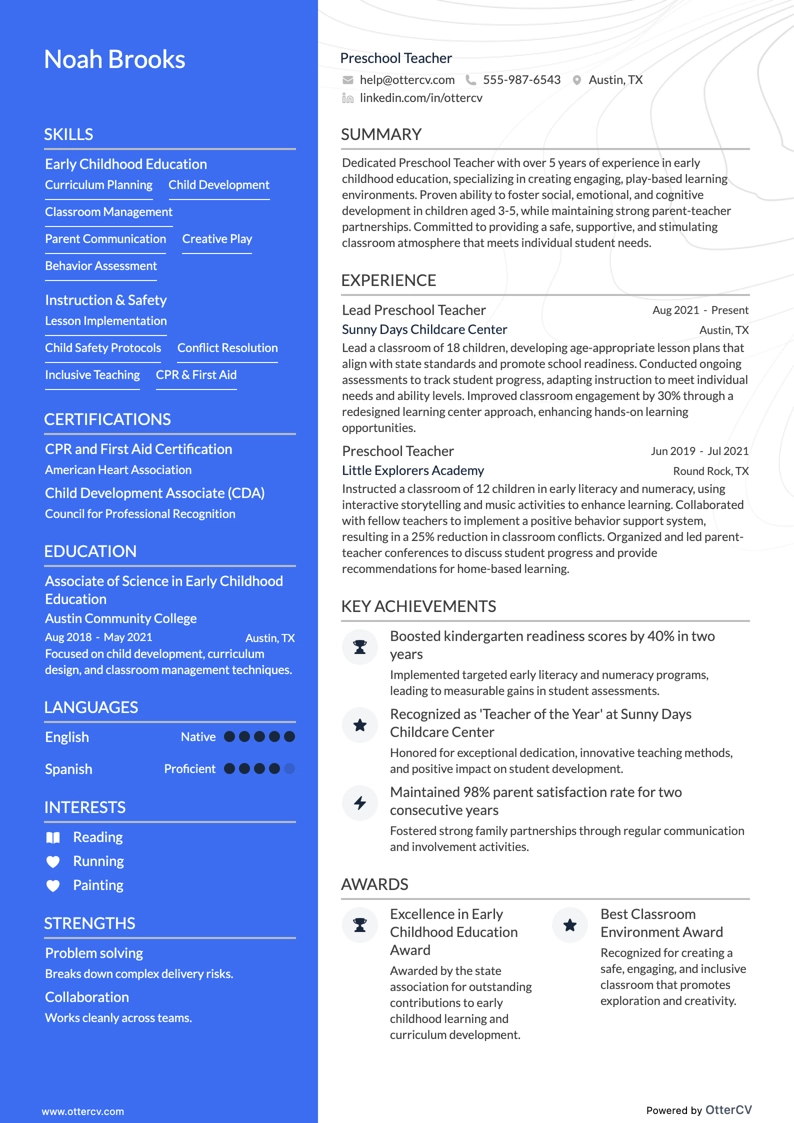
Preschool Teacher resume example

Preschool Teacher

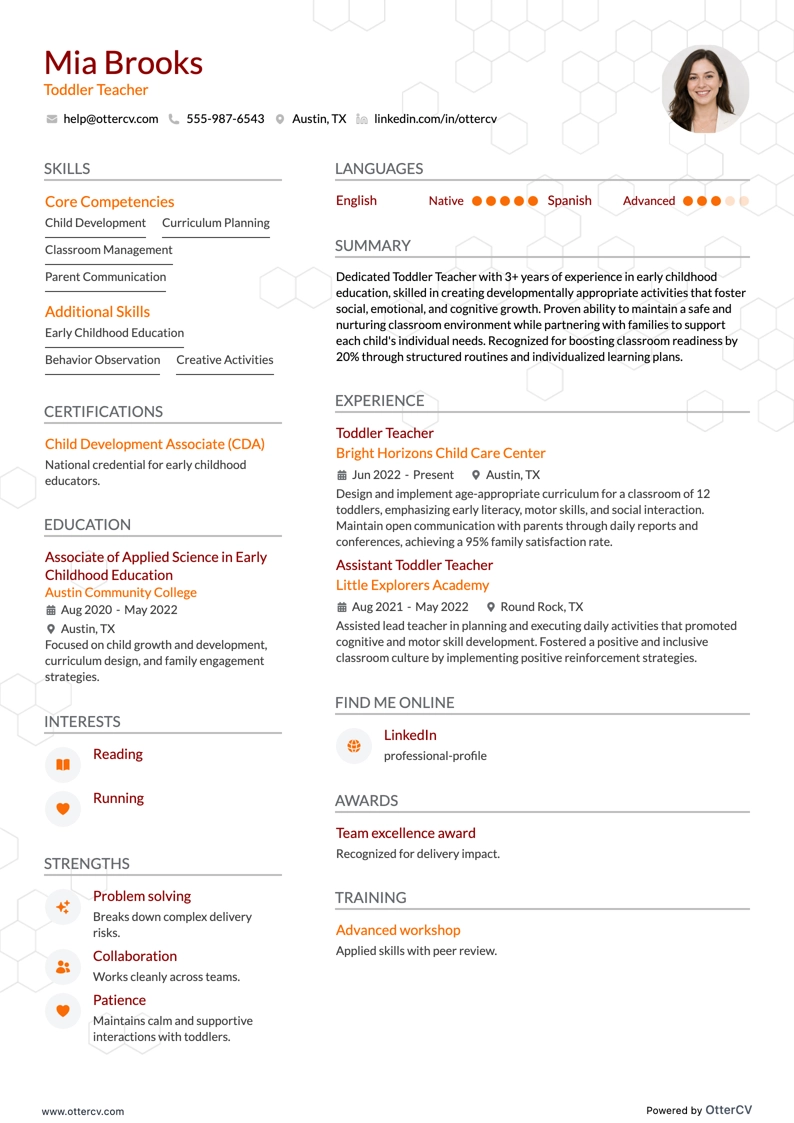
Toddler Teacher resume example

Toddler Teacher

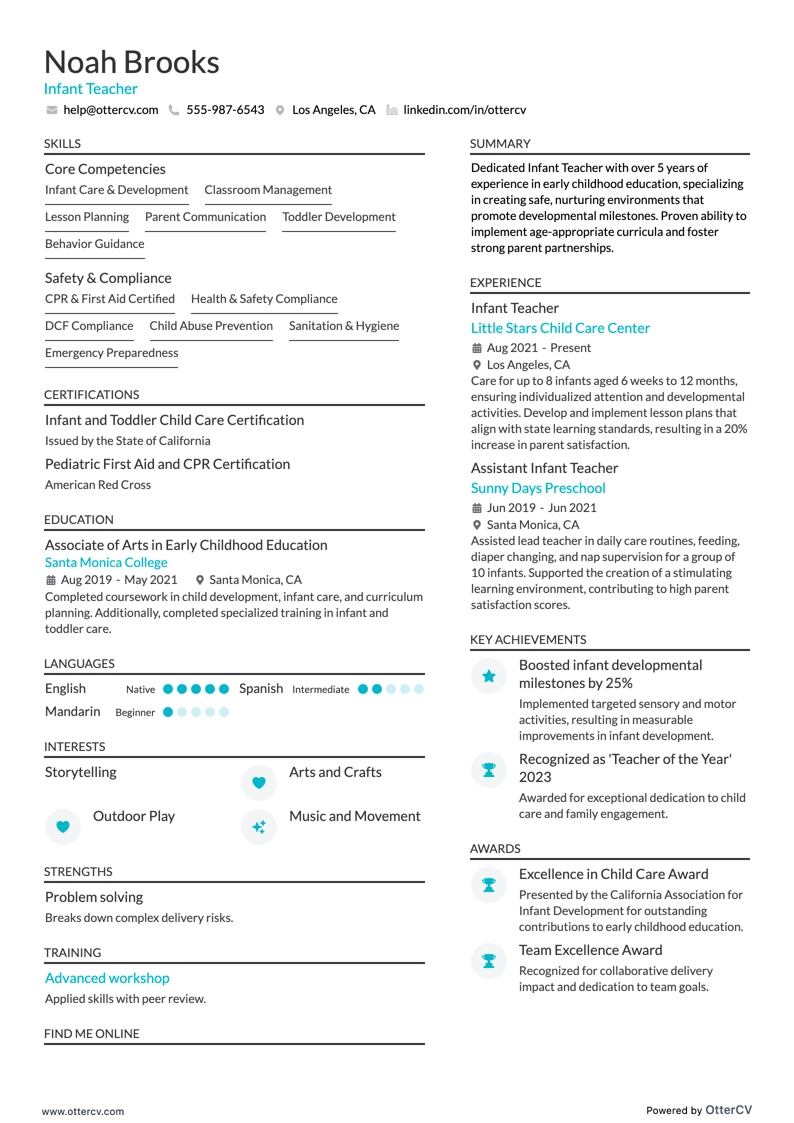
Infant Teacher resume example

Infant Teacher

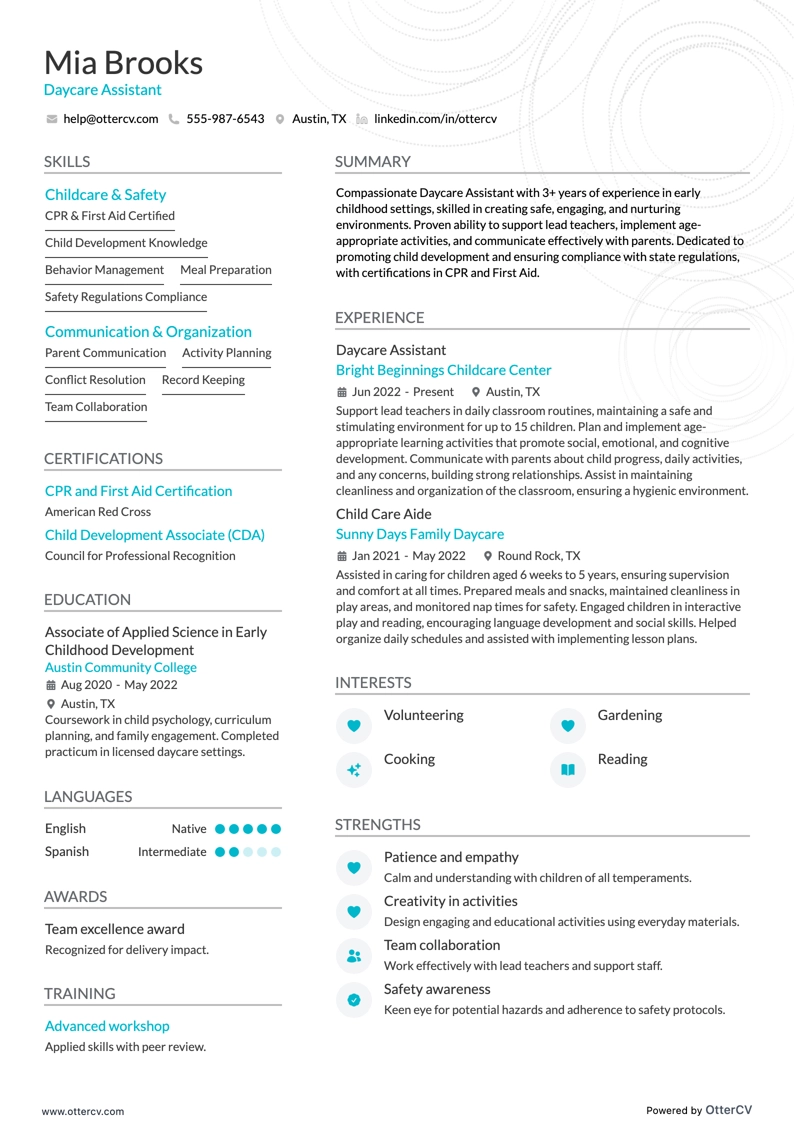
Daycare Assistant resume example

Daycare Assistant

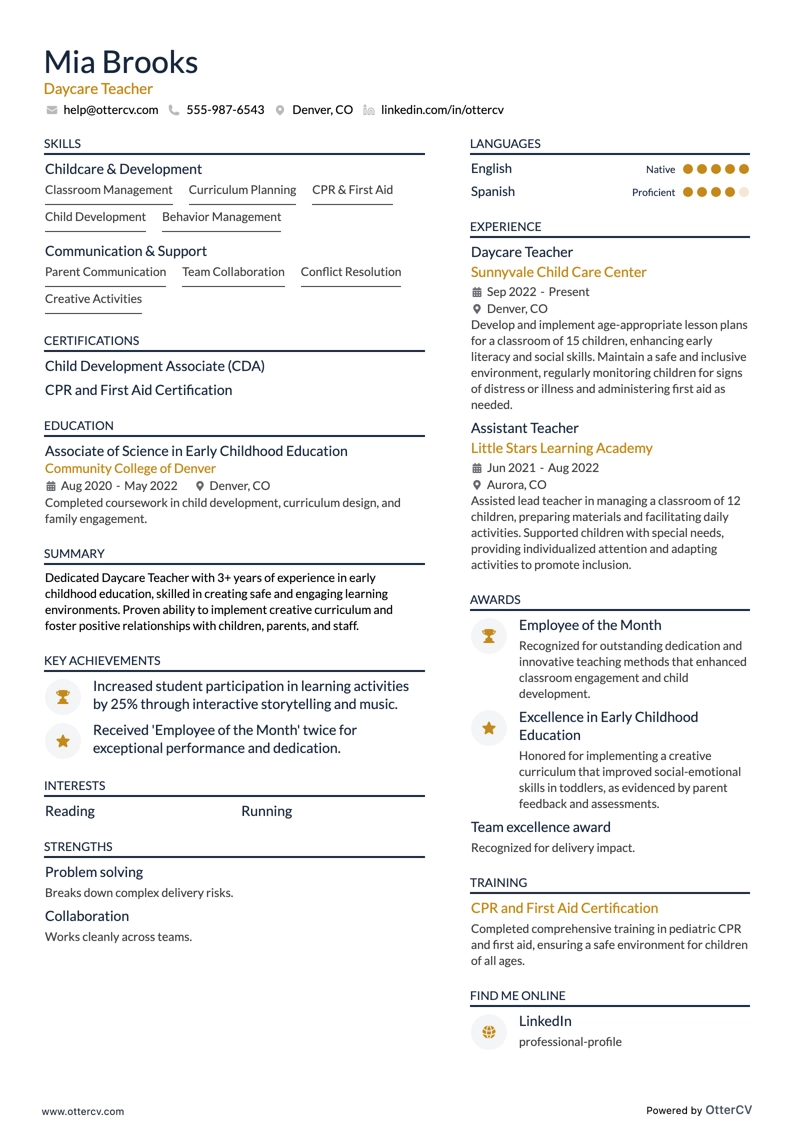
Daycare Teacher resume example

Daycare Teacher

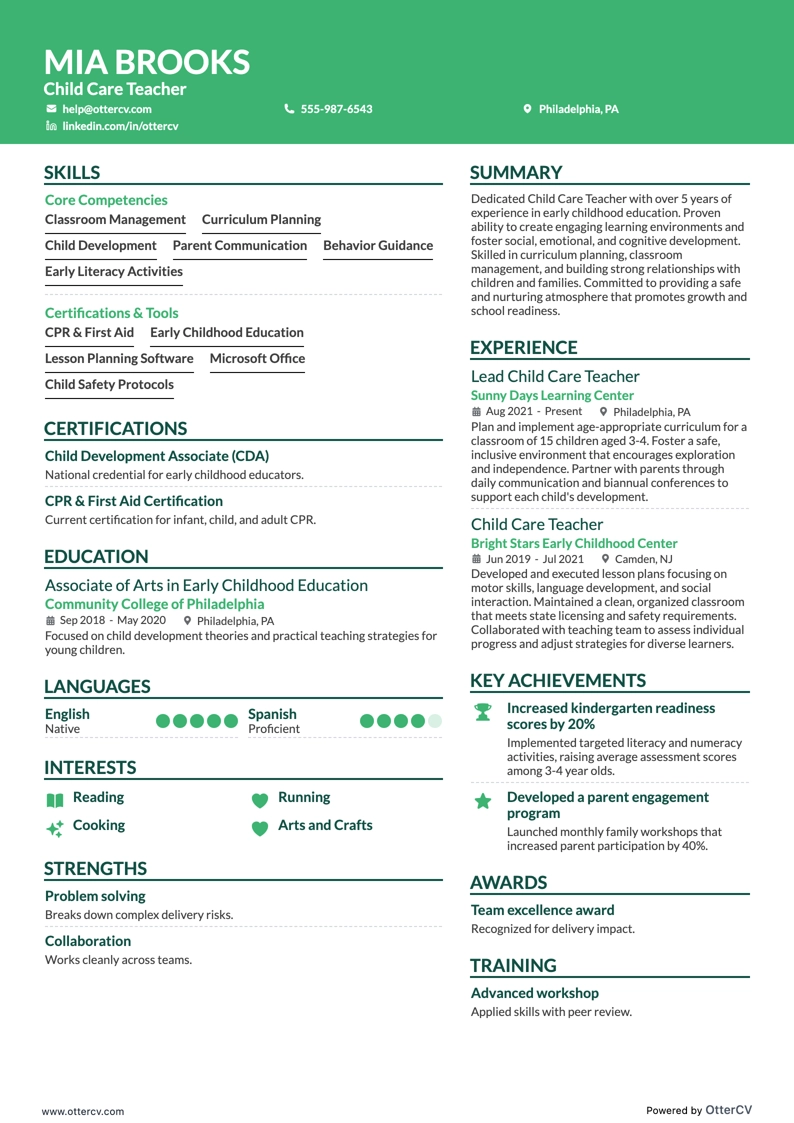
Child Care Teacher resume example

Child Care Teacher

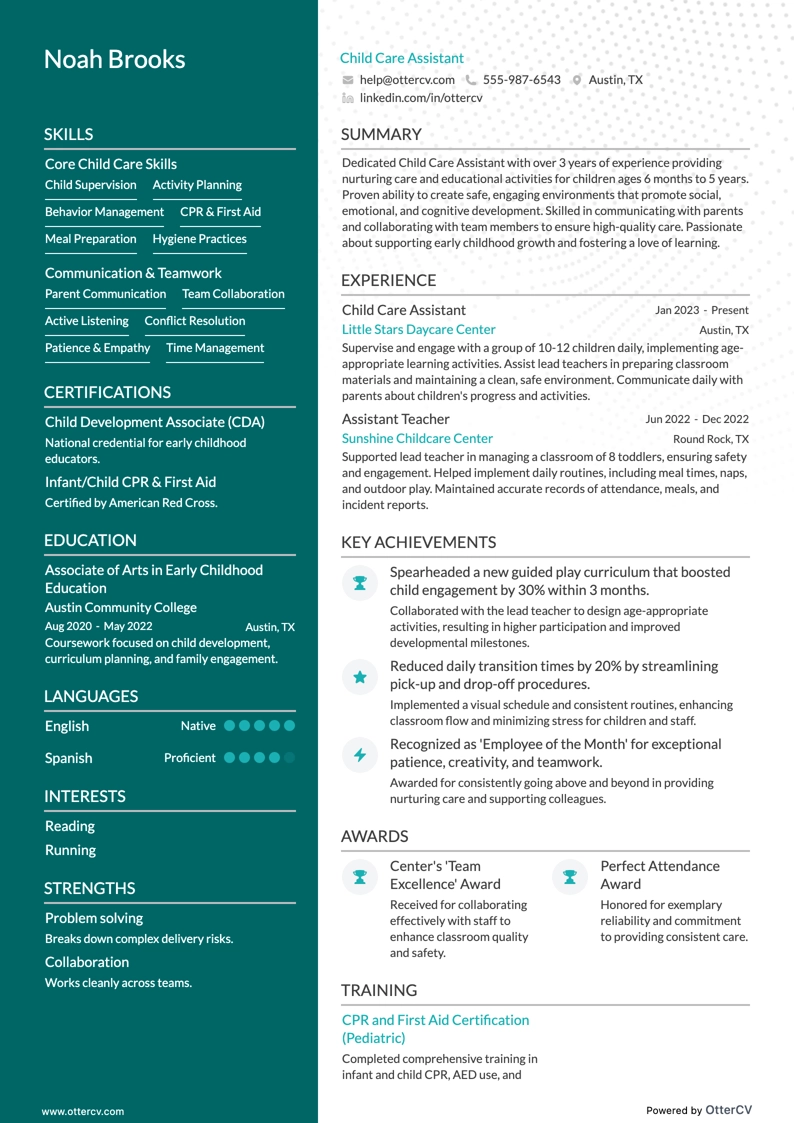
Child Care Assistant resume example

Child Care Assistant

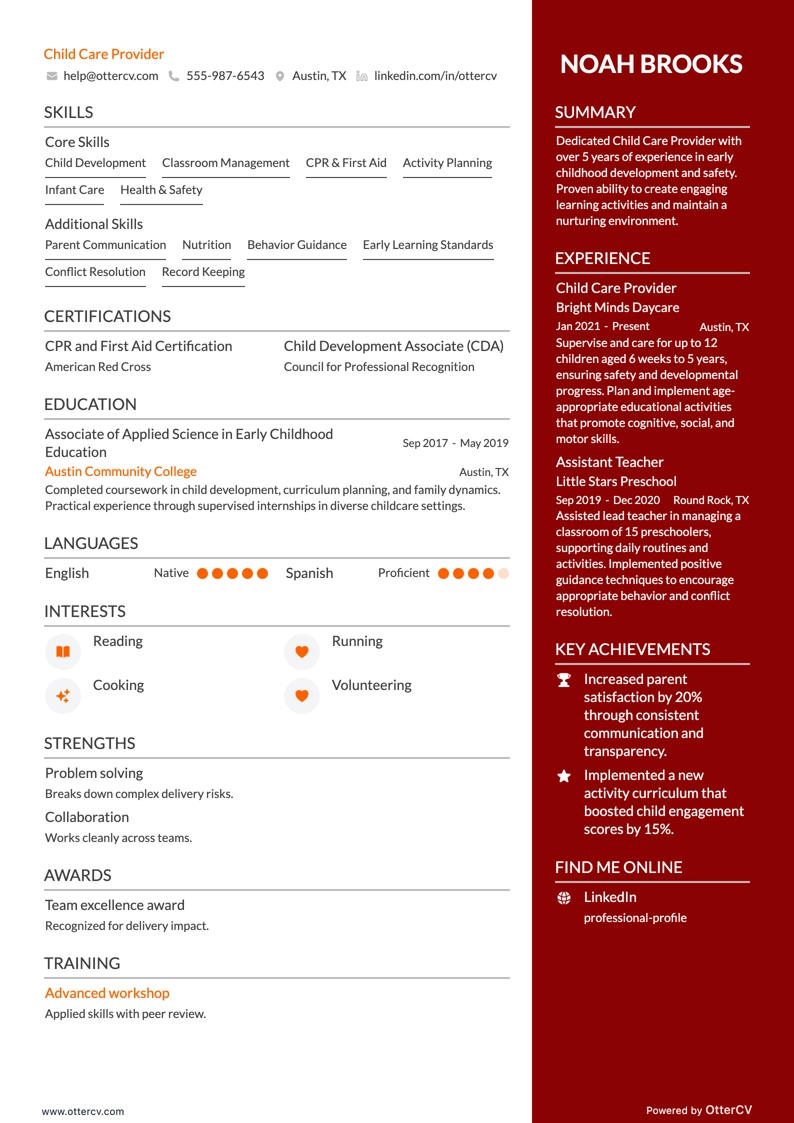
Child Care Provider resume example

Child Care Provider

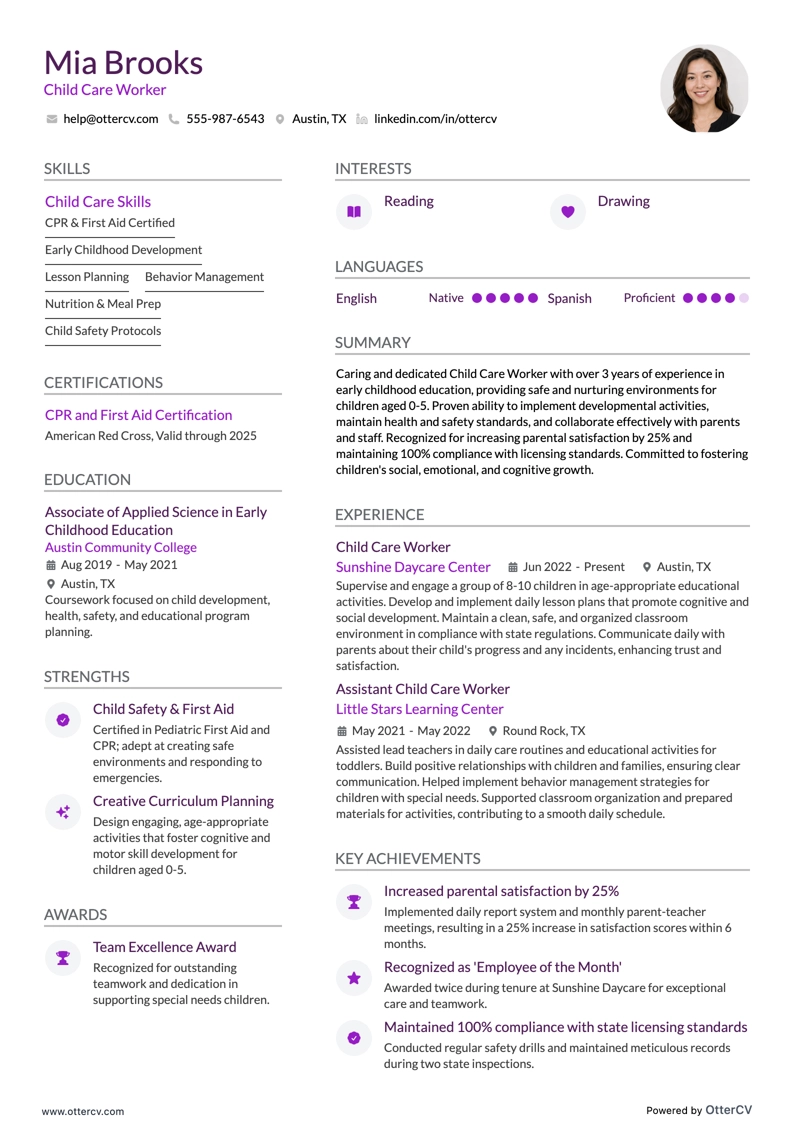
Child Care Worker resume example

Child Care Worker

Writing a child care resume can be challenging. Many candidates struggle to balance technical qualifications and education with hands-on experience gained through personal child care responsibilities and volunteer work. The key is to present both professional and personal strengths in a way that recruiters and families can quickly understand.

In this guide, we’ll show you how to build a professional child care resume using real-world examples. You’ll learn how to:

  • Show advanced child care skills by listing certifications such as First Aid/CPR, early childhood education, and child development.
  • Include volunteer work, internships, and part-time or full-time roles that demonstrate practical experience caring for children in specific age groups.
  • Add professional social media links and websites that reflect your involvement in the child care community and your commitment to providing excellent care.
  • Create a tailored child care resume that helps you stand out in a competitive field.

If you need a different type of child care resume, check out resume examples for similar caregiver roles.

The first step in writing your resume is choosing the right format. No matter what kind of job you are applying for, you should stick to a standard resume format.

Play is often talked about as if it were a relief from serious learning. But for children, play is serious learning. Play is really the work of childhood.

—Fred Rogers

How to format a child care resume

A resume presents your skills, experience, and education in a format that is easy to read. Although you can use templates with the right elements and clearly organized resume sections, it still helps to understand the basics.

A standard resume format uses one-inch margins on all sides, single-line spacing, and a font size between 10 and 12. These are common document settings, so if you are creating a resume from scratch, much of the formatting is already straightforward.

Before moving on, keep these formatting guidelines in mind:

Your font choice also matters. With so many fonts available, it can be tempting to pick something more creative, but harder-to-read fonts may cause your resume to be overlooked.

Echocv resume templates include the main resume sections and modern font options such as Exo 2, Lato, Rubik, Montserrat, and Volkhov.

One final formatting tip: save your resume as a PDF document (.pdf). This helps preserve the layout regardless of the operating system or screen size used to view it.

Resume standards can vary by market, and a Canadian resume layout may differ, for example.

If you want to see how your current child care resume compares with other professional resumes, run it through our resume checker for an in-depth analysis.

To help you decide what to include, here are the things recruiters and families want to see on a resume:

The top sections on a child care resume

  • Personal profile: Write a brief statement that highlights your passion for caring for children and your key child care accomplishments.
  • Child care experience: Show practical, hands-on experience caring for children within a specific age range.
  • Certification and advanced child care training: Include relevant child care training and health certifications, which are often valued more than post-secondary education in this field.
  • A wide range of skills: Demonstrate both personal strengths and experience with child care software and materials such as Montessori materials, ClassDojo, and ABCmouse.
  • References: Provide past employers who can speak directly about your abilities and accomplishments.

When adding child care experience and skills to your resume, focus most on these areas:

What recruiters want to see on your resume

  • Past work experience: Include relevant part-time and full-time jobs, volunteer work, internships, and personal child care experience that demonstrates your child care abilities.
  • Certifications: In addition to first aid and CPR certifications, advanced certifications can show your ability to care for special needs children and those with learning disabilities.
  • Patience and compassion: These qualities help show that you are resilient and can handle children who are being temperamental.
  • Reliability: Demonstrate that you are on time and have strong time management skills.
  • Communication skills: Show your ability to communicate with children, parents, and educators, as this role requires regular interaction with children, parents, and professionals.

Before adding your work experience, choose between a single-column and two-column resume layout. Both are acceptable, and despite common claims online, applicant tracking systems (ATS) can read both formats.

If you look at other child care resumes, you’ll find a mix of single-column and two-column designs. A two-column layout can help you fit more information onto a single-page resume, reduce scrolling, and works especially well for candidates with 5-10+ years of experience.

Try both options and choose the one that best fits your education, work history, and skills. Then start adding your relevant child care experience, including both professional and personal roles where you cared for children.

How to write your child care resume experience

The resume experience section will take up the most space on your resume. This is where you show your child care background and accomplishments.

Include both professional and personal child care experience, such as raising your own children, babysitting a neighbor's kids, or volunteering at child care facilities.

Each job entry should include:

  • Job title
  • Name of family or care organization
  • Location
  • Dates of employment
  • A bullet list of job details and accomplishments

For each role, include 4-8 bullet points that explain what you did and how your work supported the child’s development. When listing past jobs, be sure to tailor your resume to the specific job posting. Focus on the relevant keywords it mentions, such as first aid and CPR training, early childhood development, conflict resolution, and nutrition and meal planning.

If those keywords appear in the job post, they should appear on your resume too.

Next, let’s look at an example of a real-world child care resume experience listing so you can see how this section should look.

Experience

Child Care Provider at Private Home

Private Residence

07/2018 - Present · Fort Lee, VA

  • Cared for multiple children ranging in age from toddler to preteen.
  • Performed all assigned care duties, including special requests from parents.
  • Ensured school-aged children arrived at school on time and completed their homework.
  • Communicated with parents about behavioral concerns and offered guidance on how to address them.
  • Fostered a warm, caring environment centered on trust and compassion.
WRONG

Ask yourself: does this example make the person sound like a well-organized, thorough child care provider?

Not really. The vague description of their responsibilities and duties raises more questions than it answers, and it does not support their final claim.

As a child care provider, your resume should show how effective you are as a caregiver and how you use your skills to support the children in your care.

Now let’s improve this example by adding more specific details.

Experience

Child Care Provider at Private Home

Private Residence
07/2018 - Present
Fort Lee, VA

  • Provided attentive care for 4 children ages 2, 5, 8, and 11.
  • Changed diapers, managed bath time, prepared meals, and handled light household cleaning.
  • Maintained school and extracurricular schedules and safely transported children to and from activities in a timely manner.
  • Fostered a warm, caring environment built on trust and compassion.
  • Communicated significant events or concerns with parents immediately and discussed options for addressing behavioral issues.
RIGHT

You should now have a clearer picture of this person’s abilities and the kind of environment they worked in. Their revised list of accomplishments is more concise and works well because it:

  • Uses actionable verbs to describe past work experience.
  • Specifies the exact number of children in their care and their ages.
  • Includes relevant keywords that describe child care duties.
  • Shows time management, organization, and lesson planning skills.
  • Highlights communication skills with children, parents, and professionals.

When listing past work experience, only include up to 3 relatable jobs. Adding more can make your resume feel repetitive and take up too much space.

How to quantify impact on your resume

When describing your work experience, you’ve probably heard that you should quantify your actions with numbers and percentages. For child care roles, that can be harder to do, but it is still possible.

Here are real-world examples of how to quantify common child care metrics on a resume:

  • Number of children under your care: “Utilized meal times as a fun learning opportunity, preparing healthy foods with 3 children and helping each child overcome food aversions.”
  • Age range of children cared for: “Managed care for up to 15 children ranging in ages from 2-10 for 8+ hours per shift.”
  • Hours of child development training: “Completed 20+ hours of health, safety, and nutrition training to achieve certifications in First Aid, CPR, and childhood nutrition.”
  • Years of experience in specified child care field: “8+ years working with children aged 12-17 with behavioral and learning disabilities.”
  • Child care settings: “Promoted safe behaviors and creativity while establishing basic peer and adult rules, reducing the instances of bullying by 62%.”
  • Educational activities created/developed: “Developed and implemented 3 new learning activities that improved social interaction and behaviors in children living with autism by 23%.”
  • Number of short-to-long-term contract conversions: “Developed and implemented new homework and play schedules that led to four short-term contracts becoming long-term contracts.”
  • Percentage of childhood development improvements: “Coached children in school subjects and aided in homework, improving learning comprehension and test scores by 32%.”

You do not need to quantify every bullet point. Focus on the metrics that appear in the job duties and responsibilities. For instance, if the job post reads:

The caregiver is responsible for providing high-quality care for children ranging from infants to preschoolers. Duties include feeding babies, changing diapers, assisting with potty training, and supervising children. The applicant will also follow the provided curriculum and collaborate with another teacher to create lessons that support age-appropriate behavior and kindergarten readiness.

If you are applying for this role, tailor details from your past work to match what the employer is looking for, and quantify your impact when possible.

  • Developed a new fun potty training activity that helped children learn potty skills and decreased daily accidents by 46%.

  • Worked with teachers and child care providers to develop 6 new lessons focused on learning and early childhood development.

How do I write a child care resume with no experience

If you are passionate about child care but don’t have any experience, there’s nothing to worry about. You can still build a strong resume experience section by including jobs where you performed duties similar to those of a child care provider.

Recruiters are less concerned with job titles than with relevant experience that shows real child care skills.

Focus on roles where you:

  • Supervised children at a parent’s home or in a child care facility.
  • Developed and implemented activities that promote physical, emotional, social, and intellectual development.
  • Performed basic care needs, such as changing diapers and toilet training.
  • Created a daily routine for children to ensure a healthy mix of play time, education, and rest.
  • Participated in training and development of programs for special needs children.

Related jobs you can include on your resume may include:

  • Camp counselor
  • Preschool teacher
  • Family babysitter
  • Special needs assistant
  • Daycare assistant
  • Nanny
  • Youth worker

When describing relevant work experience, focus only on duties that are specific to the job you are applying for.

Experience

Camp Counselor

Forest Day Camp
05/2011 - 05/2013 | Paramus, NJ

Day camp for children and preteens

  • Served as a camp counselor for two summers, leading groups of 15+ children during a 6-hour camp day.
  • Worked closely with camp administrators and team members to keep camp schedules running smoothly.
  • Communicated with parents about needs and concerns and reported events to a direct supervisor.
  • Led arts and crafts projects and age-appropriate games while ensuring the safety and well-being of each camper.
  • Followed all camp rules and protocols to maintain a safe and fun environment.
RIGHT

This example shows how relatable past jobs can effectively highlight your child care skills. From it, employers can see that the candidate is:

  • Able to handle a large group of children throughout a full 6-hour shift.
  • A team player who is comfortable communicating and working with parents, other counselors, and children.
  • Experienced in leading a variety of games and activities in a safe and fun way.
  • Capable of creating a safe environment based on camp rules and regulations.

Once your resume experience section is complete, the next step is adding the technical and personal skills that child care workers should have.

How to list your hard skills and soft skills on your resume

The next sections of your resume should list important skills, including knowledge of child management software, scheduling and planning tools, and interpersonal and empathy skills. Together, these hard and soft skills help present you as a well-rounded child care provider.

Hard skills are technical abilities, such as experience with Brightwheel, Montessori Crosswords, and development assessment tools. They can also include software like Microsoft Office for emailing, creating lesson plans, building spreadsheets, and making interactive presentations.

Soft skills are more personal skills that are not always formally taught. In child care, these include active listening, communication, creative thinking, and emotional intelligence. These skills are often developed through everyday experiences with family, peers, and friends.

Including both hard and soft skills on your child care resume is essential because it shows that you can handle a wide range of care situations. Echocv resume templates offer several ways to present these skills.

A technical skills section lets you list your experience with educational and management software, development tools, and other necessary equipment and tools.

Skills

Child Management Software
Brightwheel, Himama
Child Development Software
Ages and Stages Questionnaires (ASQ), Teaching Strategies GOLD
Health & Safety Monitoring
MedicPad, CareDox
RIGHT

The strengths section is where you list your relevant soft skills.

Strengths

  • Emotional Intelligence
  • Adaptable
  • Resilience
  • Out-of-the-box thinking
RIGHT

Here is a list of the hard and soft skills most often sought by child care facilities and families:

Best hard skills for your child care resume

  • First Aid and CPR certification.
  • Health and safety training.
  • Knowledge of child nutrition.
  • Expertise in infant care.
  • Early childhood education.
  • Multilingual communication skills.
  • Special needs care.
  • Child behavior management techniques.
  • Knowledge of child psychology.
  • Learning strategies.
  • Developmental assessments.
  • Proficiency in child care management software.
  • Familiarity with child-friendly educational software.
  • Lesson planning.
  • Arts and crafts skills.
  • Music therapy.
  • Knowledge of outdoor games and activities.
  • Proficiency in educational technologies.
  • Driver's license.

Best soft skills for your child care resume

  • Patience helps you stay calm and supportive with children.
  • Compassion shows genuine care for children and families.
  • Adaptability helps you respond to changing routines and needs.
  • Creativity supports engaging activities and learning experiences.
  • Problem-solving helps you handle everyday challenges effectively.
  • Communication supports clear interaction with children, parents, and coworkers.
  • Empathy helps you understand children's emotions and needs.
  • Time management helps you balance routines, tasks, and responsibilities.
  • Active listening shows attentiveness to children and families.
  • Observational skills help you notice behavior, needs, and progress.
  • Interpersonal skills help you build positive relationships.
  • Emotional intelligence supports thoughtful and caring responses.
  • Resilience helps you stay effective during demanding days.
  • High energy levels help you keep up with active children.
  • A sense of humor helps create a warm and positive environment.
  • A positive attitude supports a welcoming child care setting.
  • Stress management helps you remain calm under pressure.
  • Dependability shows that others can count on you.
  • Leadership helps you guide activities and support others.
  • Decision making helps you act confidently in daily situations.
  • Creative storytelling keeps children engaged and entertained.

Adding skill keywords and applicant tracking systems

Applicant tracking systems (ATS) are becoming more common in recruiting offices and large companies. They help sort through resumes for a single position and identify the skills a company or family is looking for.

These systems search for specific keywords that are entered as search parameters. Each resume is scanned for those words and phrases, then scored based on how many matches are found.

To improve your chances of scoring well, match the keywords word-for-word when appropriate. If the job post mentions specific software, include it in your work experience or skills section.

The next section covers how to present your education and advanced training as a child care provider.

How to list your certifications and education on your resume

Unlike many other careers, child care facilities and private residences often place more emphasis on practical child care experience than on post-secondary education.

To make this section stronger, focus on training that is directly related to your child care specialty, such as early childhood development or working with children with special needs.

Your child care resume education section should include:

  • High school diploma
  • Associates degree
  • Child care continuing education certificates
  • Advanced child care certifications

For those who want to pursue a bachelor’s or master’s degree in child care, available degree programs include early childhood education, child/human development, and family studies.

When listing your education on a resume, include the degree name, school, and graduation date or dates of attendance.

Education

High School Diploma

Redmond High School

08/2010 - 04/2014

GPA: 3.5 / 4.0

Bachelor of Science in Early Childhood Development

University of Washington

08/2017 - 04/2022

GPA: 3.9 / 4.0

RIGHT

Certifications

  • First Aid & CPR
    American Red Cross

  • Child Development Associate (CDA)
    Pearson | VUE

RIGHT

If you want to improve your training and increase your income, explore these top child care certifications.

Next, add a personal statement to your resume. This is slightly different from a standard resume summary or objective.

How to write your child care resume summary or objective

Your resume summary or objective statement is your chance to introduce yourself to a potential employer. Think of it as the handshake before the handshake.

How you write this section depends on your level of child care experience. If you have 5+ years of experience, you will usually want to create a resume summary that highlights one or two key accomplishments.

This section should also feel personal and explain why you are passionate about child care. Next, look at a real-world child care resume summary to see what works and what to avoid.

Summary

Dedicated child care provider with many years of experience caring for infants, toddlers, and preschoolers. Instrumental in developing and implementing child care programs and evaluating program performance, resulting in a 20% improvement in child development. Offers strong child care techniques, problem-solving, and analytical skills, along with First Aid, CPR, and ECD certifications.

WRONG

Pretty impressive, wouldn’t you say? It highlights specific details such as years of experience, the ages of the children in their care, measurable developmental outcomes, and several certifications.

If you’re applying to a large organization, this type of summary can work well. Still, it may come across as cold and overly clinical. Child care workers often find it challenging to balance their passion for nurturing children with their education and technical skills.

Let’s see how this summary can be given a more personal tone.

Summary

I am a dedicated child care provider with over eight years of experience caring for infants, toddlers, and preschoolers for a nationwide child care organization. I played an instrumental role in developing and implementing individualized education plans (IEPs) and evaluating each child’s performance throughout the program, resulting in a 20% improvement in their development. I am passionate about delivering strong child care education and take pride in solving difficult situations through careful analysis of each child’s performance. I am current with First Aid and CPR training and certified in early childhood development.

RIGHT

Do you see how using “I am” makes this section feel more personal? When applying for a job with a private family, it often helps to focus on building a personal connection instead of only summarizing your career milestones.

In this situation, either example can work depending on the work environment. Families and small care facilities may connect more strongly with a personal statement than with a typical resume summary.

Additional sections for a child care resume

So far, the main resume sections have covered work experience, education, advanced training and skills, and the resume summary or personal statement.

You can also strengthen your resume with additional resume sections that highlight relevant strengths, such as nutrition education and your passion for child care. Consider adding:

  • Awards: List any awards or recognitions related to child care development or education.
  • Networking: Show your connection to the field by including memberships in national or local child care organizations and networking groups.
  • Publications: Include any published works, such as blogs, articles, or books on child care development or education, to help impress future employers.
  • Language skills: Use this section if the job requires experience with a second language.
  • Interests and hobbies: Interests such as arts & crafts, storytelling, or gardening can show your ability to teach children a wide range of topics.

Another section to consider is references. This gives families or recruiters a way to contact past employers for a personal opinion on your work ethic, reliability, passions, and achievements.

References

  • John & Betty Smith
    (832) 555-3478

  • The Parker Family
    Parker.jane@email.com

  • ABC Child Care
    (832) 222-5656

RIGHT

Before listing references, ask your past employers whether you may use them and how they prefer to be contacted.

Another resume section that child care workers often overlook is a portfolio.

Including a portfolio on your child care resume

A portfolio is not just for artists. A child care portfolio shows future employers that you have a positive web presence and lets them review your child care accomplishments in one place.

You can include:

  • Event planning and execution
  • Curriculum development
  • Community involvement
  • Parental engagement
  • Photos and videos of positive child interactions

Where should you place a portfolio link? The best place is in the header section.

Key takeaways

  • Storypark

  • Educa

  • ProCare

  • Brightwheel

  • Combining professional and personal child care experience to show practical, hands-on skills.

  • Listing education and advanced training in health and safety and child care specialties.

  • Including professional and personal references.

  • Showing your connection to the child care community through professional associations, social media, and a website portfolio.

Child Care resume examples

Explore additional Child Care resume samples and guides and see what works for your level of experience or role.

By Role

Child Care Center Director

Child Care Center Director resume preview

Nanny

Nanny resume preview

Preschool Teacher

Preschool Teacher resume preview

Toddler Teacher

Toddler Teacher resume preview

Infant Teacher

Infant Teacher resume preview

Daycare Assistant

Daycare Assistant resume preview

Daycare Teacher

Daycare Teacher resume preview

Child Care Teacher

Child Care Teacher resume preview

Child Care Assistant

Child Care Assistant resume preview

Child Care Provider

Child Care Provider resume preview

Child Care Worker

Child Care Worker resume preview