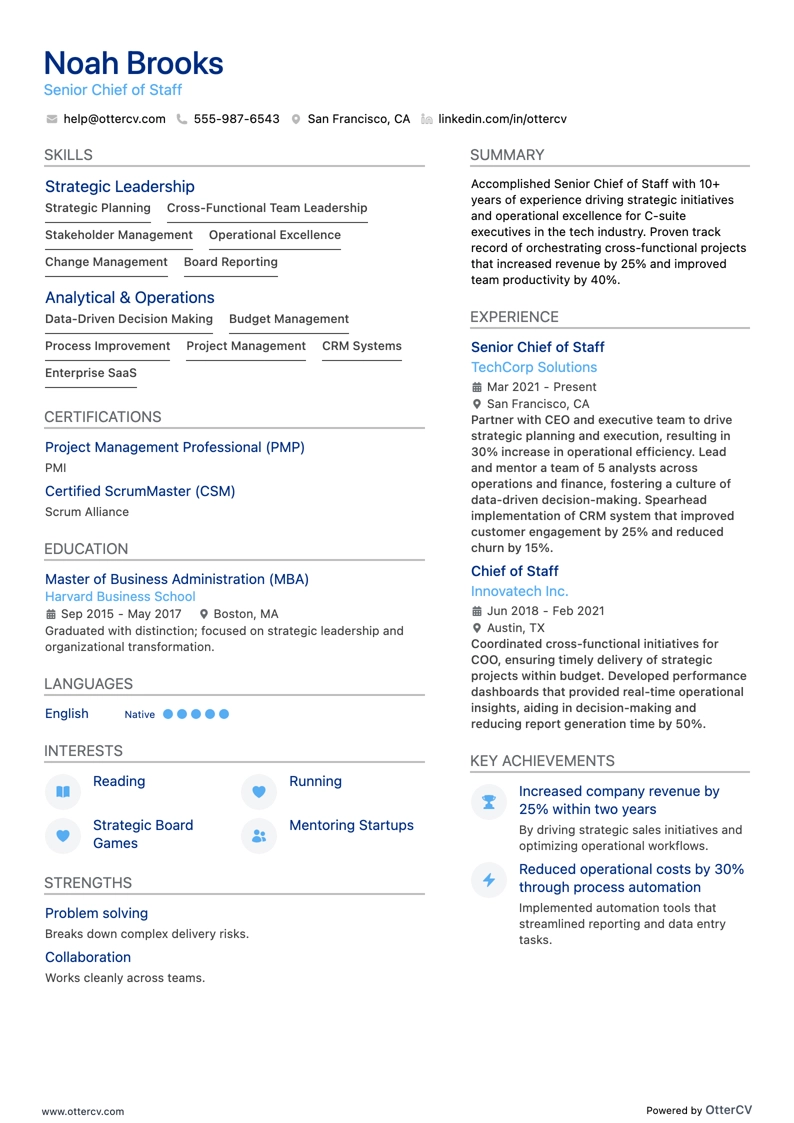
Senior Chief of Staff full preview

13 Chief of Staff Resume Examples

OtterCV

Written by The OtterCV Team

Updated: 11/23/2024•8 min read

See all resume examples in this guide, or generate your own resume example with your personalized prompt

Senior Chief of Staff resume example

Senior Chief of Staff

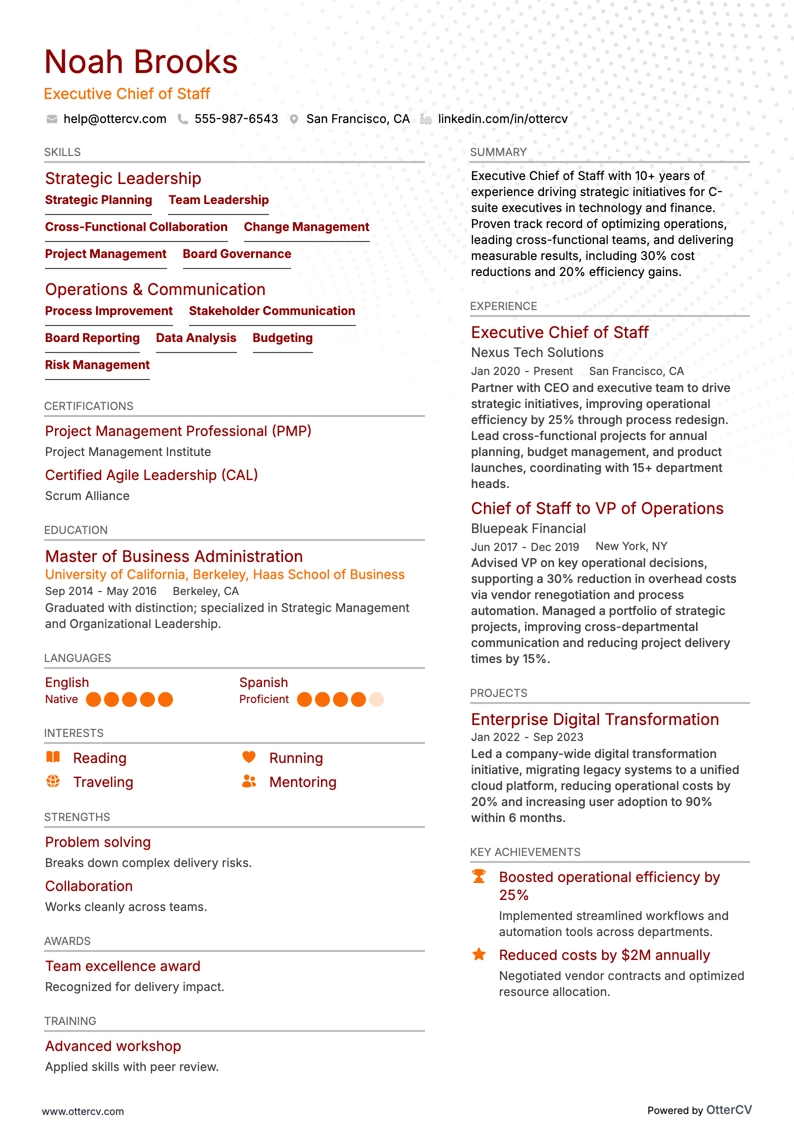
Executive Chief of Staff resume example

Executive Chief of Staff

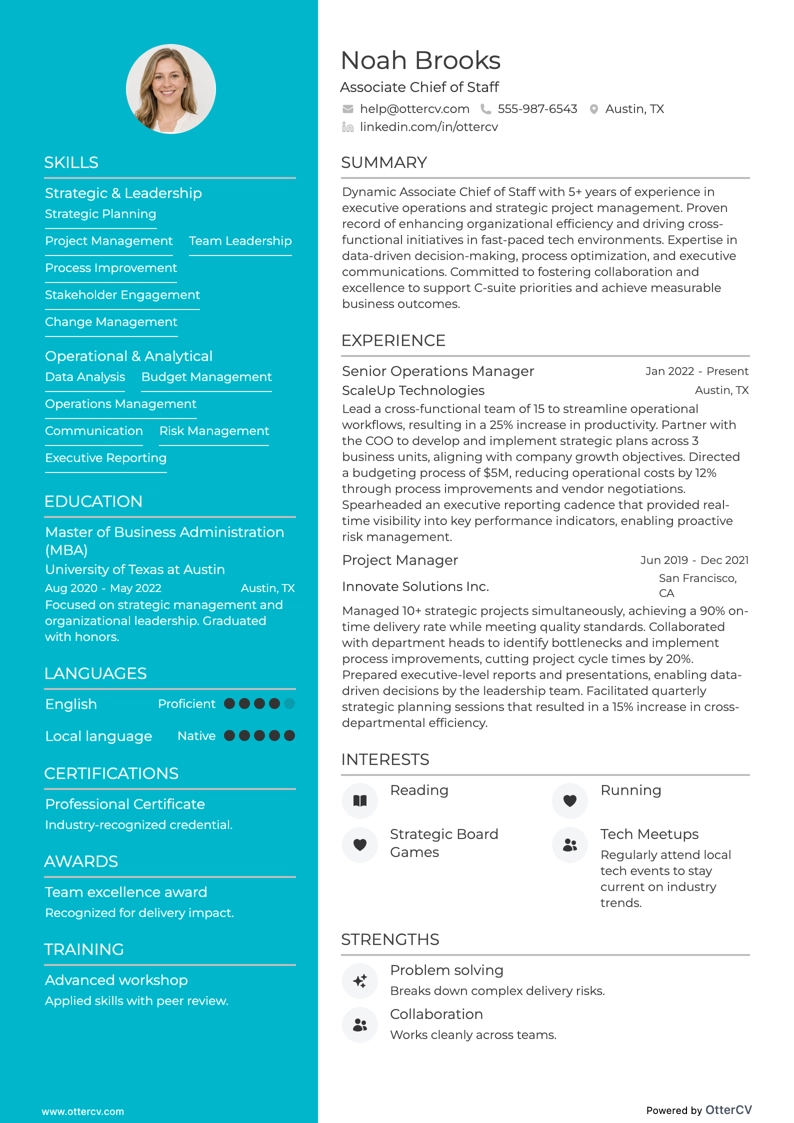
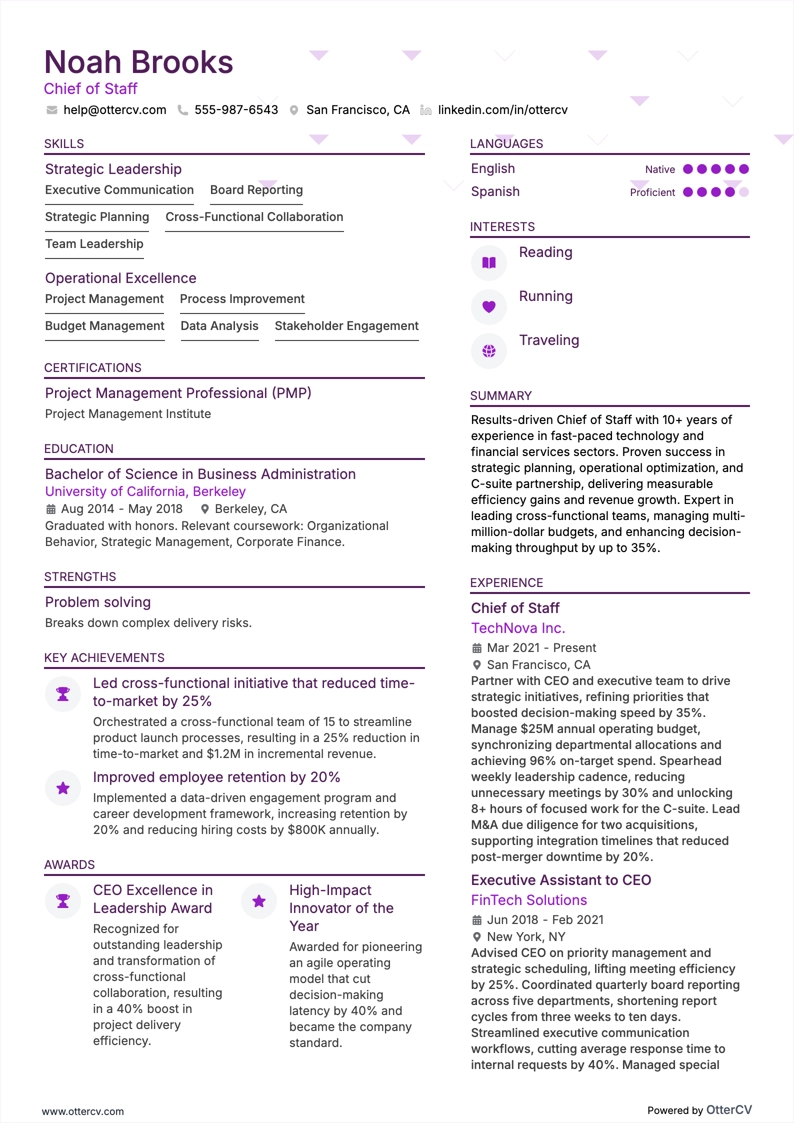
Associate Chief of Staff resume example

Associate Chief of Staff

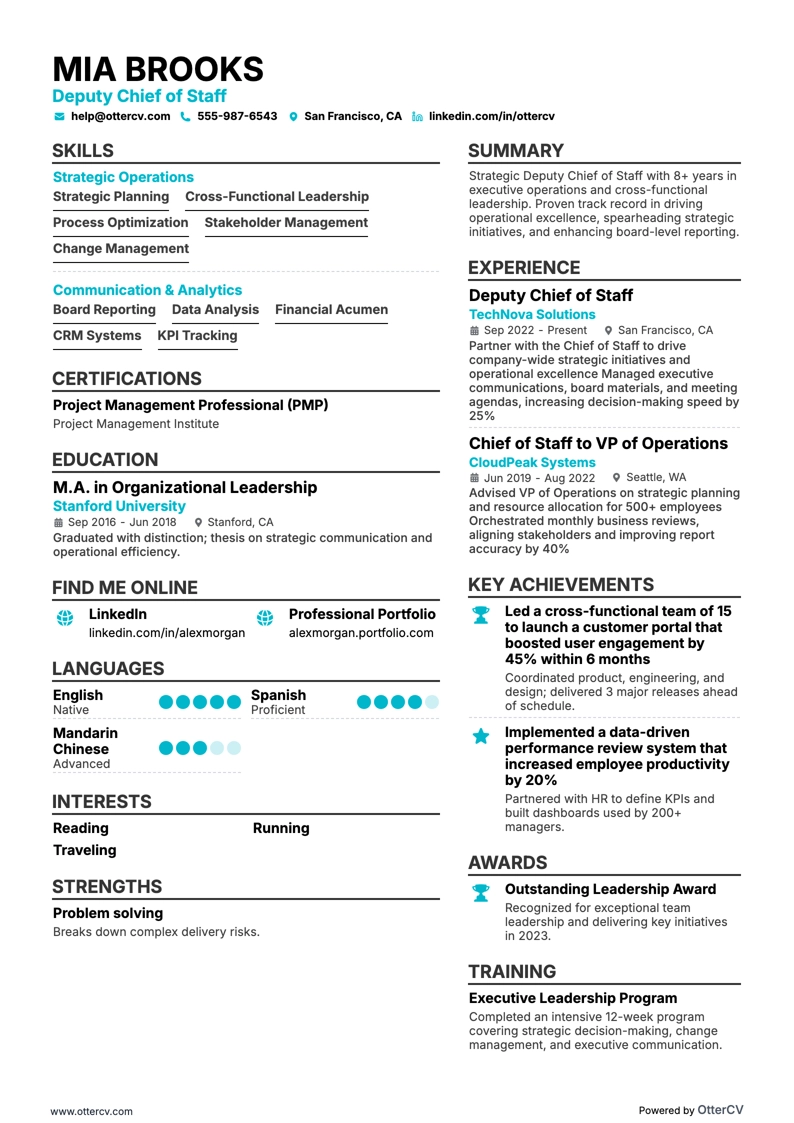
Deputy Chief of Staff resume example

Deputy Chief of Staff

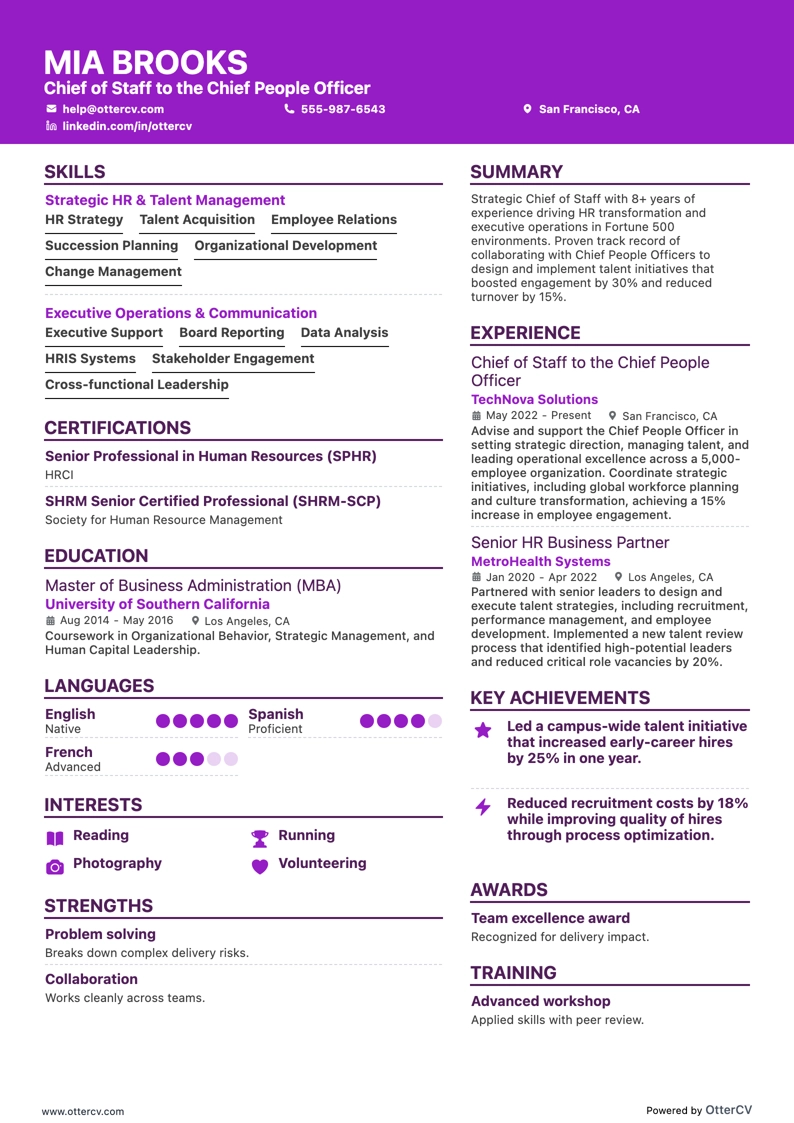
Chief of Staff to the Chief People Officer resume example

Chief of Staff to the Chief People Officer

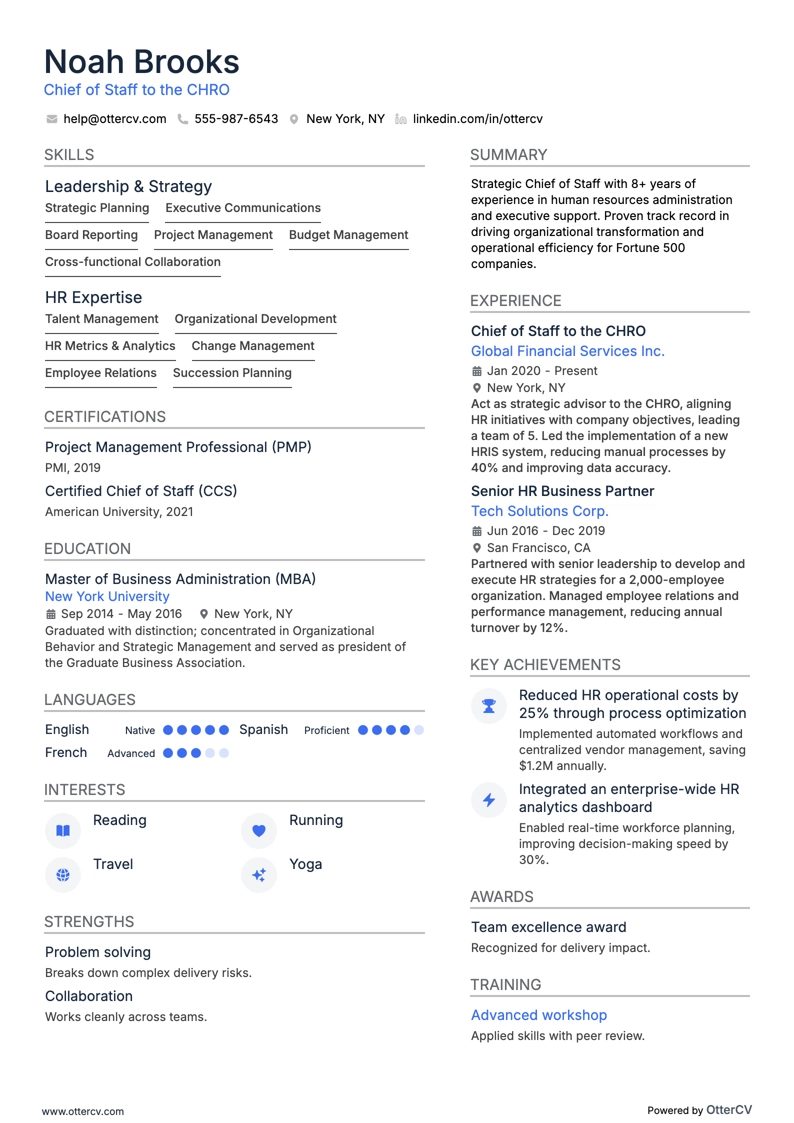
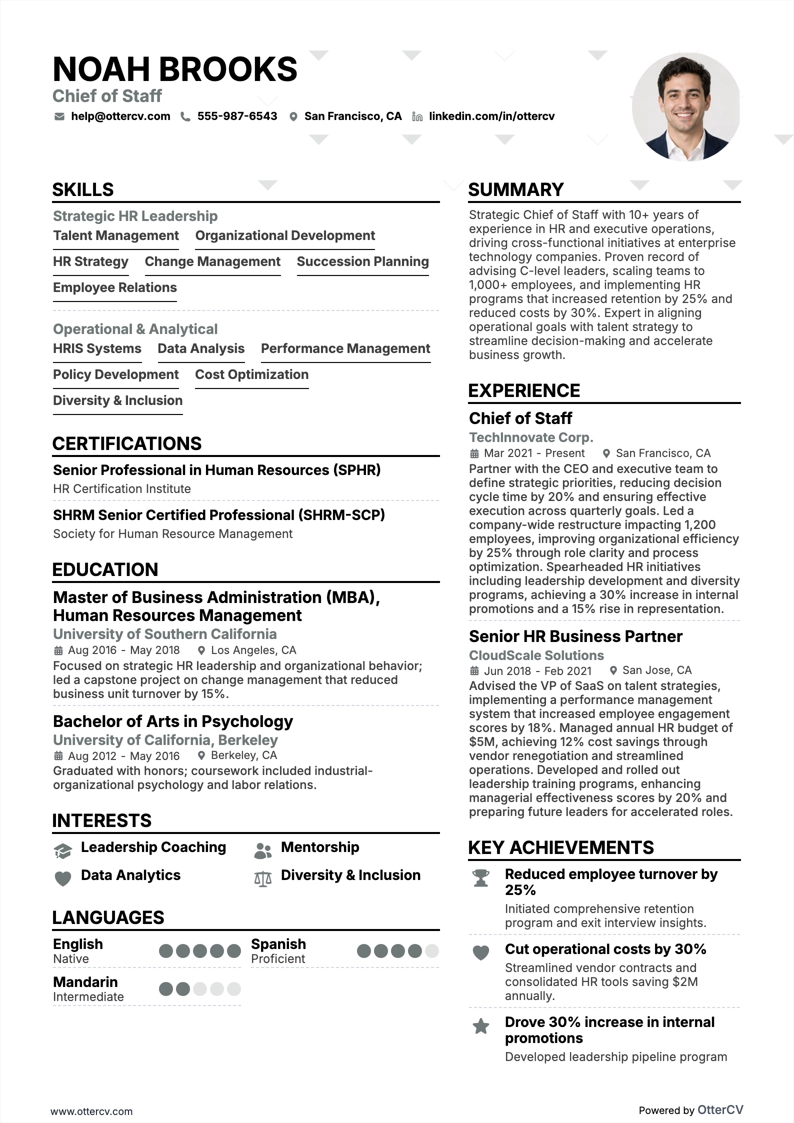
Chief of Staff to the CHRO resume example

Chief of Staff to the CHRO

People Chief of Staff resume example

People Chief of Staff

HR Chief of Staff resume example

HR Chief of Staff

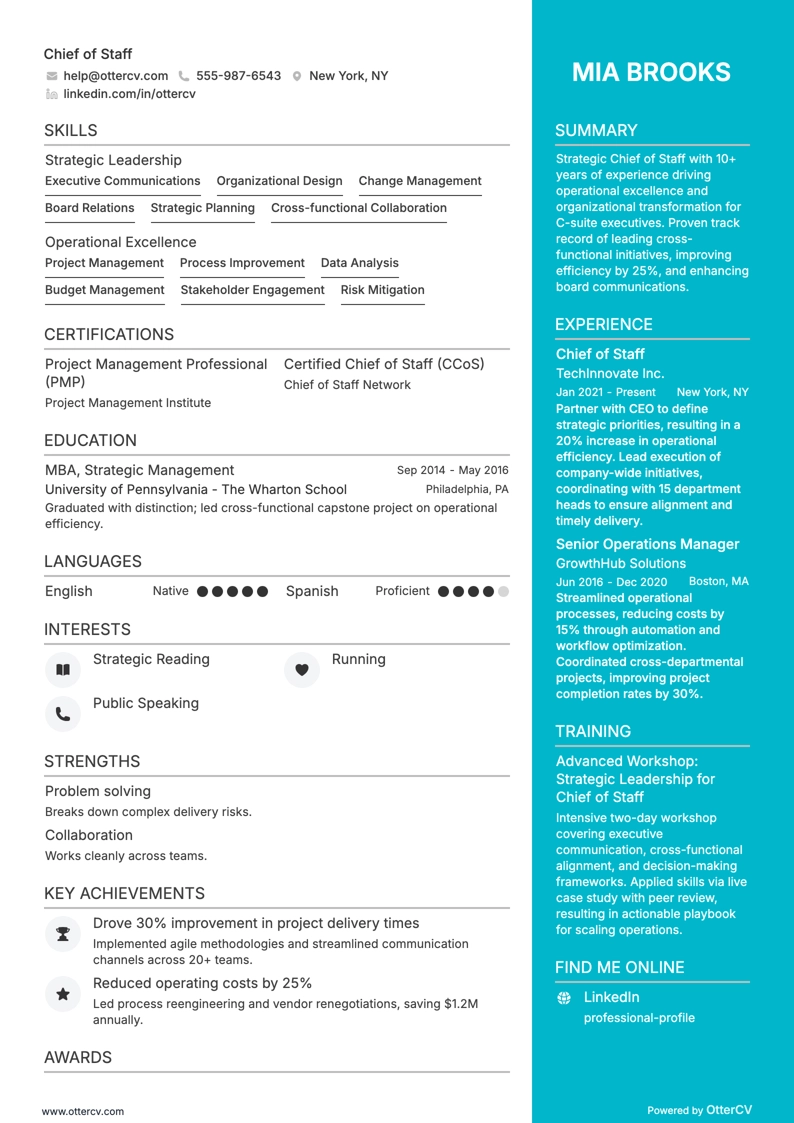
Chief of Staff resume example

Chief of Staff

Like a top-quality coach, a chief of staff brings executives, managers, and professionals from different departments together around a single goal: achieving the organization’s vision. Success in this role requires equal parts leadership and diplomacy, along with the ability to adapt and try new approaches when needed.

As a chief of staff, you may have overseen major initiatives without directly owning a specific department. That can make it harder to quantify your contributions on individual projects, especially when your impact has been more strategic and cross-functional. This article will show you how to measure and present your experience on a chief of staff resume in a way that resonates with hiring managers.

In this article, you’ll find:

  • An exemplary chief of staff resume format that highlights the multifaceted nature of the role.
  • Techniques for showcasing your role in leading major cross-departmental initiatives and projects.
  • Strategies for describing your expertise with organizational tools and methodologies that improved company efficiency.
  • Insights on emphasizing collaboration with executive teams to drive decision-making and maintain strategic alignment.

If you’re exploring related roles, browse these guides:

Chief of staff resume example

Senior Chief of Staff resume preview

Here’s what this resume does well:

  • Quantifiable achievements: Specific percentages and dollar amounts help validate accomplishments. Examples include: “Led strategy and operations team resulting in a 30% reduction in food waste and a 20% increase in profit margins.” and “Advised executive teams on market entry strategy resulting in $10M+ in new revenue.”
  • Relevant experience and skills: Experience as a “Director of Strategy and Operations” and “Senior Strategy Consultant” directly applies to a chief of staff role. Skills such as “Project management,” “Strategic planning,” and “Leadership” are also vital for the position.
  • Awards and recognitions: Listing awards like “Outstanding Leadership Award” and “Team Collaboration Award” reinforces professional recognition and showcases expertise.
  • Education and certifications: An MBA from a reputable institution like “Harvard Business School” suggests a strong foundation in business management and strategy, which is crucial for this role.

How to format a chief of staff resume

As a chief of staff, you bring order to workplace chaos. Your resume should reflect that same ability to organize information clearly and effectively. Following a strong structure helps present your experience with maximum impact while highlighting the organizational strengths that make you successful in the role.

Small improvements can help your resume present you in a better light. With dozens or even hundreds of applicants competing for the same position, your unique skills and abilities can help you stand out. A resume that clearly highlights those strengths can set you apart from the rest.

Below are some helpful tips to keep in mind when formatting your resume:

  • Reverse chronological format: Employers are most interested in your recent experience. Use a reverse chronological format to list your latest roles first. This shows where you are now, how you progressed, and the responsibilities you held before becoming a chief of staff.
  • Header and contact info: Your header should include the key details an employer needs to contact you, including your name, phone number, email, and location. You may also want to include your LinkedIn profile so employers can see your network.
  • How many pages? As a chief of staff, you may have a long list of previous roles, so a resume longer than one page is not unusual. For candidates with senior management experience, the best rule of thumb is to keep it between one and two pages.
  • File format: Unless otherwise requested, use the PDF file format. It is easier to share than a Word document, and your text and images are less likely to shift.

Adjust your resume layout based on the market. Canadian resumes, for example, may follow a unique format.

The top sections on a chief of staff resume:

  • Professional summary: Use this section to highlight your career achievements, unique experience, key qualifications, and your goals as a chief of staff.
  • Core competencies: List specific skills rather than generic ones, and quantify them with numbers when possible, such as strategic planning, project management, communication, and problem-solving.
  • Professional experience: Include each company, your employment dates, your distinctive responsibilities, and quantified results wherever possible.
  • Education: Your education can help you stand out, especially if you attended a prestigious Ivy League school or the same alma mater as a hiring manager.
  • Certifications (if applicable): Relevant certifications can show that you stay current with trends in your market and continue building your expertise.
  • Strategic initiatives: Add a separate section for strategic initiatives you contributed to, and include a portfolio link if you have one that shows how you achieved your goals.

What recruiters want to see on your resume:

  • Demonstrated experience in strategic planning and execution at the executive level.
  • Proven ability to collaborate and communicate effectively with C-suite members.
  • Evidence of leading cross-functional teams or projects, showing leadership without direct authority.
  • Specific accomplishments related to organizational growth, change management, or efficiency improvements.
  • Familiarity with, or experience in, the industry or sector where the hiring company operates.

How to write your chief of staff resume experience

Your resume experience section is often one of the first things employers review. In the competitive upper-management job market, they will usually look closely at how you helped build and improve other companies. That is why this section needs to be clear, well organized, and informative.

A common mistake is listing job duties instead of highlighting accomplishments and achievements. Employers want to understand the impact you made. Use dollar amounts, percentages, and other real-world data to show how you improved the business and to demonstrate your value as a chief of staff.

You should also include role-specific keywords that match your past positions and the industry you worked in. Recruiters often begin by scanning resumes with ATS (applicant tracking system) software, and resumes that do not include the right keywords or buzzwords may be filtered out.

Below are two example experience sections. One shows the right approach, while the other falls below expectations. Use both examples as a guide when writing your own.

Experience

Director of Operations and Chief of Staff

High Tech Computers

05/2021 - 05/2023 · New York, NY

  • Helped implement a comprehensive strategic planning process that resulted in significant revenue growth and increased market share.
  • Identified operational inefficiencies and developed cost optimization measures.
  • Oversaw the successful execution of a high-impact project that improved workflows between departments.
  • Supported the CEO by conducting in-depth market research and financial analysis.
WRONG

What went wrong with this example:

  1. Inefficient and inelegant word choices: The first issue is the use of the word “helped” in this resume experience section. That choice weakens the impact of the claims being made. When you say “helped,” you suggest that you played only a secondary role in driving change within the company. Instead, begin each bullet point with a strong action verb to make your contributions sound more direct and credible. Examples include guided, developed, directed, facilitated, advised, arranged, cultivated, maintained, and pioneered.
  2. No quantifiable examples: It is good that the candidate helped implement a “Strategic planning process” that increased revenue growth and market share. But by how much? Employers want to understand the significance of your impact, and the clearest way to show that is with percentage points, dollar figures, and other concrete data points.

Experience

Director of Operations and Chief of Staff

High Tech Computers

05/2021 - 05/2023 | New York, NY

  • Led a comprehensive strategic planning process that resulted in 15% year-over-year revenue growth and a 20% increase in market share over two years.
  • Identified operational inefficiencies and implemented cost optimization measures, reducing operating expenses by 12% and significantly improving the company's profit margin.
  • Oversaw a high-impact project to streamline cross-departmental workflows, increasing team efficiency by 30% and reducing project delivery timelines by 25%.
  • Supported the CEO's decision-making through in-depth market research and financial analysis, contributing to a 10% increase in shareholder value.
RIGHT

What went well in this example?

Beyond the points mentioned above, this resume example works well because it is detailed and developed while still being easy to read. Each point is supported by a quantifiable result. For example, the author “orchestrated a comprehensive strategic planning process resulting in a 15% year-over-year revenue growth and a 20% increase in market share within two years.” A recruiter or hiring manager can quickly skim a resume for percentages and other data points that show clear success. Once those results capture their attention, they are more likely to keep reading and understand the steps you took to achieve them.

How to quantify the impact on your resume

It’s important to quantify the impact you made in previous roles because it adds credibility to your claims. Many people say they made a difference at their previous workplace, but the key question is: how did you make a difference?

Do not make false claims or exaggerate what you did in previous roles. Keep in mind that everything on your resume may be fact-checked, and employers may speak to your previous employer or team members to verify your claims. If you inflate a percentage to make yourself seem more successful, the numbers don’t lie, and eventually you may be found out.

Stick to what you actually accomplished, and don’t take credit for other people’s work. As a chief of staff, many achievements may happen under your guidance, but employers can usually tell when someone is trying to puff themselves up.

Examples of ways to quantify impact

  • Include percentage improvements in organizational efficiency or process optimization.
  • Mention dollar amounts saved or generated through strategic initiatives.
  • Highlight the number of cross-functional projects led.
  • List specific metrics related to change management successes.
  • Detail any growth in team size or resources you managed.
  • Specify the number of C-suite executives or board members you worked directly with.
  • Include measurable improvements in stakeholder or employee satisfaction.

How to list your hard skills and soft skills on your resume

As a chief of staff, you’ll likely have a long list of hard skills built through years of experience. Hard skills, often called technical skills, are typically gained through hands-on work and apply to specific roles or workplaces. Whether it’s experience handling crises or familiarity with customer relationship management software, these job-specific skills can show the value you bring.

At the same time, it’s easy to overlook the soft skills you’ve developed. Soft skills, often called people skills, are usually built through experience working with others. Leadership skills, for example, may have helped you streamline operations and optimize workflows.

Including both hard and soft skills on your resume helps present you as a well-rounded candidate. You can learn an organization’s mission and vision, apply that knowledge to create KPIs and expectations for each department you oversee, and build strong organizational awareness of the company you work for.

4-step process for listing skills on your resume

  1. List all the skills that you possess: Include both the hard and soft skills you developed through previous experience.
  2. Separate your skills between hard and soft skills.
  3. Review the job description: Look for the specific skills required to fulfill the role. These are the skills employers want to see on your resume.
  4. Edit the list for the skills that are most applicable to the job: Tailor your list to fit the role you’re applying for. Remove skills that are less relevant. For example, if a previous role involved significant technical IT support because you oversaw programmers and IT professionals, you may not need to include those skills if you’re applying for a chief of staff role at a hardware company.
Best hard skills for your chief of staff resume

  • Strategic planning.
  • Project management.
  • Data analysis.
  • Budgeting and financial forecasting.
  • Change management.
  • Process optimization.
  • Stakeholder management.
  • Risk management.
  • Performance metrics and KPIs.
  • Familiarity with CRM systems.
  • Business intelligence tools.
  • Contract negotiation.
  • Resource allocation.
  • Operations management.
  • Policy formulation.
  • Cross-functional team leadership.
  • Conflict resolution.
  • Organizational development tools.
  • Corporate governance.
  • Familiarity with ERP systems.

Best soft skills for your chief of staff resume

  • Effective communication helps you align teams and priorities.
  • Diplomacy supports balanced judgment in sensitive situations.
  • Conflict resolution shows you can handle tension constructively.
  • Leadership demonstrates your ability to guide people and initiatives.
  • Emotional intelligence helps you navigate relationships with awareness.
  • Active listening shows that you understand concerns before acting.
  • Critical thinking helps you assess information and make sound recommendations.
  • Adaptability shows you can respond well to changing priorities.
  • Collaboration reflects your ability to work effectively across teams.
  • Decision-making shows confidence in choosing the best path forward.
  • Time management helps you stay organized and keep work on track.
  • Influencing and persuasion support progress without direct authority.
  • Problem-solving shows you can address challenges efficiently.
  • Empathy helps you build trust and support strong working relationships.
  • Organizational awareness shows you understand internal dynamics and priorities.
  • Resilience helps you stay effective under pressure.
  • Stakeholder management shows you can balance competing needs.
  • Visionary thinking reflects your ability to support long-term direction.
  • Negotiation helps you reach practical agreements.
  • Integrity shows that you act with honesty and sound judgment.

How to list your certifications and education on your resume

Your education can play an important role in your success. If you attended a prestigious university or completed a highly sought-after program, that may signal to a hiring manager that you’re likely to excel in the role. It can also serve as an interview icebreaker, especially if you and the employer attended the same school. Sharing an alma mater can help you build rapport and stand out from other candidates.

Industry-recognized certifications can also give you an advantage, especially in a field like chief of staff where candidates may come from many backgrounds and some may have little to no direct experience. For example, if you’ve led a charity or non-profit organization, you may want to pursue a CFRE (Certified Fundraising Executive) to demonstrate competency in the logistics, ethics, and practical elements of receiving donations. Having CFRE after your name can show that you have specific experience optimizing charity operations.

Here’s what to include when listing your education on your resume:

  • The name of the degree
  • The name of the school
  • The location of the school
  • The years you attended the school
  • GPA (optional)
  • Honors or extra-curricular involvement (optional)

Education

Master of Business Administration (MBA) in Information Systems Management
The University of Toronto
02/2006 - 11/2010
GPA: 3.89 / 4.0

RIGHT

Best certifications for your chief of staff resume

  • Certified Chief of Staff Professional (CCSP).
  • Certified Executive Leadership Coach (CELC).
  • Certified Chief Executive Officer (CCEO).
  • Certified Business Strategist (CBS).
  • Certified Public Manager (CPM).
  • Certified Organizational Change Manager (COCM).
  • Certified Project Management Professional (PMP).
  • Certified Chief Operating Officer (CCOO).
  • Certified Human Resources Professional (CHRP).
  • Certified Quality Assurance Professional (CQAP).

How to write your chief of staff resume summary or objective

Your resume summary or objective is your first chance to show who you are, what your goals are, and what you want to do in your career before landing an interview.

A resume objective, also called an objective statement, is a brief statement focused on the impact you plan to make in the role you are applying for. It is most commonly used by candidates who are new to a field or applying for a position where they have limited experience. Because of that, an objective can include what you hope to achieve or learn from the role.

A resume summary, or professional summary, lets you go a bit deeper into your career goals and aspirations. It can explain how your unique skills will benefit the company, show why you are a strong candidate, and highlight your career direction. A strong approach is to quantify your achievements with real data points and dollar figures when possible.

For a chief of staff role, a career summary is usually the better fit because this is a high-level managerial position that typically requires substantial experience. In your summary, go deeper into what you have achieved and what you hope to accomplish in the chief of staff position you are applying for.

Summary

Highly skilled and results-driven Chief of Staff with over 20 years of experience. Optimized a global team of 70+ employees and played a major role in guiding strategic decision-making. Spearheaded initiatives to streamline operational workflows, resulting in a significant increase in operational efficiency and a decrease in operational costs.

WRONG

What went wrong with this resume summary?

It starts strong by including a tangible number: 70+ employees. But after that, it shifts into a more generic list of accomplishments.

The summary also does not seem tailored to the specific role the person is applying for, and it does not include quantifiable examples of their achievements.

Another issue is that it does not bring the candidate to life. A strong resume summary should show how the person could make a meaningful impact at the company they are applying to. That same level of enthusiasm does not come through here.

Summary

Highly skilled and results-driven chief of staff with over 20 years of experience. Led the optimization of a global team of 70+ employees and played a major role in guiding strategic decision-making. Spearheaded initiatives to streamline operational workflows, resulting in a 20% increase in operational efficiency and a $5 million reduction in operational costs. Known for leveraging data-driven insights to inform decisions, implemented a data analytics system that improved forecasting accuracy by 40% and reduced resource allocation discrepancies by 25%. Excited to bring this expertise to QP Robotics and support the company’s success.

RIGHT

What does this resume summary do well?

  • Include the most pertinent information in your resume header, and make sure your resume header and cover letter header match.

  • Include all education and certifications that apply to the job you are applying for.

  • Use quantifiable percentages, dollar figures, and other data points to support claims in your experience section or resume summary.

  • Use keywords and other buzzwords so your resume can be easily scanned by ATS software.

  • Make a list of your skills and abilities, and include only the ones that apply to the job you are applying for.

Chief of Staff resume examples

Explore additional Chief of Staff resume samples and guides and see what works for your level of experience or role.

By Experience

Senior Chief of Staff

Senior Chief of Staff resume preview

Executive Chief of Staff

Executive Chief of Staff resume preview

Chief of Staff resume examples

Explore additional Chief of Staff resume samples and guides and see what works for your level of experience or role.

By Role

Associate Chief of Staff

Associate Chief of Staff resume preview

Deputy Chief of Staff

Deputy Chief of Staff resume preview

Chief of Staff to the Chief People Officer

Chief of Staff to the Chief People Officer resume preview

Chief of Staff to the CHRO

Chief of Staff to the CHRO resume preview

People Chief of Staff

People Chief of Staff resume preview

HR Chief of Staff

HR Chief of Staff resume preview

Chief of Staff

Chief of Staff resume preview