Startup Chief Executive Officer full preview

42 CEO Resume Examples

OtterCV

Written by The OtterCV Team

Updated: 12/21/2024•8 min read

See all resume examples in this guide, or generate your own resume example with your personalized prompt

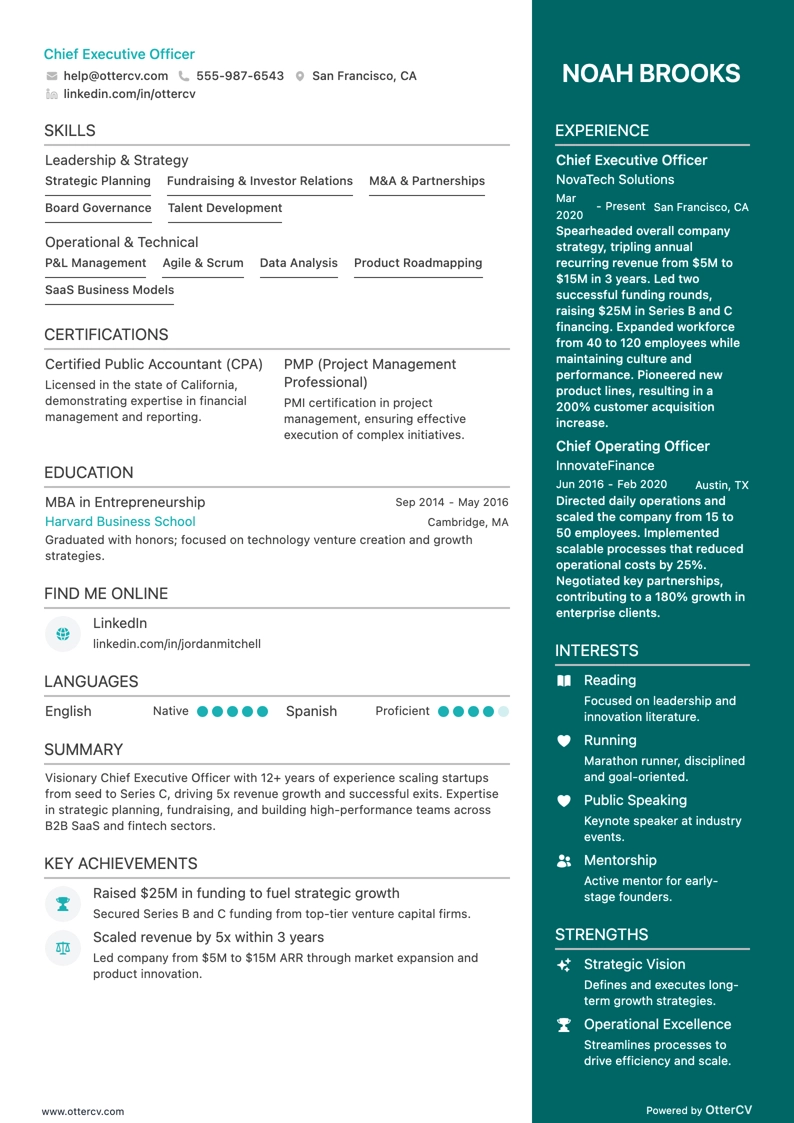
Startup Chief Executive Officer resume example

Startup Chief Executive Officer

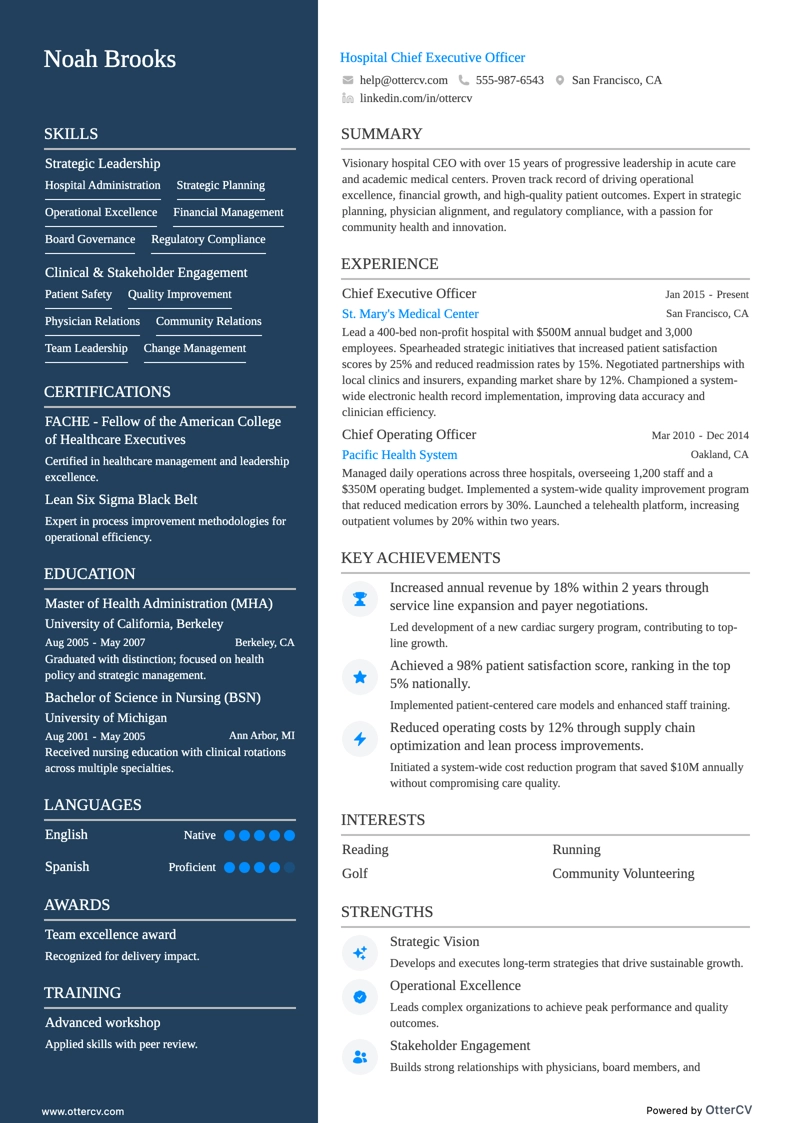
Hospital Chief Executive Officer resume example

Hospital Chief Executive Officer

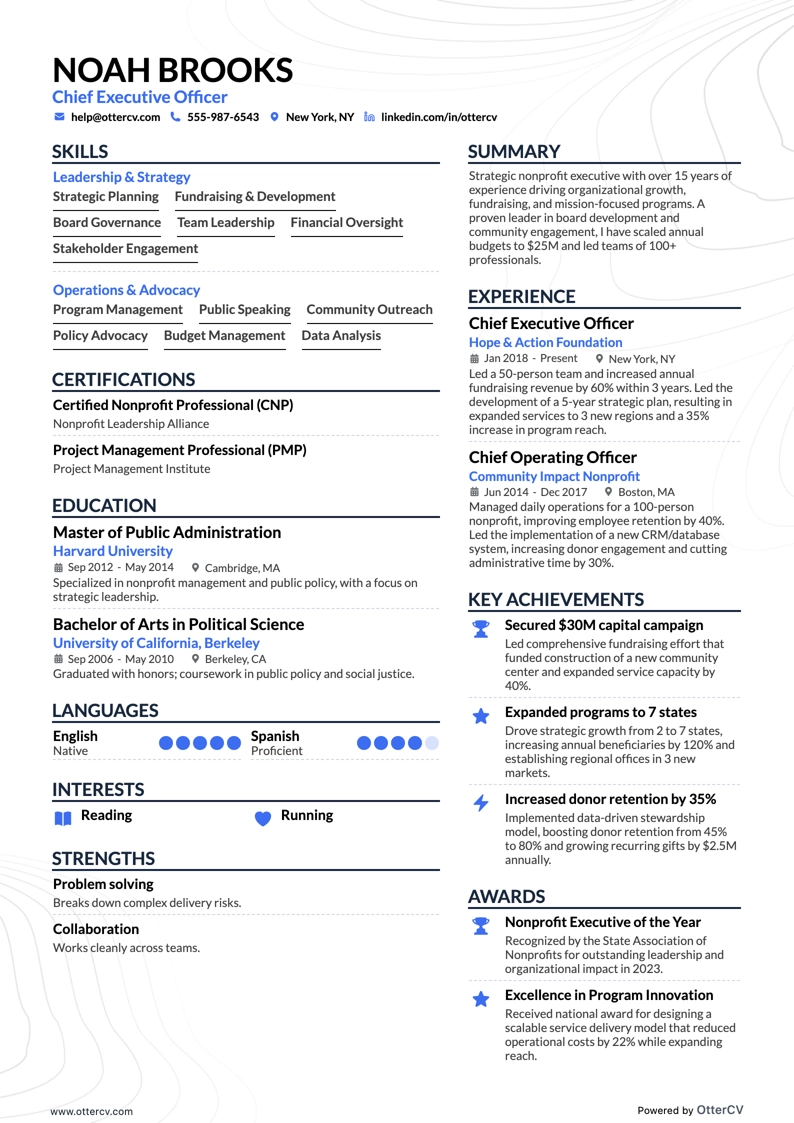
Nonprofit Chief Executive Officer resume example

Nonprofit Chief Executive Officer

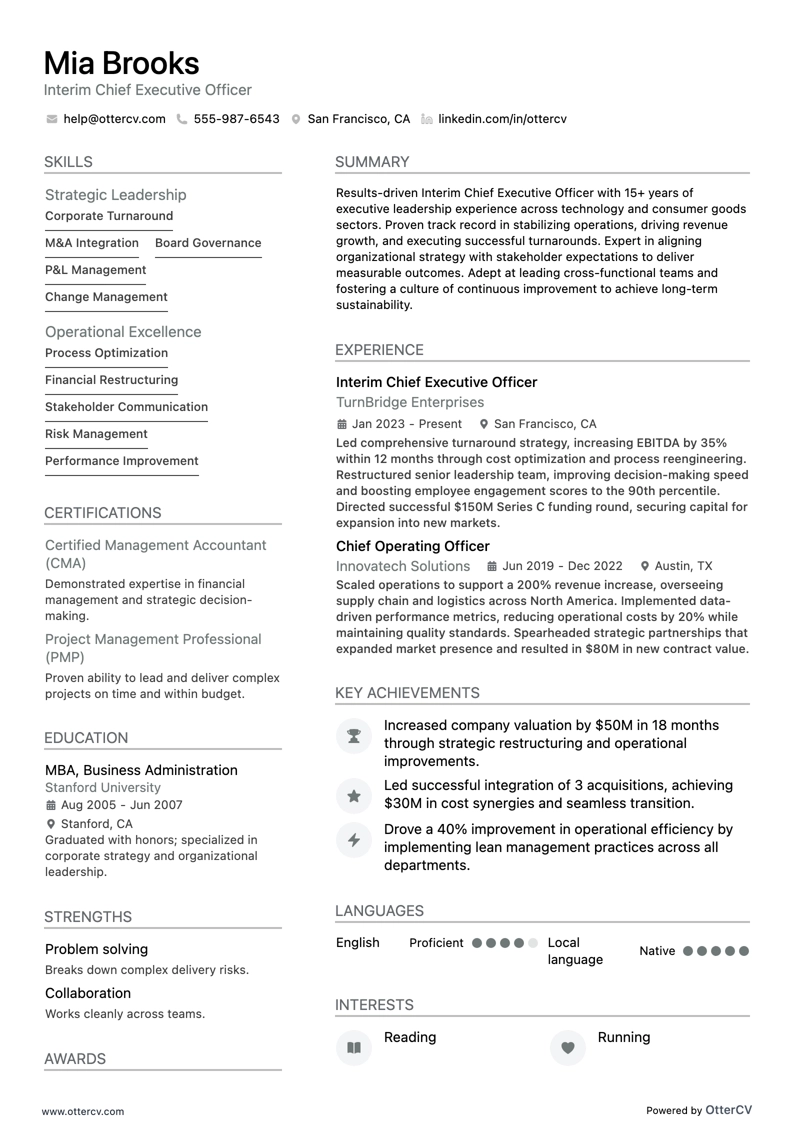
Interim Chief Executive Officer resume example

Interim Chief Executive Officer

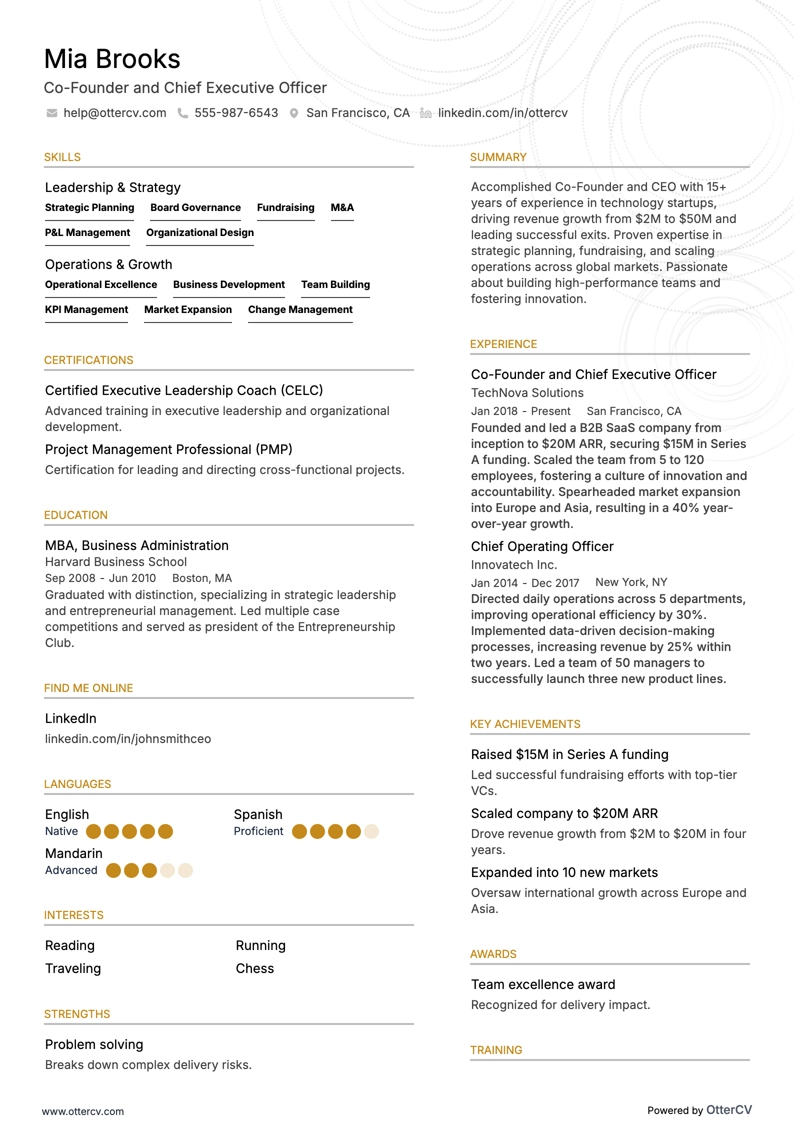
Co-Founder and Chief Executive Officer resume example

Co-Founder and Chief Executive Officer

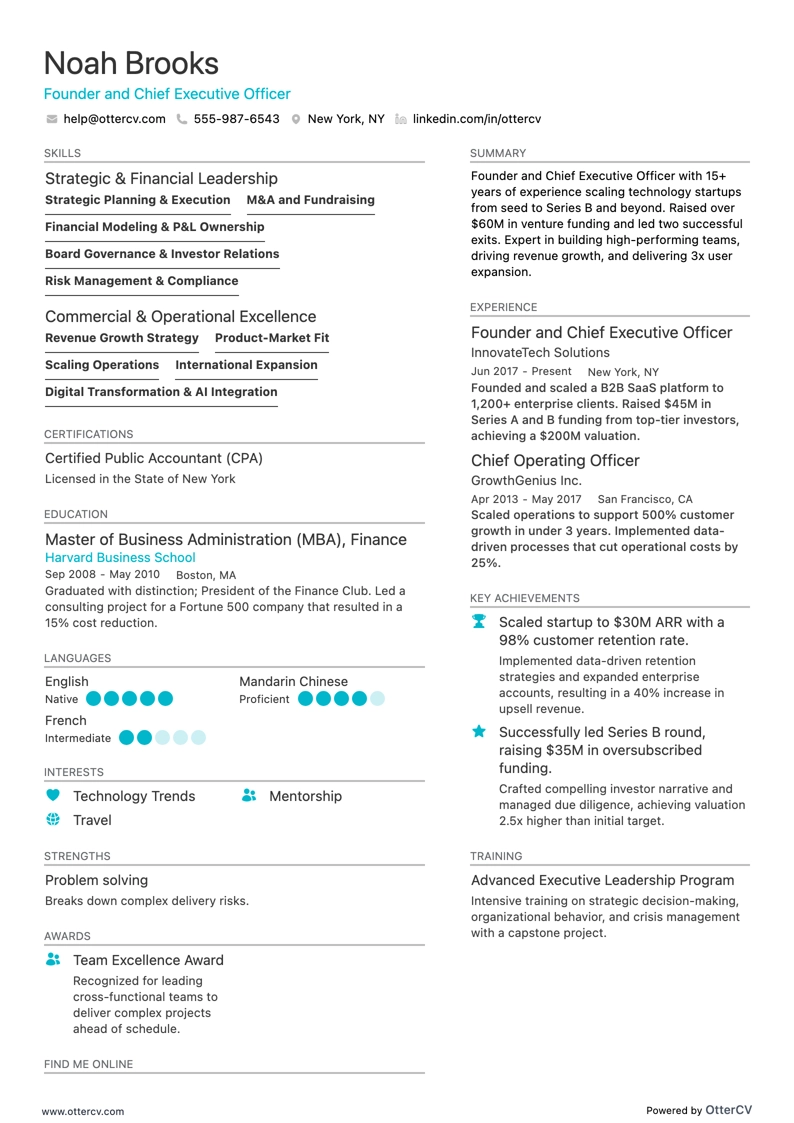
Founder and Chief Executive Officer resume example

Founder and Chief Executive Officer

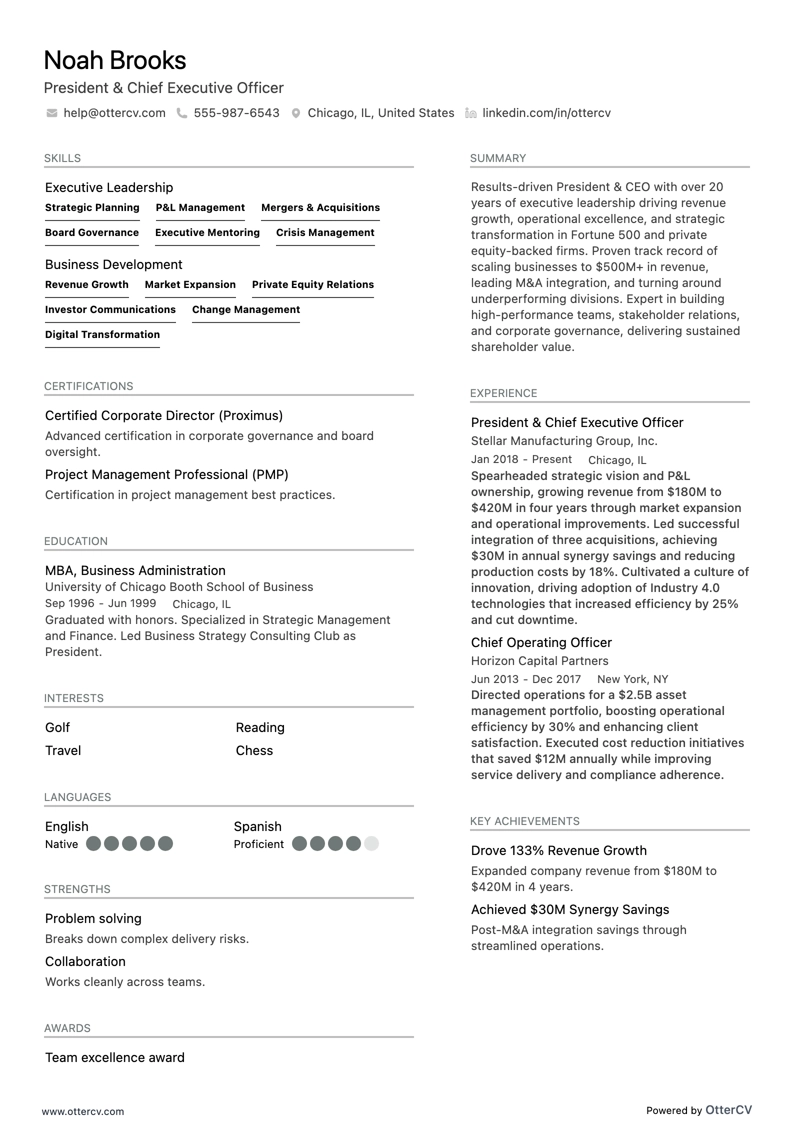
President and Chief Executive Officer resume example

President and Chief Executive Officer

Your next career milestone could be closer than you think. To become a chief executive officer, you need a CEO resume that makes a strong impression.

But how do you present major achievements in the right corporate tone without overcrowding your resume?

Our straightforward guide will help you:

  • Learn how to appeal to different companies based on their goals
  • Analyze strong CEO resume examples to guide your writing process
  • Build a powerful experience section the right way

Review these executive-level guides to find the one that best fits your needs:

CEO resume example

Startup Chief Executive Officer resume preview

Here’s what this resume does well:

  • Highlights "Mergers & Acquisitions" under Strengths: Given the executive focus on business transformation, showcasing expertise in M&A adds weight to strategic capabilities.
  • Emphasizes Harvard MBA in Education: For an executive role, a prestigious educational background can be a differentiator.
  • Features Global Expansion under Achievements: A 40% increase in global revenue is a standout accomplishment that aligns with the role’s focus on global strategy.
  • Quantifies achievements in Experience: Metrics like "increased retention rates by 35%" and "saved $20M in operational expenses" provide concrete proof of effectiveness and should be front and center.

How to format your CEO resume

What a CEO resume looks like depends on the applicant’s background and the company offering the position.

Because this is a C-level role, your candidacy will likely be reviewed by other executives and board members. To stand out, use a simple, streamlined design.

Here’s what you can do:

  • Use the reverse-chronological resume format: C-level professionals are busy, so a more traditional CEO resume template will usually be appreciated.
  • Choose a modern CEO resume design: A proven layout can still be customized. Use the company’s brand colors, but don’t overdo it.
  • Make the most of your resume header: Include your LinkedIn profile, as well as a link to a portfolio featuring your statements, media appearances, and business insights.
  • Show your career growth: Curate your experience section to demonstrate the range of your skills and emphasize your knowledge of the specific industry market.
  • Keep your resume under two pages: Executive resume formats may give you more room to highlight board memberships and side projects, but you should still be selective.
  • Save your CEO resume as a PDF file: As a C-level professional, you can’t risk sending a scrambled document. A PDF helps preserve your resume’s design and layout.

Remember, resume layouts can vary by country—for example, a Canadian resume format could look different.

PRO TIP

CEOs are the face of a company, so polish your LinkedIn profile before submitting your resume for evaluation.

Board members and investors often conduct a careful social media review to see whether a candidate’s views align with their own, especially on sensitive current issues such as international conflicts and trade wars.

The top sections on a CEO resume

  • Contact Information: Include your LinkedIn and any other professional profiles, such as GitHub, so employers can reach you.
  • Executive Summary: Use this section to highlight your leadership skills, achievements, and expertise with a compelling summary.
  • Professional Experience: Start each experience entry with measurable results, data, and statistics.
  • Board Memberships: This section shows your networking strength and how established you are within your business niche.
  • Skills and Competencies: Tailor your skills to the C-suite responsibilities and abilities listed in the job ad.

What recruiters want to see on your resume:

  • Strategic Vision: Show that you can set and execute long-term goals for the company.
  • Leadership Skills: Demonstrate the experience and expertise to lead teams and drive organizational change.
  • Financial Acumen: Highlight examples where you were responsible for significant revenue growth, strong budget management, and fiscal responsibility.
  • Stakeholder Relations: Show that you can manage relationships with the board of directors, investors, and partners.
  • Industry Expertise: Demonstrate that you stay current on trends, challenges, and competitors in your sector.

How to build an effective CEO resume experience section

Although your expertise and qualifications should appear throughout your resume, the experience section is by far the most important one.

It gives employers a condensed view of your work history and highlights the most relevant accomplishments. For that reason, many executives aiming for a C-suite role wonder how much experience to include on a CEO resume.

The short answer is: include as much as you can. The main caveat is that your selection should reflect how much research you’ve done on the company beforehand.

If you’re applying for a CEO role at your current company, you should already understand its culture, and the board of directors will expect that. In this case, focus on showing that you have a strong, high-level view of the business sector and the competitive landscape. It also helps to mention any connections to major industry players.

If you’re pursuing a CEO position at a different company, research where the business is headed and what its current goals are. Target your resume by choosing examples from your past experience that align with the employer’s interests.

To do this, review the company’s:

  • Website
  • Annual reports from the last few years
  • Media coverage
  • Posted job ad

This may seem like a lot of work, especially if you plan to present your CEO skills and services to several companies and need to repeat the process for each one.

However, there’s a good reason to do this research thoroughly: knowledge is power. A company’s financial position and strategy can reveal the type of candidate it is looking for.

For example, a well-established company may need someone with deep industry and technical knowledge. By contrast, a startup or a business facing recent financial difficulties may be looking for a candidate with strong business acumen and leadership experience who can guide the company through challenges and support future growth.

That’s also why you shouldn’t hesitate to include side projects that fall outside traditional employment, if they strengthen your case.

Regardless of the company you’re targeting, any executive resume should show clear career progression. Instead of listing past duties, focus on tangible examples with measurable outcomes:

  • Review the CEO job description and identify the core skills and experience required for the role.
  • Match those requirements with examples from your own work history.
  • Use the highlighted resume keywords to describe your experience.
  • Include between 5 and 6 bullets for the most relevant positions and 2 and 3 bullet points for other related roles.

Take a look at the sample CEO experience section below:
Ellis Serrano

President at Libros Ltd.

01/2018 - 11/2021 | CA

Company Description

  • Expanded the company's international market share.
  • Boosted YoY revenue for 2021.
  • Negotiated over 40 contracts for $2.6 billion.
WRONG

No experienced board member would read this entry and think, “Wow, we’ve struck gold here!”

Some of the most obvious problems are:

  • Missing company description: Executives do not have much spare time, so do not expect them to click through to the company website, even if it is listed for convenience.
  • Insufficient context: Each bullet starts with an action verb and includes some statistics, but there is still not enough context to understand the real impact of those achievements.
  • No reference to the industry: Without a company description, the reviewer has to rely on clues from the company name and the bullet points, but there are none.

Once those missing pieces are added, the entry becomes much more effective.

Ellis Serrano

President, Libros Ltd.
01/2018 - 11/2021
Mountain View, CA

The largest publisher of Eastern and Western philosophy, politics and scientific literature in the United States.

  • Expanded the company's international market share by 74% to 13% by introducing Libros Ltd. to the East Asian scientific community and publishing market.
  • Boosted 2021 year-over-year revenue by 25% by launching a special collector's edition featuring the top 50 philosophers of all time.
  • Negotiated more than 40 contracts worth $2.6 billion with universities across the US and Japan after organizing a fundraising event where 12 first editions were auctioned.
RIGHT

At this point, board members can see that Ellis is active not only in book publishing, but also in the related academic community.

If her prospective employer were looking for someone with deep knowledge of philosophy from a scientific perspective, she would be an excellent candidate.

However, if the role called for exceptional management ability, the emphasis of the examples would need to change.

Consider the following leadership experience resume example:

Ellis Serrano

Chief Executive Officer
Launchpad Inc.
03/2020 - 08/2022
Mountain View, CA

  • Overhauled existing business procedures and practices.
  • Raised funds in a Series B round.
  • Signed service contracts with the State of California.
WRONG

Again, this entry is not as strong as it could be. Beyond the lack of context in the bullet points, Ellis has:

  • Not linked to the company’s website: Not every start-up receives equal media coverage. If public information is limited, investors should not have to search for basic details.
  • Been vague about the Series B funding round: Fundraising details are often publicly available, so Ellis missed a chance to highlight her leadership in the process.
  • Been ambiguous about some of her actions: She may have wanted to showcase her management skills in the first bullet, but there is no explanation of why an overhaul was needed.

Here is a much better version of the above experience entry:

Ellis Serrano

Chief Executive Officer at Launchpad Inc.

03/2020 - 08/2022 · Mountain View, CA

An innovative drone shipping and delivery startup focused on making drone shipping accessible and cost-effective for small and medium businesses.

  • Overhauled business procedures and practices that no longer fit the company’s rapid growth, saving $1.9 in yearly costs.
  • Raised $46 million in Series B funding just 12 months after the company’s Series A round.
  • Signed 28+ service contracts totaling $43 million with 7 counties across California to deliver medication and food to house-bound single people during the pandemic.
RIGHT

How to quantify impact on your resume

The examples above show why measurable outcomes matter on a CEO resume. C-suite executives are expected to be results-oriented, so data and numbers are key here.

When choosing what to highlight, focus on experience that is easy to quantify and strengthens your resume, such as:

  • Fiscal responsibility and knowledge: Even though the financial side of running a company often falls to the CFO, you should still show your ability to avoid unnecessary risks and save money.
  • Growth and development: Highlight examples where your expertise led to considerable revenue growth or market expansion.
  • Attention to detail: While understanding the big picture is essential, details also matter. Show how you recognized and acted on opportunities when they appeared.
  • Scale and scope of your work: Mention how many people you managed or how many relevant projects you oversaw.
  • Industry involvement: Demonstrate your networking ability by listing important public appearances, such as product presentations and industry summits.
  • Key performance indicators tracking: Explain how your work influenced past employers. Show your goal-setting skills and your ability to run seamless business operations.

How to describe your hard and soft skills on your resume

Depending on the type of professional a company is looking for, your CEO resume skills section should include a mix of technical and social skills.

Technical abilities, or hard skills, reflect your industry-specific and field-specific knowledge.

If your business niche is highly technical, such as healthcare, a science-based background is a must.

Because this is a C-suite position, you also need a range of soft skills, including leadership and relationship building.

Show that you can communicate effectively with mid-management staff, partners, and board executives.

To describe your CEO skills properly on your resume:

  • Start each entry with an action verb.
  • Include a relevant achievement, supported by numbers and data.
  • Provide context to show the broader impact.

Whether you are describing your skills or your work experience, make sure you quantify your accomplishments.

Best hard skills for your CEO resume

  • Strategic planning.
  • Financial analysis.
  • Budget management.
  • Team leadership.
  • Project management.
  • Risk assessment.
  • Data analytics.
  • Mergers & acquisitions.
  • Supply chain management.
  • Corporate governance.
  • Stakeholder management.
  • Business development.
  • Change management.
  • Contract negotiation.
  • Market research.
  • Crisis management.
  • Performance metrics.
  • Revenue growth.
  • Investor relations.
  • Regulatory compliance.

Best soft skills for your CEO resume

  • Leadership demonstrates the ability to guide teams and set direction.
  • Communication shows you can convey ideas clearly across the organization.
  • Emotional Intelligence reflects strong self-awareness and relationship management.
  • Decision-Making highlights your ability to make sound executive choices.
  • Problem-Solving shows you can address complex business challenges.
  • Adaptability signals that you can respond effectively to change.
  • Negotiation supports successful partnerships, deals, and stakeholder alignment.
  • Conflict Resolution shows you can manage disputes constructively.
  • Time Management reflects your ability to prioritize competing demands.
  • Strategic Thinking shows you can align decisions with long-term goals.
  • Team Building highlights your ability to develop strong leadership teams.
  • Delegation demonstrates trust in others and efficient use of resources.
  • Resilience shows you can stay effective under pressure.
  • Empathy reflects an understanding of employee and stakeholder perspectives.
  • Accountability shows ownership of decisions and outcomes.
  • Innovation highlights a willingness to drive new ideas and growth.
  • Networking supports relationship-building across industries and markets.
  • Public Speaking shows confidence in representing the company.
  • Active Listening reflects the ability to understand concerns and opportunities.
  • Motivation shows you can inspire performance and engagement.

How to add your certifications and education to your resume

It’s true that not every CEO has a college degree. Still, some industries require at least a bachelor’s or master’s degree in the relevant field.

Either way, the education section helps reinforce your professional credentials and qualifications.

To make your academic background stand out:

  • List the name of your degree and the issuing institution.
  • State the location of your college or university.
  • Include the date you completed the course.
  • Add 1–2 relevant achievements, especially if you’ve applied your skills in practice.
  • Include relevant course projects, courses you’ve taken, or papers you’ve authored.
  • Mention if you were a member of a fraternity or sorority, or if you made the dean’s list.

You can also list your GPA if the job ad requires it, but it’s not necessary.

For instance:

Ellis Serrano

Stanford LEAD Online Business Program
Stanford University, Graduate School of Business
02/2020 - 04/2021
GPA: 3.9 / 4.0

  • Increased EBITDA for Pharma Dream Inc. by 35% in 2020 by taking business risks and effectively applying strategies learned through the course.
RIGHT

PRO TIP

Even if you don’t have a college degree, don’t list your high school diploma. Instead, mention any associate degree or upskilling course you’ve completed.

Ellis Serrano

Master of Business Administration

Stanford University

RIGHT

How to write your CEO resume summary or objective

Before you write your CEO elevator pitch, it helps to understand the two types of personal statements you can use.

The first is the resume objective. This is a short paragraph of no more than 100 words that highlights your top skills, 1 or 2 job-related achievements, and certificates.

The second is the resume summary. This is also a short statement, but it focuses on your strongest industry achievements and core professional skills.

Both work as a pitch to potential employers, but they differ in two key ways:

  • The identity of the applicant
  • The focus of the text

In general, a resume objective is used by college graduates and professionals changing careers. Its goal is to show how the candidate’s skills will benefit the company.

A resume summary, by contrast, is mainly used by established professionals. Its purpose is to highlight the applicant’s broad expertise and accomplishments.

So what does this mean for your CEO resume?

As a tenured expert, you would usually write a CEO resume summary. However, do not dismiss the objective too quickly.

Think about the role you are applying for. If the company wants a skilled leader and the position allows for a wide range of industry backgrounds, much like a career change, a resume objective may be the better choice.

If the role requires very specific technical expertise, it is better to write a CEO executive summary for your resume.

First, take a look at the resume objective below:

Summary

Resourceful, innovative, and dedicated Managing Director with many years of experience in the health industry, seeking to become Health Spring's next Chief Executive Officer. Specialized in M&As and corporate restructuring. MBA holder.

WRONG

The sample objective is too vague. Instead of highlighting key skills and accomplishments, the applicant relies on too many adjectives.

It also lacks verifiable details, including the candidate CEO’s exact years of experience.

More importantly, the objective feels self-centered and does not explain how the applicant can help the company achieve its goals.

After addressing these issues, a stronger version of the example would be:

Summary

Resourceful Managing Director with 9 years of experience in business administration, mergers and acquisitions, and corporate restructuring, seeking the Chief Executive Officer position at Health Spring Inc. Strengthened Strong and Fit Clinic's financial standing and increased revenue by 80% by optimizing existing business processes and introducing 6 new revenue streams. Achieved a 25% increase in market share at Pharma Dream by facilitating the acquisition of two of the company's suppliers. Adept at public speaking, partner relations, and negotiations. Certified Mergers & Acquisitions Professional (M&AP).

RIGHT

Take a look at another example:

Summary

Dedicated and innovative CEO with 2+ years of relevant experience, seeking to become Health Spring Inc.'s new Chief Executive Officer. Skilled in market research, product development, and strategic thinking.

WRONG

This candidate uses a resume summary to showcase extensive industry knowledge.

However, instead of emphasizing real expertise, the summary lists broad CEO skills without relevant examples.

Being more specific about your experience can make your resume summary much stronger.

Summary

Dedicated CEO with 15 years of experience in the healthcare, pharmaceuticals, and cosmetics industry, seeking to become Health Spring Inc.'s next Chief Executive Officer. Increased Pharma Dream's sales by 160% through market research and product development while reducing operating costs by 39% by optimizing the production line and bringing key operations in-house. Strategic and analytical leader focused on business growth and innovation.

RIGHT

Is there anything else you can add to your CEO resume to impress executives?

Of course.

Before adding extra sections, consider how much space you have left on your resume.

If you still have room, you can include additional resume sections such as:

  • Association memberships, such as ASAE, AMA, BNI, and similar organizations
  • Presentations or publications that highlight your industry insights, forecasts, and trends
  • Awards and prizes you’ve won over the years
  • Foreign languages, especially if the company is expanding its operations overseas

How to put a day in the life section on a resume

A strong way to show your fit with a company’s culture is to explain how you typically spend your workday.

You do not need to go into detail.

Simply list the 5 or 6 core activities that take up most of your day. This helps executives understand where your personal and professional priorities lie.

Here is how to do it:

Ellis Serrano

  • Client meetings and networking
  • Serving on the boards of X and Y company
  • Inspiring and mentoring everyone at ABC company
  • Building a future-proof business strategy for ABC company
  • Spending time with family and friends
RIGHT

Key takeaways

  • Research your target company before you start writing, and never send the same resume to different companies.

  • Refine your LinkedIn profile and any other professional profiles before linking them in the resume header.

  • Build a convincing resume summary by highlighting industry-specific accomplishments and skills.

  • Craft an experience section that reflects the requirements listed in the job description.

  • Always quantify your achievements and provide context to make them more impactful.

  • Tailor your skills section to match the type of candidate the company is looking for.

  • Reference relevant academic publications or papers you’ve authored in the education section.

Chief Executive Officer resume examples

Explore additional Chief Executive Officer resume samples and guides and see what works for your level of experience or role.

By Role

Startup Chief Executive Officer

Startup Chief Executive Officer resume preview

Hospital Chief Executive Officer

Hospital Chief Executive Officer resume preview

Nonprofit Chief Executive Officer

Nonprofit Chief Executive Officer resume preview

Interim Chief Executive Officer

Interim Chief Executive Officer resume preview

Co-Founder and Chief Executive Officer

Co-Founder and Chief Executive Officer resume preview

Founder and Chief Executive Officer

Founder and Chief Executive Officer resume preview

President and Chief Executive Officer

President and Chief Executive Officer resume preview