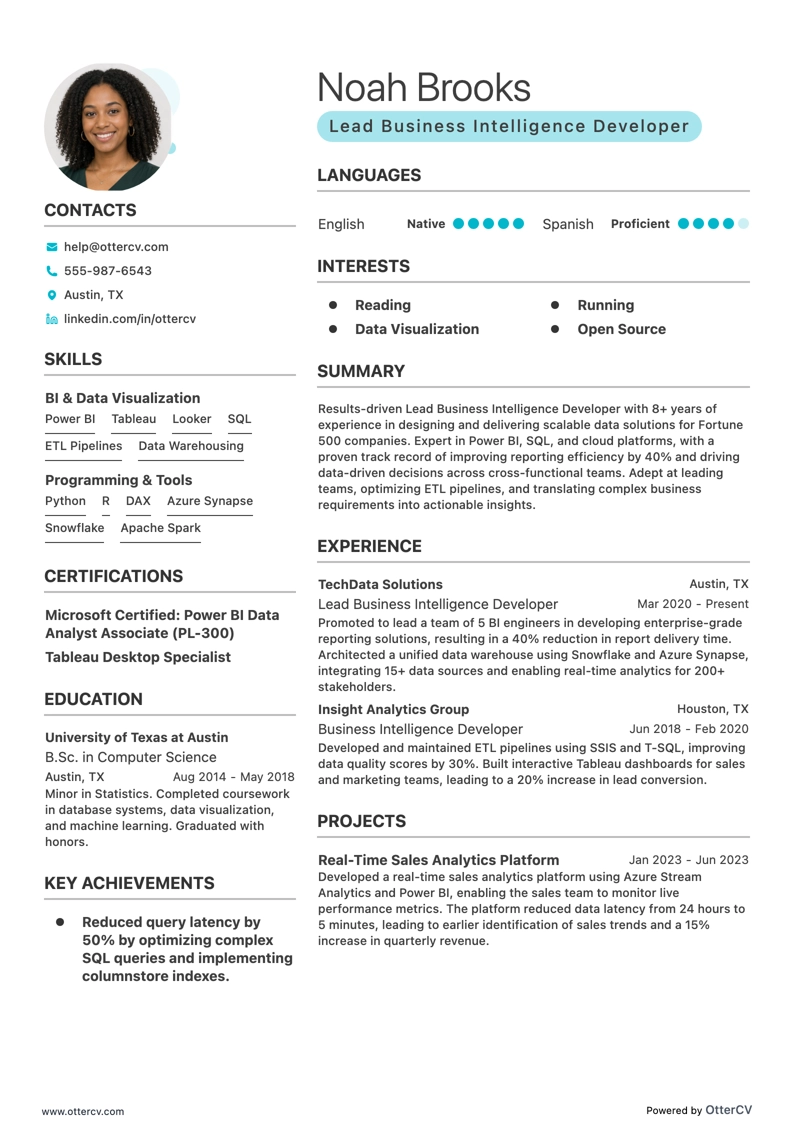
Lead Business Intelligence Developer full preview

20 Business Intelligence Resume Examples

OtterCV

Written by The OtterCV Team

Updated: 12/21/2025•8 min read

See all resume examples in this guide, or generate your own resume example with your personalized prompt

Lead Business Intelligence Developer resume example

Lead Business Intelligence Developer

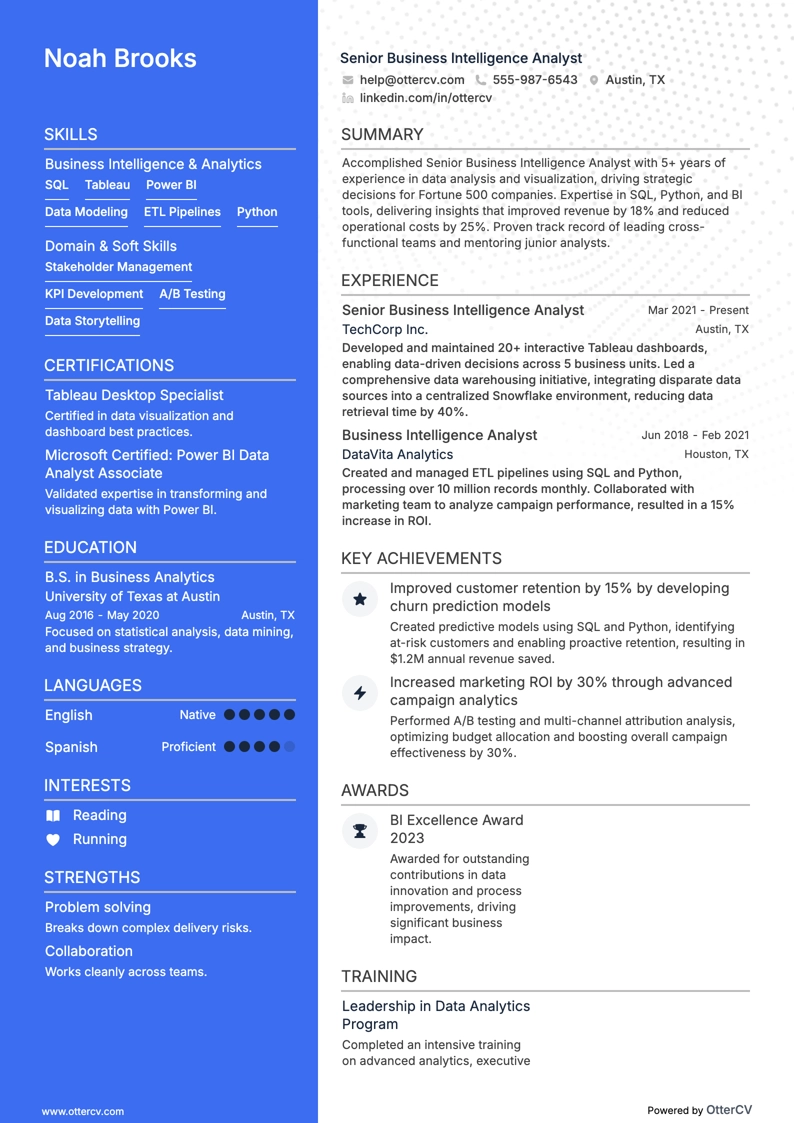
Senior Business Intelligence Analyst resume example

Senior Business Intelligence Analyst

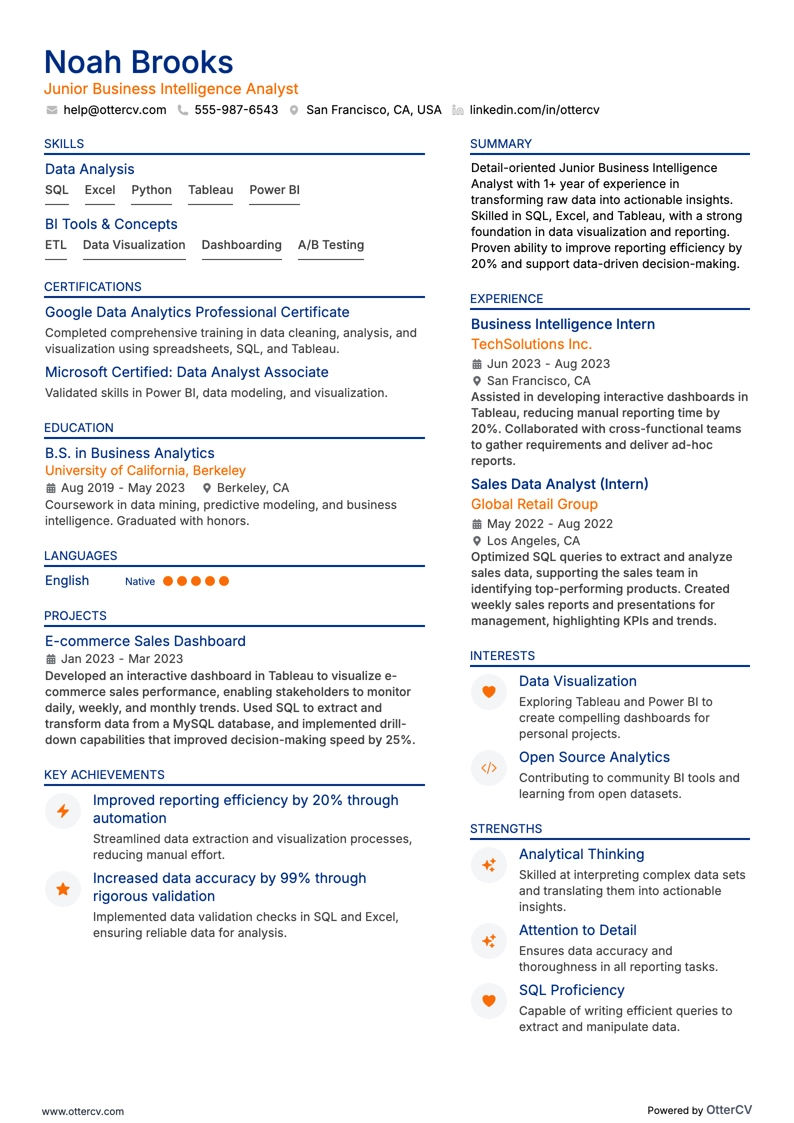
Junior Business Intelligence Analyst resume example

Junior Business Intelligence Analyst

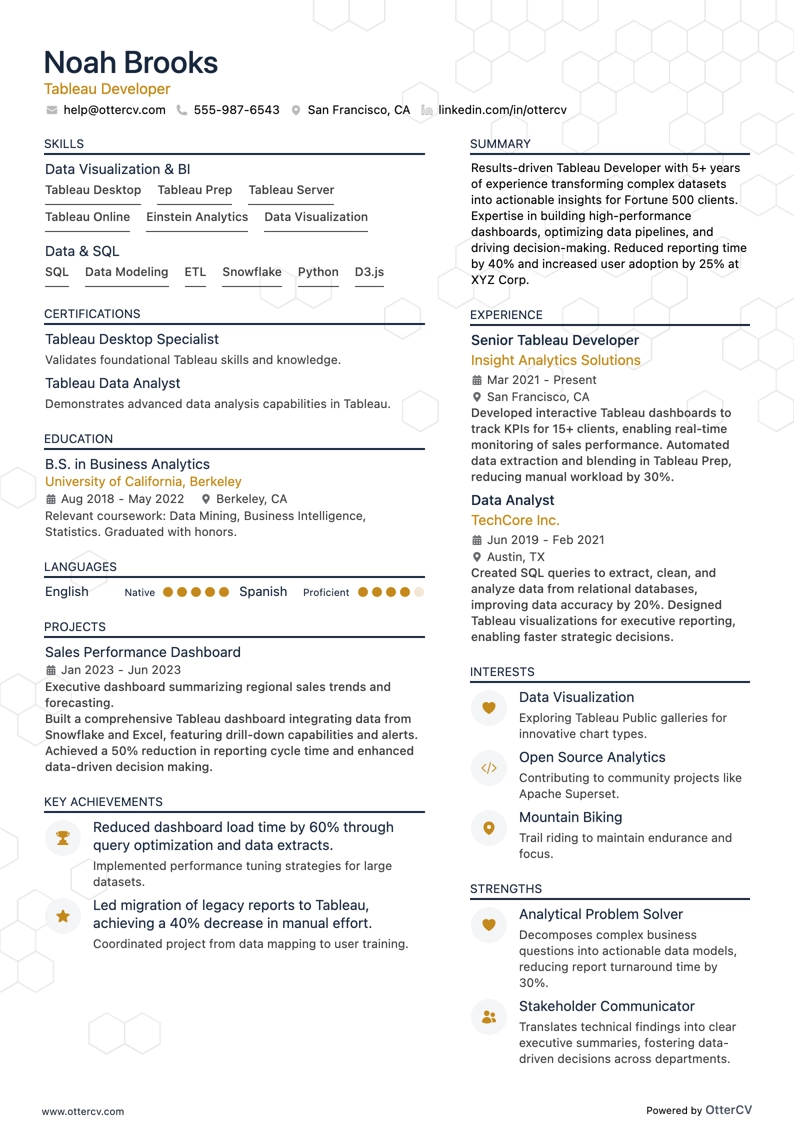
Tableau Developer resume example

Tableau Developer

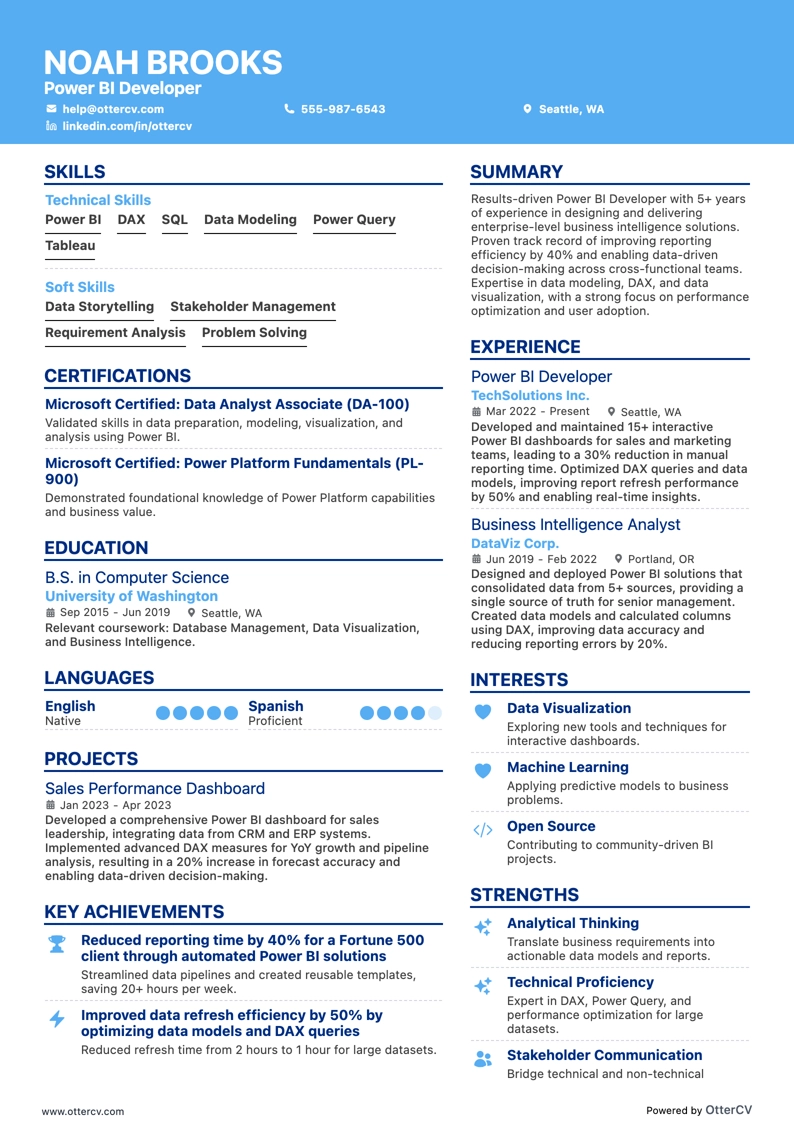
Power BI Developer resume example

Power BI Developer

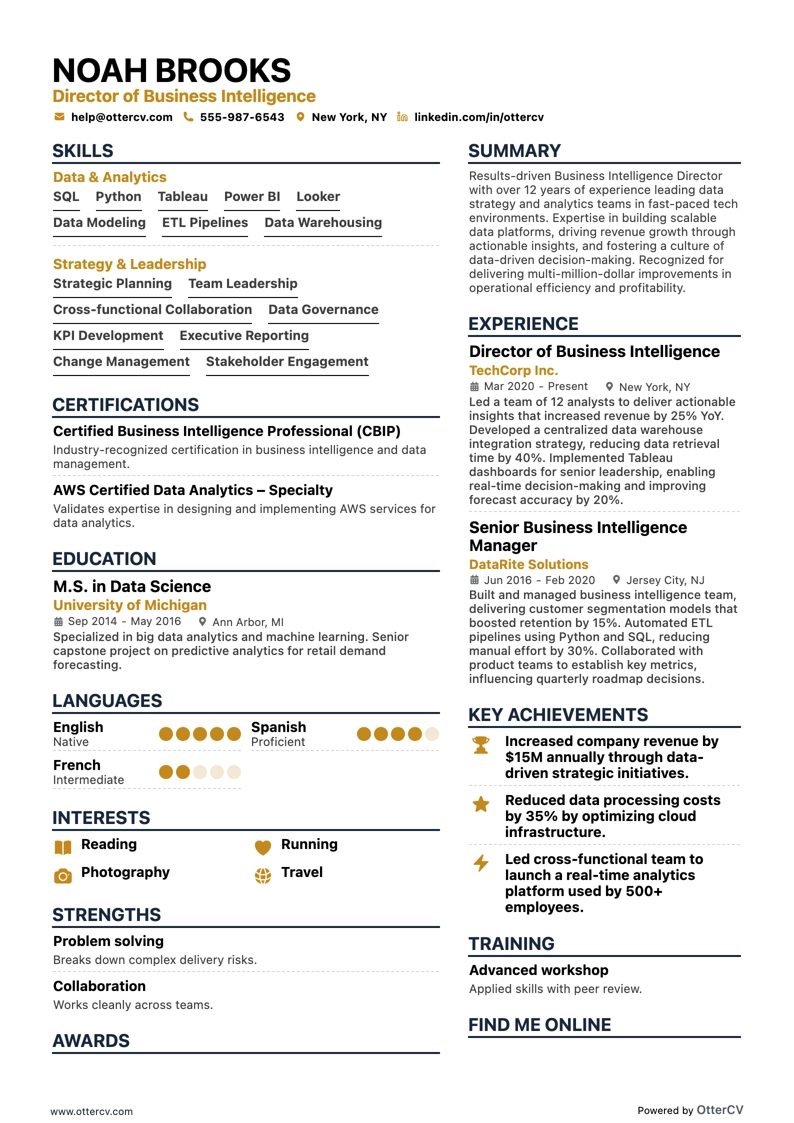
Director of Business Intelligence resume example

Director of Business Intelligence

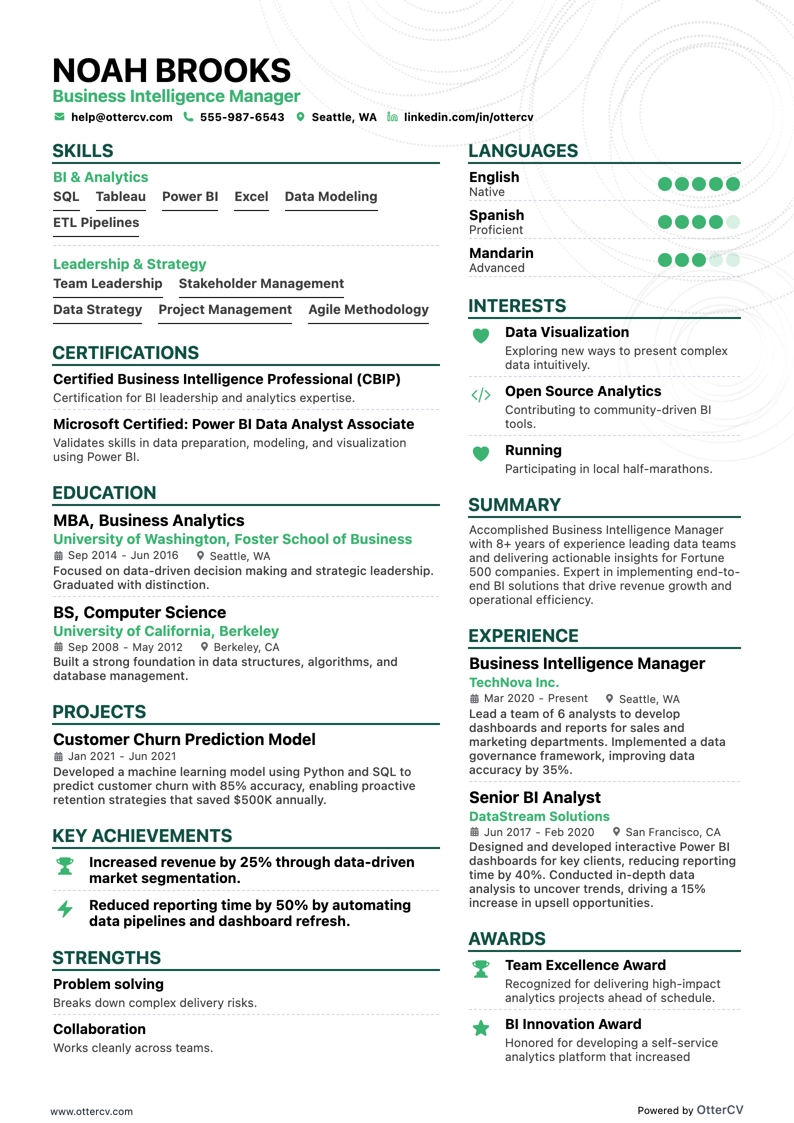
Business Intelligence Manager resume example

Business Intelligence Manager

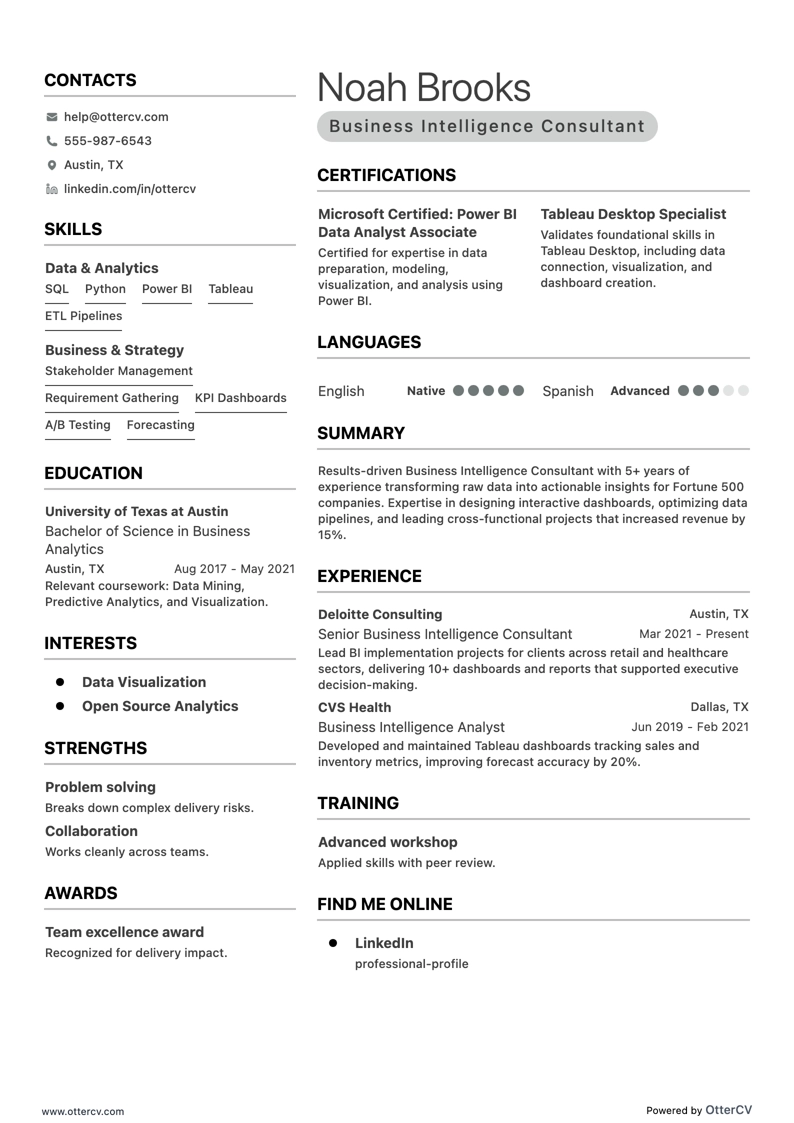
Business Intelligence Consultant resume example

Business Intelligence Consultant

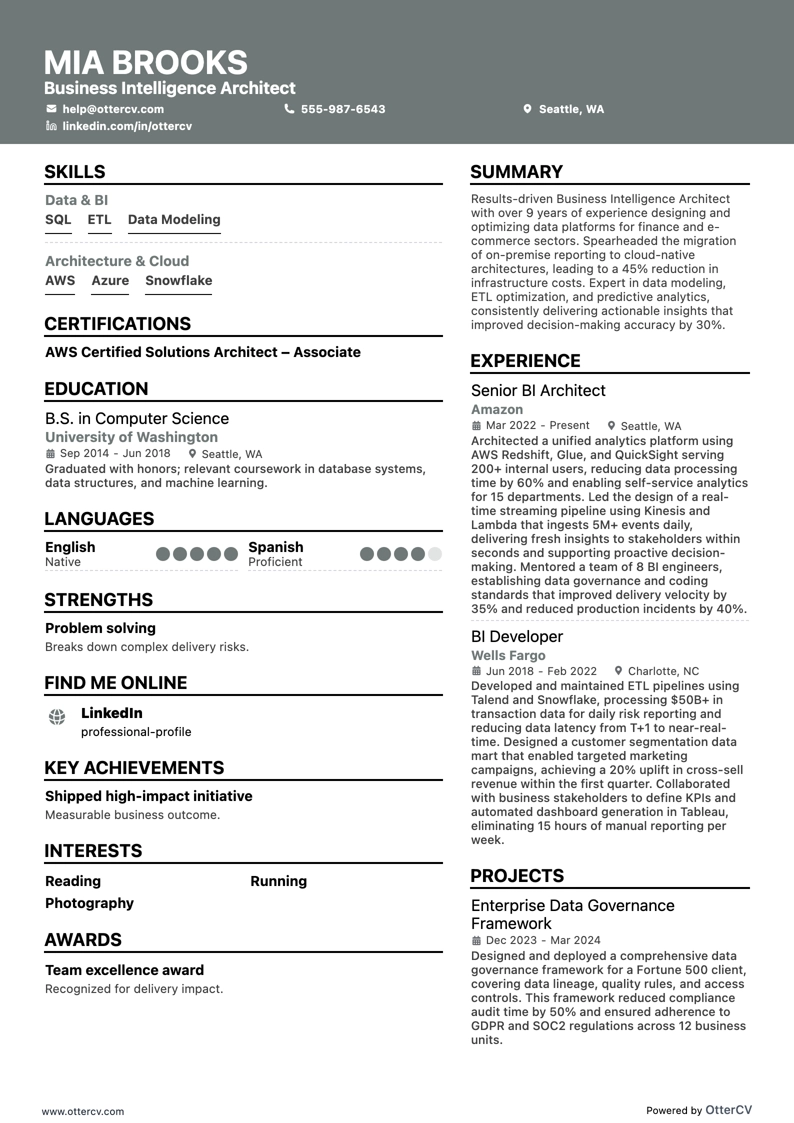
Business Intelligence Architect resume example

Business Intelligence Architect

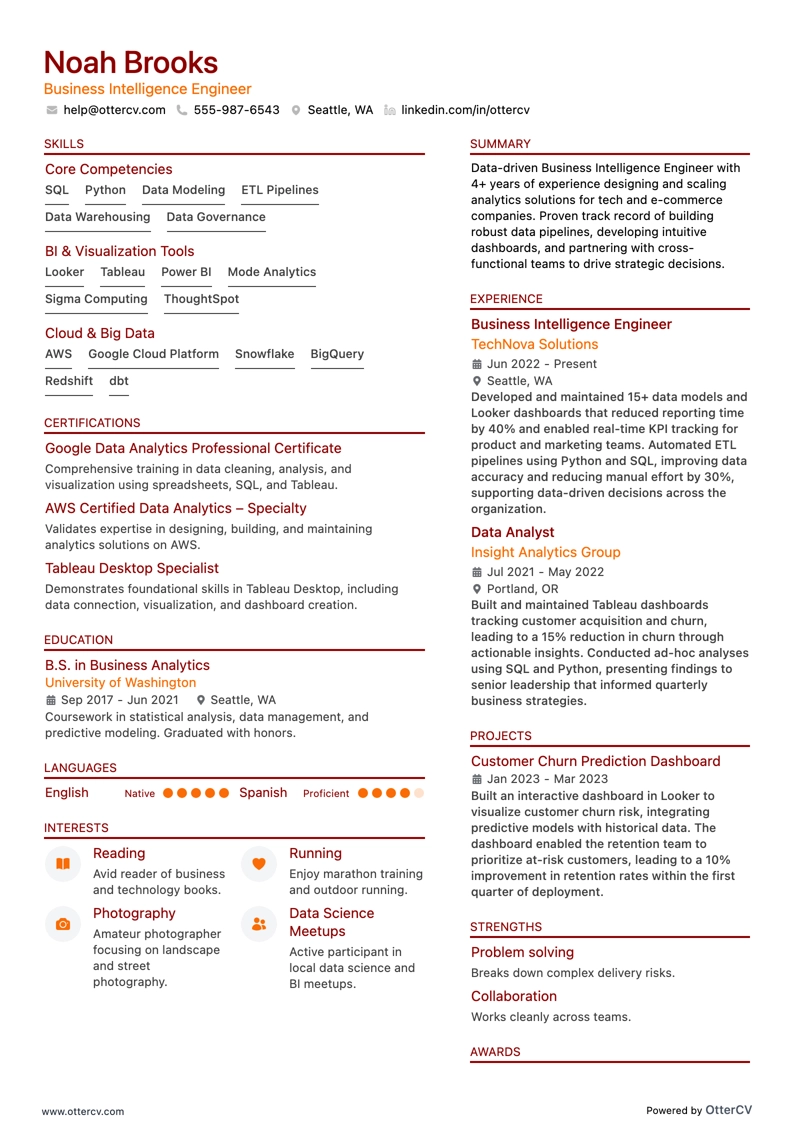
Business Intelligence Engineer resume example

Business Intelligence Engineer

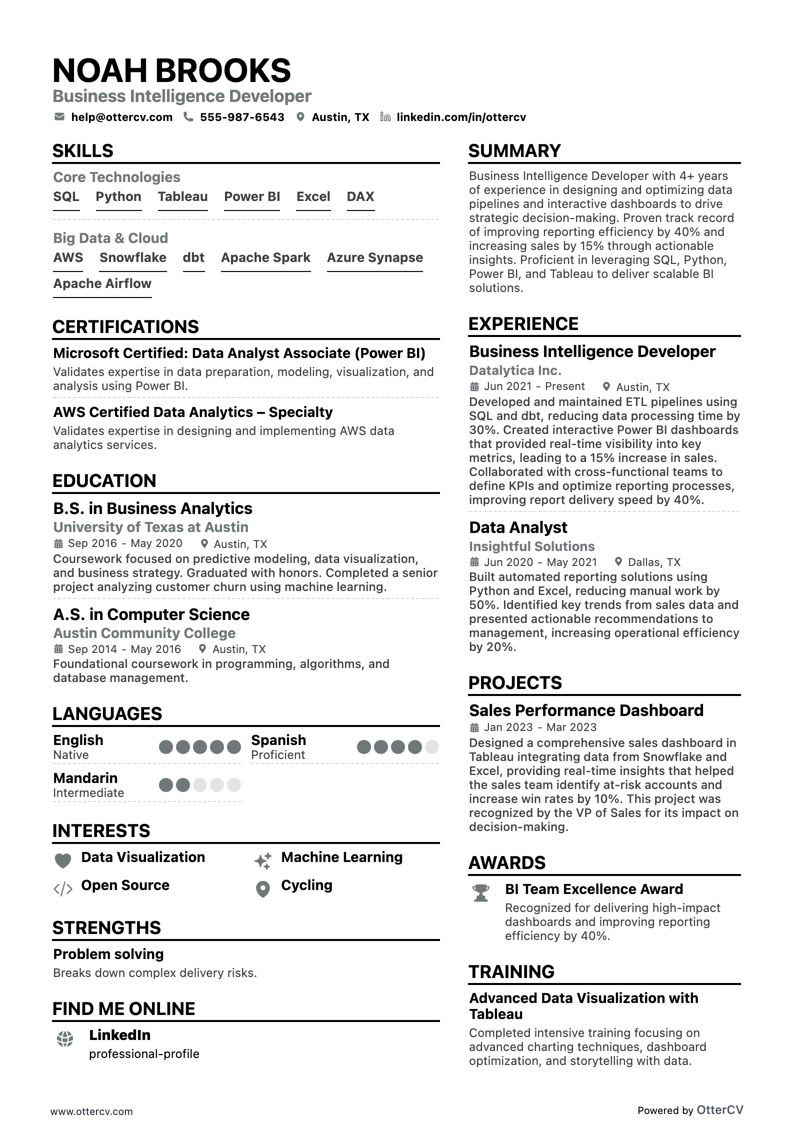
Business Intelligence Developer resume example

Business Intelligence Developer

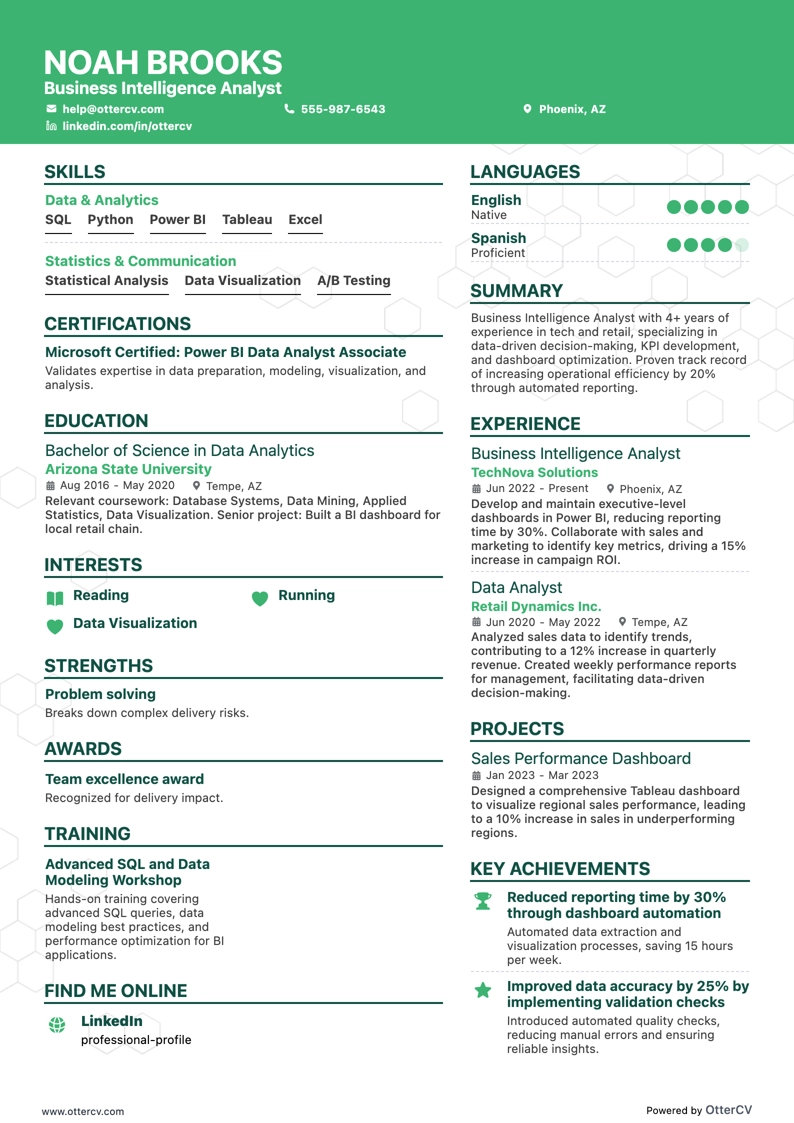
Business Intelligence Analyst resume example

Business Intelligence Analyst

Today’s business environment demands a combination of strong expertise and robust analytical tools. As a BI specialist, you can turn meaningful data into strategic decisions. With deep knowledge of the business, you may sometimes understand its operations even better than the owners themselves.

As data grows more complex, businesses are increasing their demand for tailored BI solutions. As RIB Software notes, “Businesses are no longer wondering if visualizations improve analyses but what the best way to tell each data story is, especially with the help of modern BI dashboard software.”

This shift highlights the essential role BI specialists play in shaping the future of data-driven decision-making. Learn how to create an outstanding business intelligence resume with our comprehensive guide.

Key takeaways

  • Show your strengths and accomplishments with a clear resume template, legible fonts, and subtle colors.

  • Use a reverse-chronological format to present your business intelligence career progression.

  • Emphasize your experience with quantifiable achievements and tangible outcomes to catch hiring managers’ attention.

  • Add a dedicated business intelligence skills section for your target niche, and weave interpersonal skills throughout the resume.

  • A relevant background in business analytics, IT, or a related field is highly valued for BI roles.

Business intelligence resume sample

Let’s look at a specific resume sample to see how this works in practice.

Review Layla’s resume for ideas on how to structure your own. You can copy the format and replace the text with your information using the Echocv resume builder.

Layla Jones

Business Intelligence Analyst
layla.jones@bi-analyst.com | @LinkedIn | New York, NY

Summary

Accomplished Business Intelligence Analyst with over five years of experience using data to drive business solutions across finance and retail. Skilled in developing BI solutions, improving data-driven decision-making, and communicating complex findings to support strategic planning. Recognized for improving operational efficiency through streamlined processes and strong data analysis frameworks.

Experience

Business Intelligence Analyst
Goldman Sachs, New York, NY
June 2019 – Present

  • Led the development and management of business intelligence solutions that increased the efficiency of financial reporting processes by 30%.
  • Analyzed business requirements and communicated actionable insights to management, contributing to a 20% increase in operational efficiency.
  • Collaborated with IT and management to support seamless data integration and align reporting with strategic objectives.

Business Intelligence Specialist
Macy’s, New York, NY
May 2015 - June 2019

  • Designed and delivered reports and dashboards that strengthened retail decision-making and improved sales performance analytics.
  • Contributed to a team that developed a new data collection strategy, improving the accuracy of consumer behavior forecasting.
  • Created and maintained documentation for user training and system maintenance, reducing error rates by 25%.

Education

Master of Science in Business Analytics
New York University
Graduated: 2015

Bachelor of Science in Computer Science
Columbia University
Graduated: 2013

Certifications

  • Certified Business Intelligence Professional (CBIP)
  • Microsoft Certified: Data Analyst Associate

Skills

  • Data analysis and visualization tools (Power BI, Tableau)
  • SQL and database management
  • Project management
  • Statistical analysis (R, Python)
  • Process improvement techniques

Languages

  • English (Native)
  • Spanish (Professional Proficiency)
How to format a business intelligence resume

Now that you've seen a sample, let's look at how to format your own resume for maximum impact.

Business intelligence specialists know how important clear, visually appealing presentation is. When formatting your resume, choose a template that aligns with your goals and qualifications. Also consider the market you're applying to. For example, a Canadian resume may follow a different layout.

Whether you choose a simple, traditional, or modern format, begin by outlining the main sections on a resume.

The layout of a resume can vary by region, and Canadian resumes may use a distinct format.

Section 6

  • Professional summary
  • Work experience
  • Education and certifications
  • Technical skills
  • Projects and accomplishments

We’ll break down each section below.

Resume format

The right resume format shows your analytical mindset and ability to present key information effectively. Choose a clear, organized template that highlights your data analysis and reporting skills. Hiring managers value a well-structured layout that aligns with industry standards.

Opt for the classic reverse-chronological format. It is widely recognized and gives a comprehensive view of your professional journey while emphasizing dedication and consistency in driving results.

Resume designs

Use your data visualization skills to create a thoughtful resume design.

Contact information

The header on top of your resume should include essential contact information, such as your name, job title, and email address. Photos are generally not required for positions in BI.

Always include your LinkedIn profile to show potential employers that you’re well-connected and that your ideas reach a wide audience.

You can also highlight your achievements with a professional portfolio. Add a QR code or a simple link to it in your header.

File formatting

Use a PDF to keep all your resume elements in place. A clear naming convention, such as John_Green_BusinessIntelligenceSpecialist, will save recruiters precious time.

PRO TIP

Applicant Tracking Systems often cause unnecessary fear. Contrary to popular belief, our tests showed that fonts, colors, columns, and resume length do not affect parsing.

Instead, focus on matching the language in the job description and on formatting details like dates and bullet symbols, as those may affect your application.

However, not all companies use ATS, so avoid keyword stuffing and keep your resume clear and readable.

Moving from the broad structure, focus next on presenting your professional experience clearly and persuasively.

How to write your business intelligence resume experience

As a business intelligence specialist, you connect large volumes of business data with industry-specific insight. In practice, you turn data into meaningful conclusions. Apply that same approach to your work experience section by highlighting achievements with specific examples that capture recruiters’ attention.

You’re not expected to be as deeply knowledgeable as a CFO with 20 years of experience in a highly specific industry. But you do need to know how to ask the right questions and drink from the firehose so you can quickly understand not just what users want you to build, but more importantly why they need it and how they’ll use it to run the business.

—— Olivier Travers, on Business Intelligence job profiles

Let’s look at a real job posting. The highlighted parts are targeted in the experience section below.

Business Analyst

Business Analyst

The Business Analyst role supports processes critical to the day-to-day operations of J&J Vision Canada. Core responsibilities include managing tailored pricing programs, calculating and deploying field sales quotas, preparing quarterly commission calculations, and maintaining sales tools used by the field sales and management teams. The role also requires strong root cause analysis skills to deliver insights by brand, channel, region, and customer that help drive business strategy. In addition, this individual will take a leadership role in developing Customer Relationship Management (CRM) and Marketing Automation capabilities for J&J Vision to help tailor marketing messages to each patient throughout the sales cycle.

Key responsibilities

  • Maintain key reports and processes that inform decisions on strategy, investment, customer-facing programs, sales targets, and compensation.
  • Prepare and analyze weekly and monthly reporting on business sales results by brand, channel, region, and other dimensions, identifying key trends, insights, and opportunities.
  • Prepare and analyze quarterly and annual reporting on market data, including Market Share data and rebate redemption, to surface key insights.
  • Manage the key customer discount program by tracking quarterly, by-customer target achievement and assigning appropriate pricing for the following quarter; also oversee the annual deployment, tracking, and archiving of customer contracts through DocuSign, along with monthly and quarterly email statements to program participants.
  • Deploy quarterly national and by-customer growth targets to the territory level.
  • Complete quarterly Field Sales and Key Account Manager commission calculations.

Collaboration

  • Support the Sales and Management team with ad hoc reports and analysis.
  • Collaborate with the Strategic Accounts team to review sales trends and the impact of account initiatives on sales.
  • Collaborate with Finance on business results and forecasting requirements.

Qualifications

  • Bachelor’s degree in finance, accounting, business, mathematics, or statistics.
  • A minimum of three years of professional analytical experience, including problem identification, data gathering, analysis, solution development, and implementation.
  • Strong data management and analytical skills, with the ability to communicate complex issues and solutions.
  • In-depth knowledge of report creation and maintenance in Tableau.
  • Track record of creating and implementing key process improvements.
  • Ability and experience conducting formal and ad hoc presentations to cross-functional partners.
  • Ability to cultivate new insights, challenge the status quo, and see possibilities.
  • Strong written and verbal communication skills across all levels.

Tailoring your resume to the job posting

A foolproof resume strategy is to tailor it to the job you’re applying for. Use keywords from the job description so recruiters can quickly see that you match the profile they need.

BI specialists are sometimes tempted to list every job they’ve ever held. While each role may offer value, that approach can make a resume too long and leave it feeling unfocused.

Now let’s put that into practice with this example experience entry:

Professional Experience

Business Analyst

J&J Vision Canada

01/2019 - 09/2022 | Toronto, ON

  • Developed and managed tailored pricing programs, achieving a 15% increase in sales quota fulfillment through optimized sales strategies and commission structures.
  • Led quarterly and annual sales commission calculations and maintained CRM and marketing automation tools, resulting in a 20% increase in marketing campaign efficiency.
  • Analyzed and reported business sales results, identifying key trends and insights by brand, channel, and region that led to a 10% increase in strategic decision accuracy.
  • Managed a customer discount program, increasing customer retention by 25% through effective quarterly pricing adjustments and contract management.
  • Collaborated with Strategic Accounts and Finance teams to evaluate sales trends and forecast business results, contributing to a 30% improvement in financial planning accuracy.
  • Implemented key process improvements in data management and analytics using Tableau, enhancing report creation and maintenance while reducing reporting errors by 40%.
RIGHT

Here’s what makes it effective:

  • Each bullet point directly addresses responsibilities listed in the job description.
  • Using percentages in the bullet points highlights measurable impact.
  • The bullets emphasize specific skills such as data analysis, strategic planning, and process improvement, which are essential for a business analyst role.

Once your experience is outlined, it’s important to quantify these accomplishments so your impact is clear.

How to quantify your experience on resume

Quantifying achievements on your resume as a BI specialist is important because it gives potential employers concrete evidence of your impact and value. By including specific metrics or results from your initiatives, you show how your analytical skills contributed directly to business success.

Here are some ideas:

Demonstrate measurable data impact

  • Describe how you identified, developed, and tracked KPIs that contributed to business growth.
  • Explain how much raw data you transformed into clear, easy-to-understand formats that supported decision-making.
  • Share examples of correcting flawed data points that significantly improved data quality.
  • Include strategies or analyses that produced a tangible return on investment.
  • Highlight your experience creating or optimizing data models that improved data consistency and efficiency.

How do i write a business intelligence resume with no experience

If your experience is limited, you can still create an appealing resume.

When building a BI resume without direct experience, consider using a hybrid resume format that highlights both your skills and educational background.

Here’s how to approach it:

  • Start with a strong objective statement that explains your goals and shows why you are relevant to the role.
  • Add a detailed skills section that includes both technical proficiencies, such as SQL and Excel, and the soft skills needed for data analysis.
  • Include relevant coursework, certifications, and projects that show your ability to use BI tools and methodologies. Describe projects with clear outcomes to demonstrate practical experience.
  • Highlight academic or volunteer experiences where you used analytical skills, even if they were not directly tied to BI.
  • Present everything in a modern resume template to suggest fresh ideas and insight.

PRO TIP

To prepare for both the interview process and the job itself, review video case studies of Adaptive Insights and Anaplan, as one Reddit user suggests.

These examples show how BI is used to solve business problems, as well as support planning and forecasting.

Take a look at this well-written BI resume objective:

Objective

Eager and analytical recent graduate with a Master's in Data Science, seeking to apply a strong academic background in data manipulation and a solid understanding of business intelligence concepts to deliver high-impact BI reports. Skilled in Microsoft Power BI and data modeling, with a strong drive to embrace new technologies and collaborate effectively with diverse teams. Committed to helping decision-makers turn complex data into actionable insights while maintaining professionalism and clear communication.

RIGHT

A strong example emphasizes the candidate’s relevant Master’s degree and specialized skills in Microsoft Power BI and data modeling. It also shows a proactive willingness to learn and adapt, which aligns with company values such as creativity and enthusiasm.

Beyond experience, employers also look closely at the hard and soft skills a candidate brings.

Business intelligence skills on your resume

When writing your skills section, don’t aim for a perfect list. Instead, think strategically about which skills best match the job you want and build your skill set with intention.

Technical proficiency in leading BI programs is the foundation of business intelligence. These tools help you build queries, extract data, and communicate findings across a large team. Combined with industry knowledge and critical thinking, these skills position you to interpret and understand data effectively.

BI is a varied and expansive field, with many different areas to focus on or specialize in. This variety offers substantial career flexibility without requiring a complete shift in your expertise or skill set.

—Sandra Durcevic, Data Pipe

Highlight your technical skills to strengthen your application. Here are some of the most common ones:

Best hard skills for your business intelligence resume

  • Power BI is a core business intelligence tool.
  • Tableau is widely used for data visualization and reporting.
  • QlikView is a valuable business intelligence platform.
  • Microsoft Excel remains an essential analytics skill.
  • Google Analytics supports data tracking and performance analysis.
  • SAS business intelligence is useful for enterprise analytics.
  • Oracle business intelligence is relevant for reporting and data insights.
  • ThoughtSpot is a modern analytics and search-driven BI tool.
  • Looker is a strong option for business intelligence and data exploration.
  • SAP BusinessObjects is commonly used for enterprise reporting.
  • IBM Cognos Analytics is an established business intelligence solution.
  • Microsoft SQL Server is important for managing and querying data.
  • MySQL is a widely used relational database skill.
  • Oracle Database is valuable for enterprise data management.
  • R Programming is useful for statistical analysis and modeling.
  • Python is a key skill for data analysis and automation.
  • Apache Hadoop supports large-scale data processing.
  • Apache Spark is important for fast data processing and analytics.
  • Predictive Modeling helps forecast trends and business outcomes.
  • Alteryx is helpful for data preparation and analytics workflows.
  • DAX is essential for advanced calculations in BI reporting.

People skills are just as important on your BI resume. No matter how strong you are with data, what matters most is your ability to communicate it clearly and comprehensively.

Consider including these soft skills on your resume:

Best soft skills for your business intelligence resume

  • Analytical thinking helps you interpret data and draw useful conclusions.
  • Problem-solving shows you can turn insights into practical solutions.
  • Attention to detail supports accurate reporting and analysis.
  • Communication skills help you explain findings clearly to stakeholders.
  • Curiosity shows a willingness to explore trends, patterns, and business questions.
  • Creativity helps you find new ways to present and interpret information.
  • Project management shows you can organize analytics work and meet objectives.
  • Decision making reflects your ability to act on data-driven insights.
  • Adaptability helps you respond to changing tools, priorities, and business needs.
  • Teamwork shows you can collaborate across departments and functions.
  • Presentation skills help you share insights in a clear and engaging way.
  • Critical thinking supports deeper analysis and better judgment.
  • Time management helps you handle deadlines and multiple priorities.
  • Leadership shows you can guide initiatives and support team success.
  • Ethical judgment reflects responsible handling of data and decisions.
  • Relationship building helps you earn trust and work effectively with others.
  • Consulting skills show you can advise teams based on business insights.
  • Continuous learning reflects your commitment to improving tools and knowledge.
  • Strategic thought process helps connect analytics work to larger business goals.
  • Task prioritization shows you can focus on the most important work first.

Having discussed skills, let’s look at the education and certifications that can further strengthen your qualifications.

How to list your certifications and education on your resume

For a BI specialist, a strong educational background matters. It reflects depth of knowledge, consistency, and discipline.

Degrees that can strengthen your BI application include:

  • Computer science
  • Data science
  • Business administration with a focus on information systems
  • Statistics
  • Information technology

A well-structured education section should include:

Certifications on a BI resume

If your degree is in another field, there are still plenty of ways to build the qualifications needed for a BI specialist role. Additional training and relevant certifications can help.

Here are our top picks:

Education

Bachelor of Science in Mathematics

University of British Columbia

02/2014 - 11/2018 | Vancouver, BC, Canada

  • Focused on coursework including Advanced Statistical Theory, Business Analysis, and Financial Mathematics.
  • Awarded the Dean's Honor List for three consecutive years for outstanding academic performance.
  • Completed a capstone project on 'Predictive Analytics for Market Trends,' aligned with real-time data analysis and strategic decision-making needs.

Certified Business Intelligence Professional (CBIP)

Data Management Association International (DAMA)

02/2020 - 11/2020 | Remote

  • Developed strong expertise in business intelligence frameworks, data warehousing, and analytics strategies.
  • Certified knowledge in transforming business needs into analytics models and actionable insights.
RIGHT

This education section is well structured and clearly highlights key details, including the degree, institution, and notable academic achievements. It also features relevant coursework and a capstone project, which help demonstrate the candidate's practical experience and subject expertise.

You might wonder whether an MBA is worth it. It can strengthen a resume, but it is not really necessary for most BI roles. It may be worth considering if you are aiming for more senior or VP positions, while technical execution matters more at the individual contributor level.

How to write your business intelligence resume summary

With your educational credentials outlined, the next step is to present your professional profile with a compelling resume summary.

A compelling summary is an essential part of a BI resume. In just a few carefully chosen sentences, it shows employers your key strengths and the specific ways you can support their business.

  • Describe your professional journey in three to five sentences.
  • Use data and numbers to show exactly how you can contribute.
  • Strengthen your profile by adding relevant education or additional training.

Here’s the summary targeting the job description we discussed:

Summary

Dedicated Business Analyst with over three years of experience in finance, analytics, and CRM systems management. Proficient in Tableau, with a proven track record of shaping business strategy through comprehensive market analysis and data-driven insights. Skilled at multitasking in fast-paced environments, delivering targeted business solutions, and leading cross-functional teams to optimize sales processes and customer engagement.

RIGHT

This resume summary stands out by combining specific achievements with measurable results in a clear, concise way. It also emphasizes the candidate’s commitment to continuous improvement and their educational background, showing how their skills can contribute to success and making them a strong prospect for the role.

Finally, let’s strengthen your resume by adding sections that reflect your unique qualifications and interests.

Additional sections for a business intelligence resume

Optional resume sections can reveal more about your personality and make your application feel more personal. While AI tools can help, avoid making your resume sound too generic by relying on ChatGPT too heavily.

Consider adding these sections to your resume:

  • Projects: Detail key projects that show how you applied BI tools and methodologies in real-world situations, and highlight any business outcomes you influenced.
  • Professional development: Show continuous learning by listing seminars, workshops, and courses relevant to business intelligence and data analytics.
  • Conferences and public speaking: Mention your participation in major industry conferences, whether as an attendee or a speaker, to demonstrate active involvement in the BI community.
  • Languages: Include languages you speak fluently, especially if the role involves international teams or multilingual datasets.

In conclusion

Think of your business intelligence resume as a well-organized dashboard that displays your expertise in data visualization and analytics. Use this guide to present your technical skills and data-driven achievements like clear, compelling charts so employers can quickly see your value.

Business Intelligence resume examples

Explore additional Business Intelligence resume samples and guides and see what works for your level of experience or role.

By Experience

Lead Business Intelligence Developer

Lead Business Intelligence Developer resume preview

Senior Business Intelligence Analyst

Senior Business Intelligence Analyst resume preview

Junior Business Intelligence Analyst

Junior Business Intelligence Analyst resume preview

Business Intelligence resume examples

Explore additional Business Intelligence resume samples and guides and see what works for your level of experience or role.

By Role

Tableau Developer

Tableau Developer resume preview

Power BI Developer

Power BI Developer resume preview

Director of Business Intelligence

Director of Business Intelligence resume preview

Business Intelligence Manager

Business Intelligence Manager resume preview

Business Intelligence Consultant

Business Intelligence Consultant resume preview

Business Intelligence Architect

Business Intelligence Architect resume preview

Business Intelligence Engineer

Business Intelligence Engineer resume preview

Business Intelligence Developer

Business Intelligence Developer resume preview

Business Intelligence Analyst

Business Intelligence Analyst resume preview