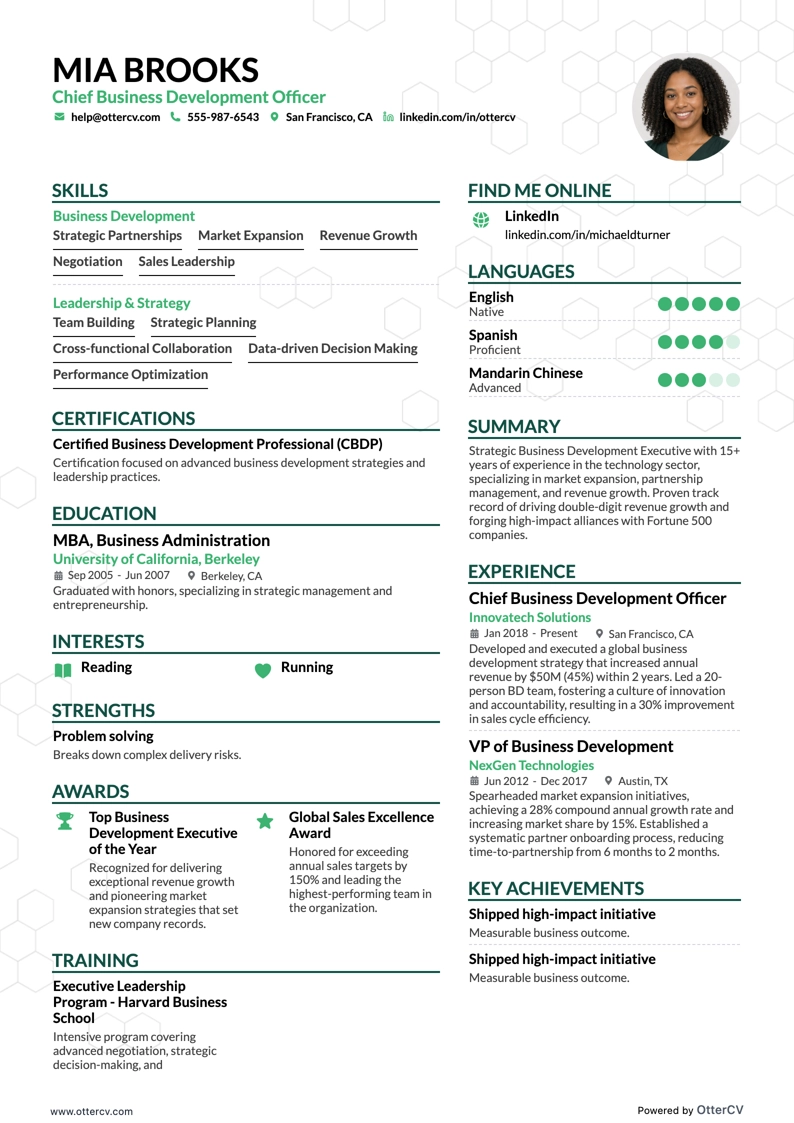
Chief Business Development Officer full preview

21 Business Development Resume Examples

OtterCV

Written by The OtterCV Team

Updated: 4/24/2023•8 min read

See all resume examples in this guide, or generate your own resume example with your personalized prompt

Chief Business Development Officer resume example

Chief Business Development Officer

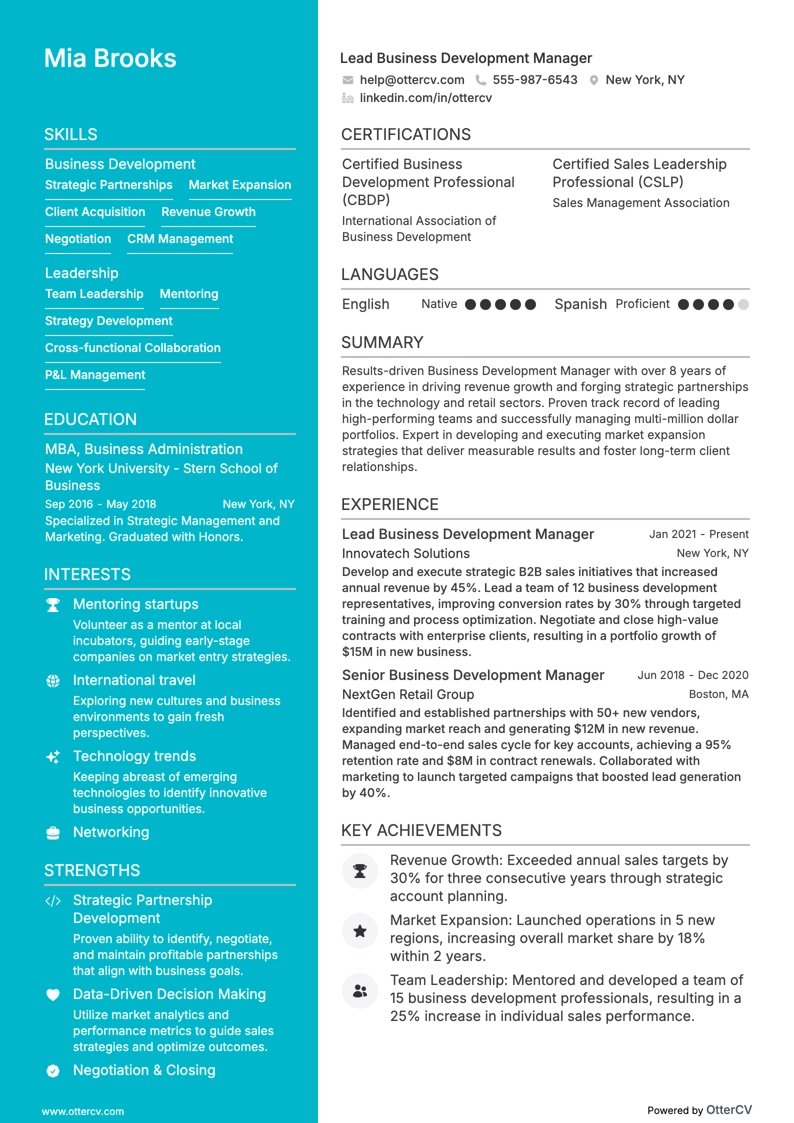
Lead Business Development Manager resume example

Lead Business Development Manager

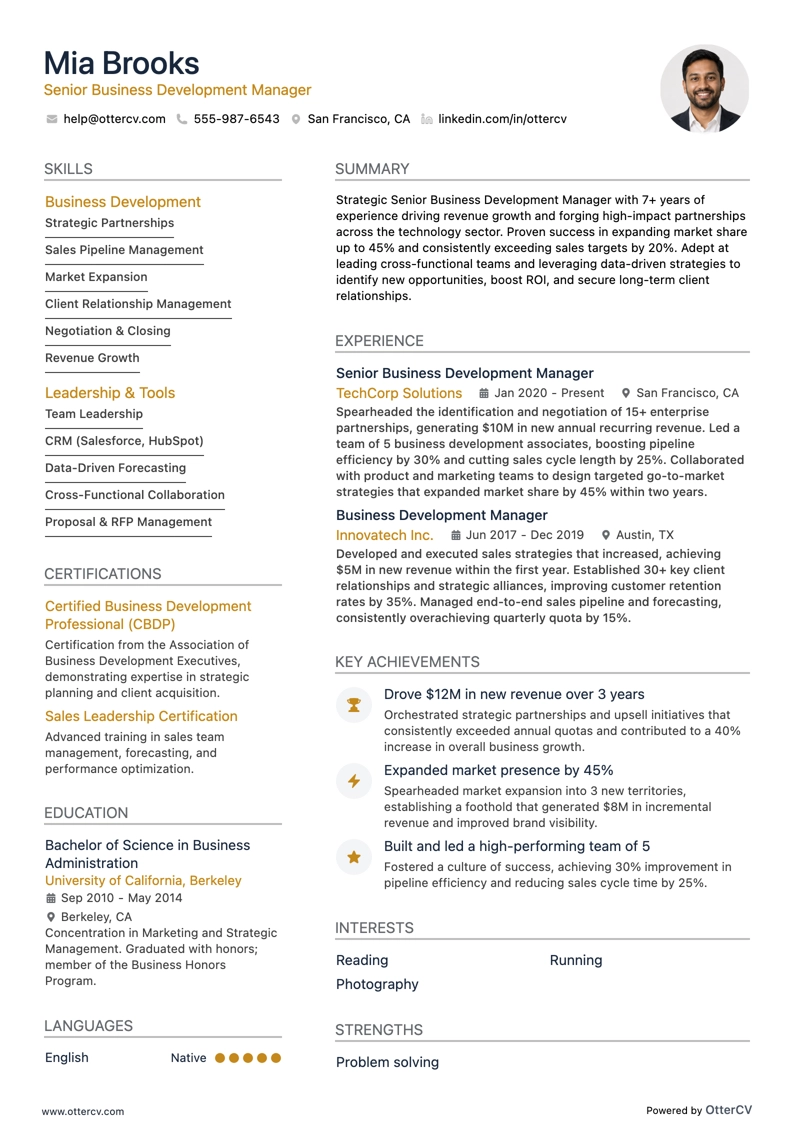
Senior Business Development Manager resume example

Senior Business Development Manager

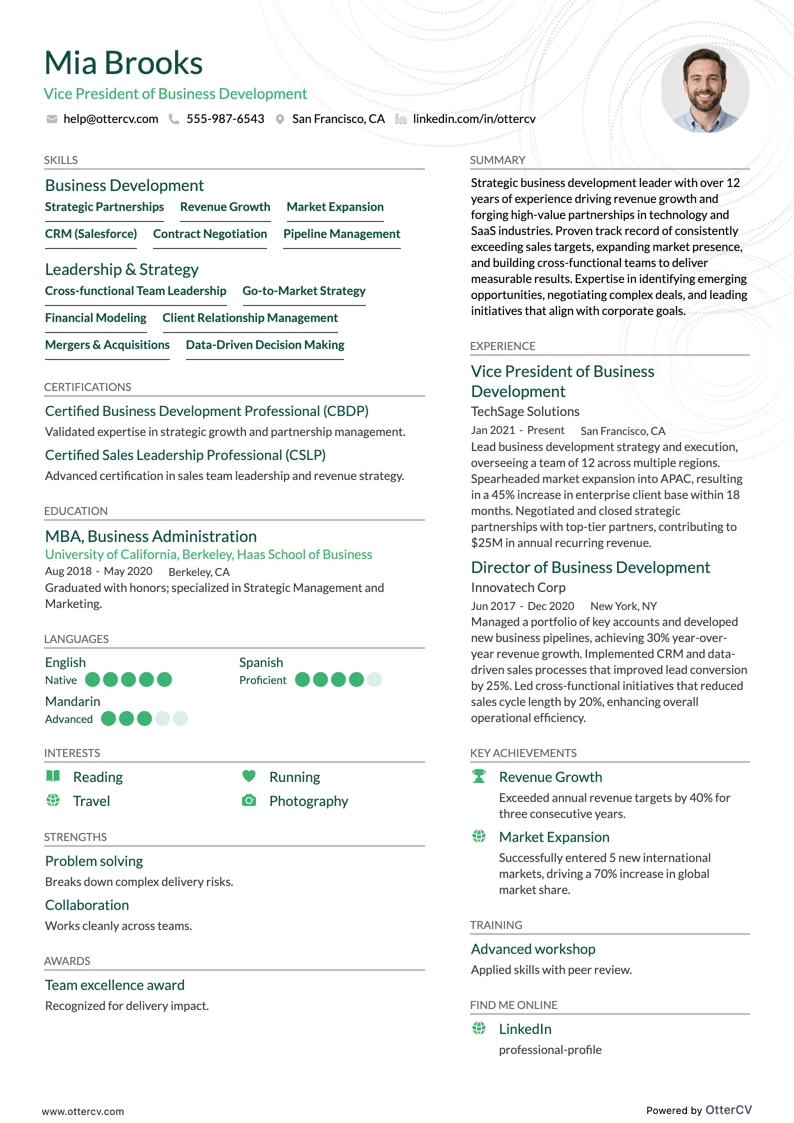
Vice President of Business Development resume example

Vice President of Business Development

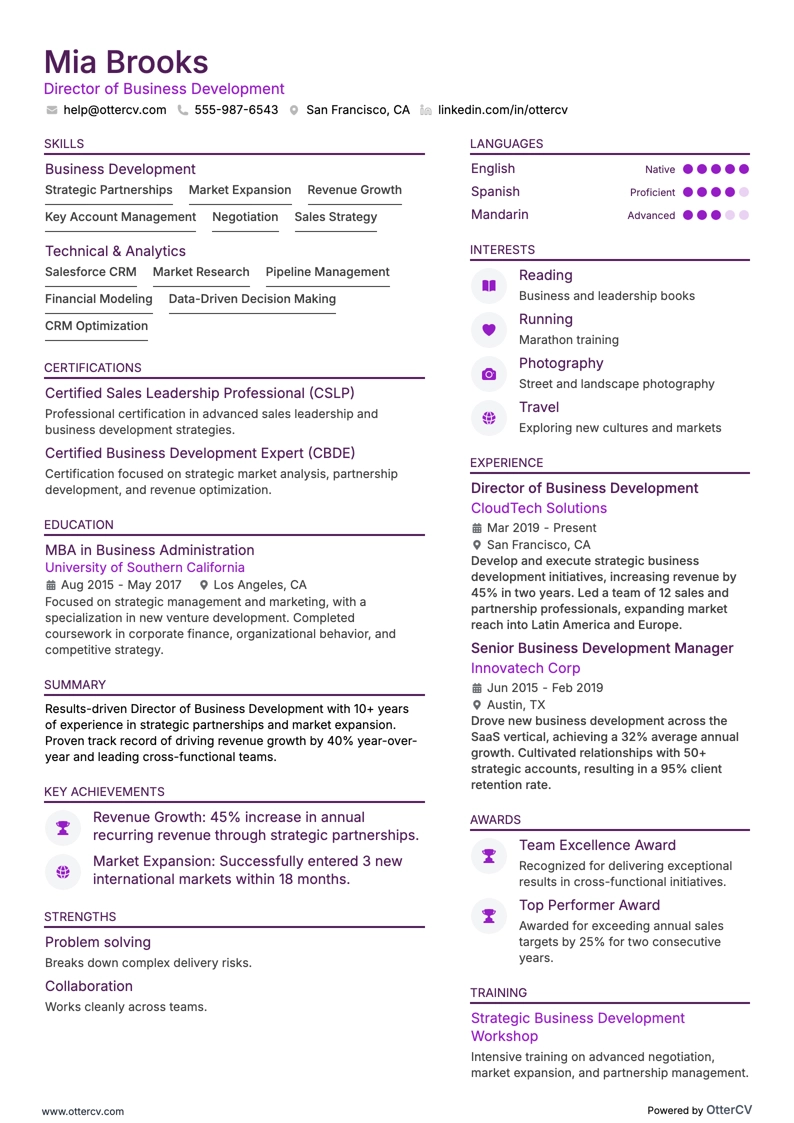
Director of Business Development resume example

Director of Business Development

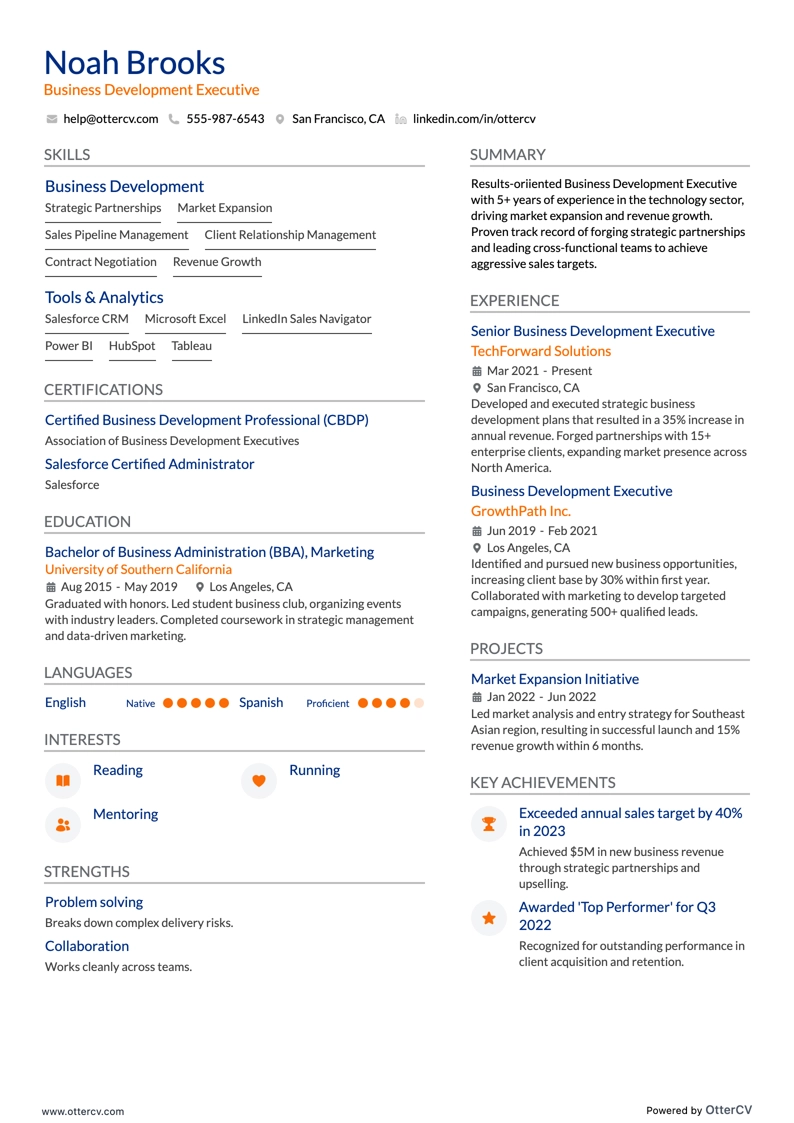
Business Development Executive resume example

Business Development Executive

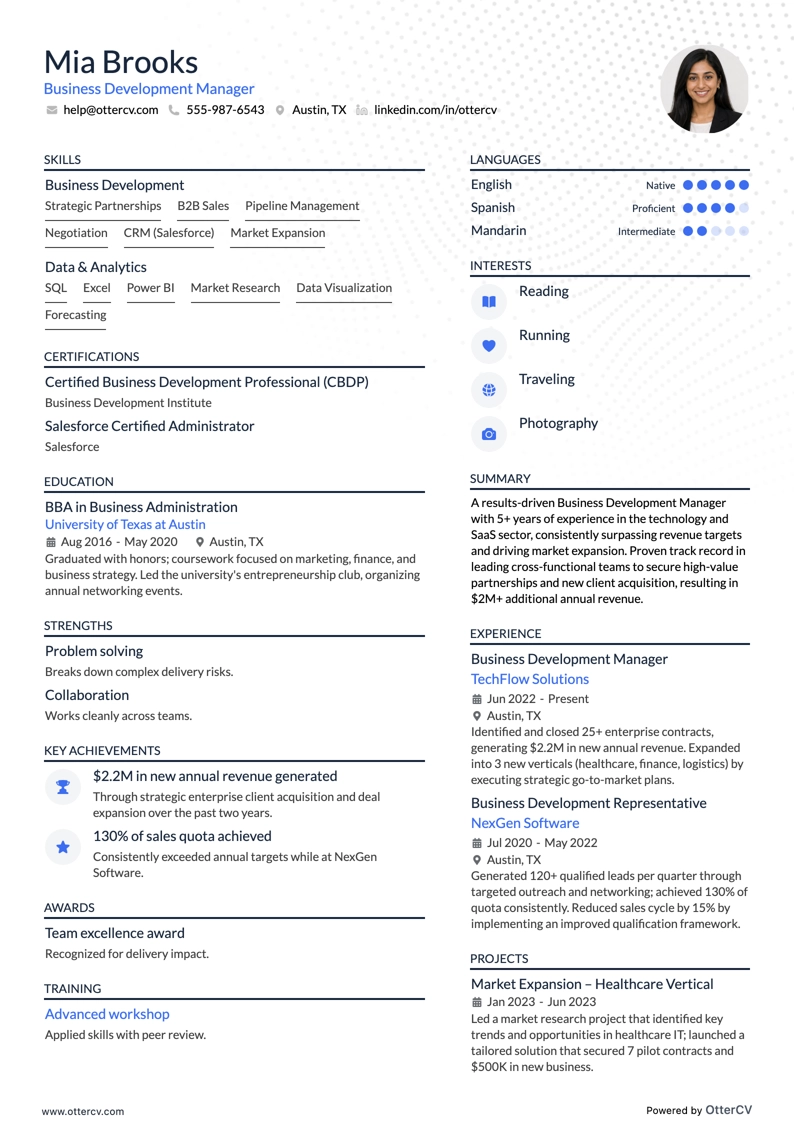
Business Development Manager resume example

Business Development Manager

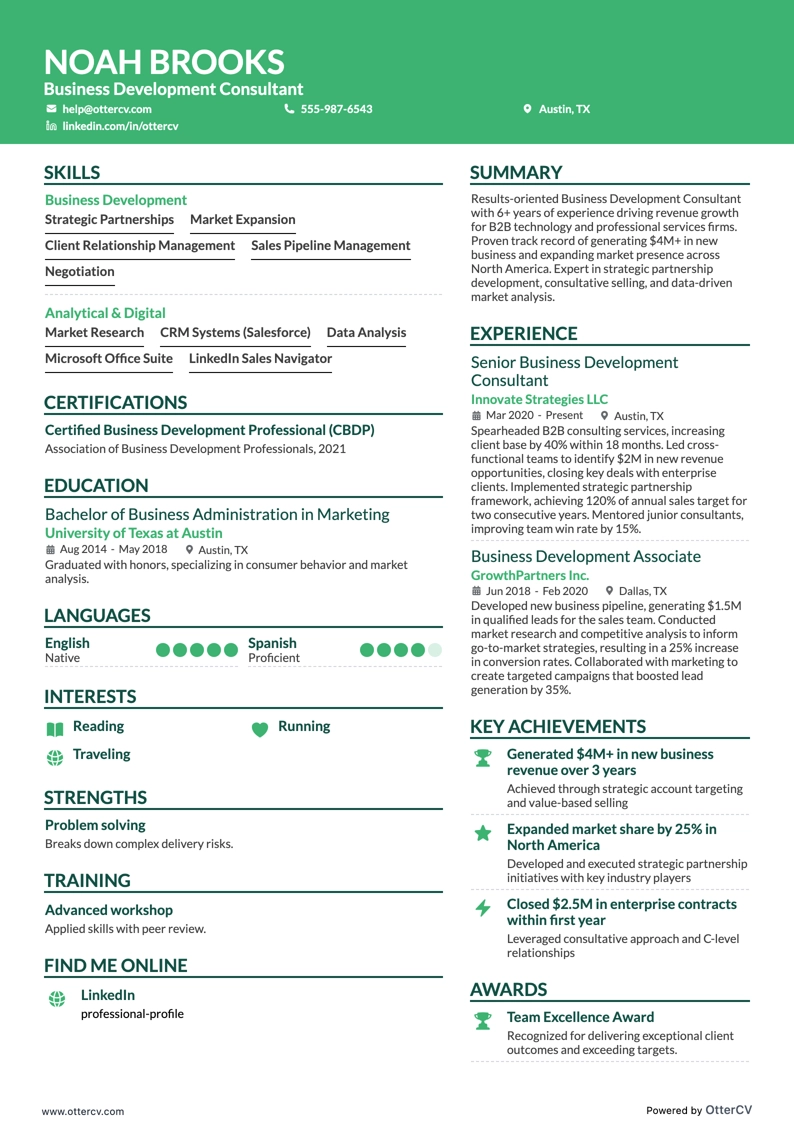
Business Development Consultant resume example

Business Development Consultant

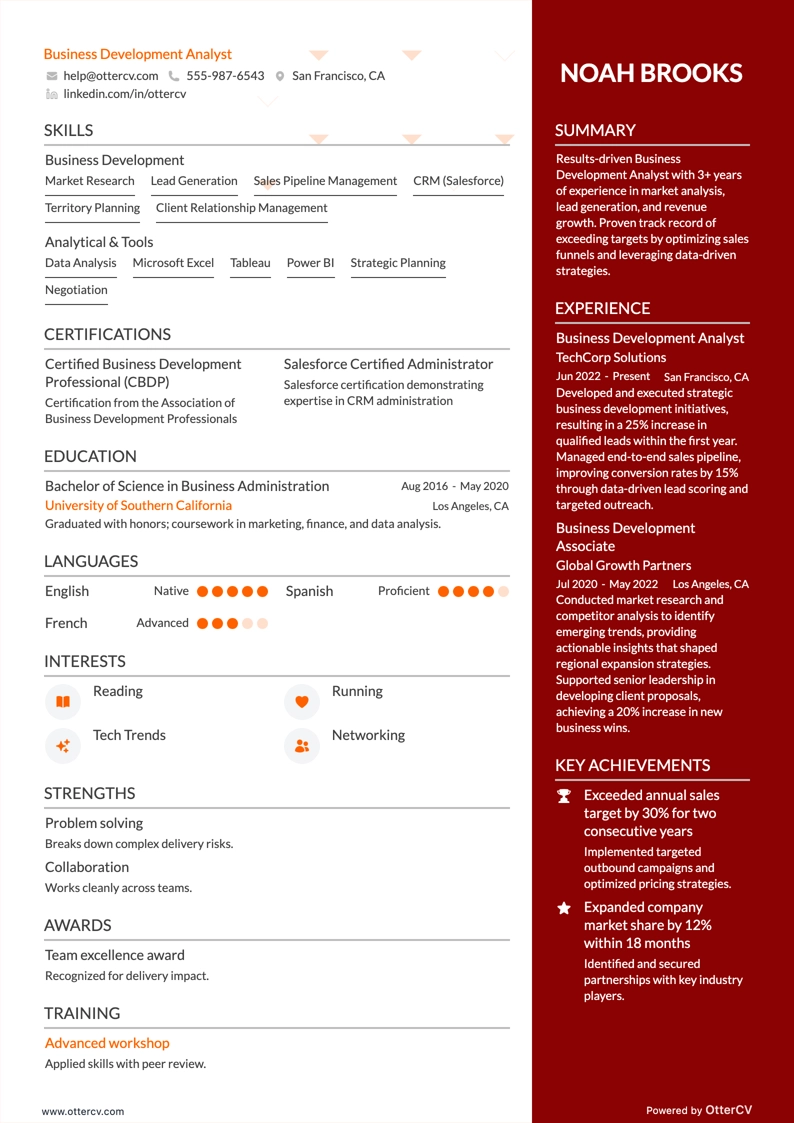
Business Development Analyst resume example

Business Development Analyst

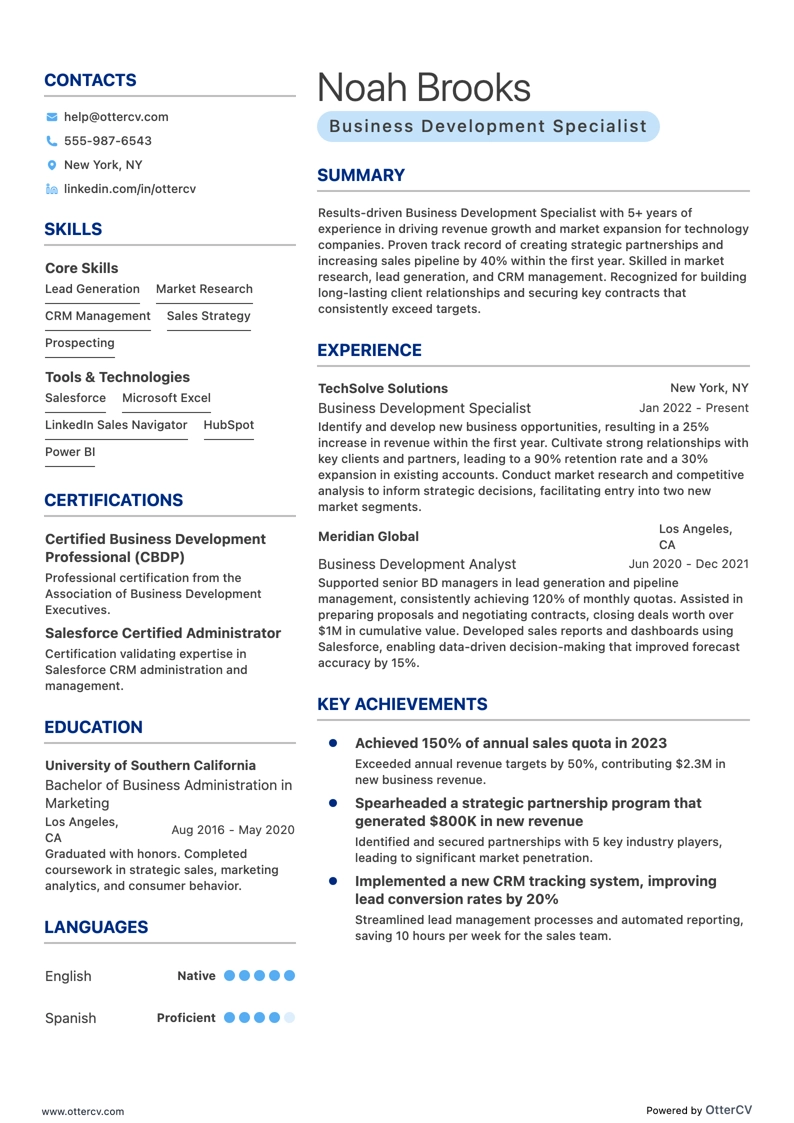
Business Development Specialist resume example

Business Development Specialist

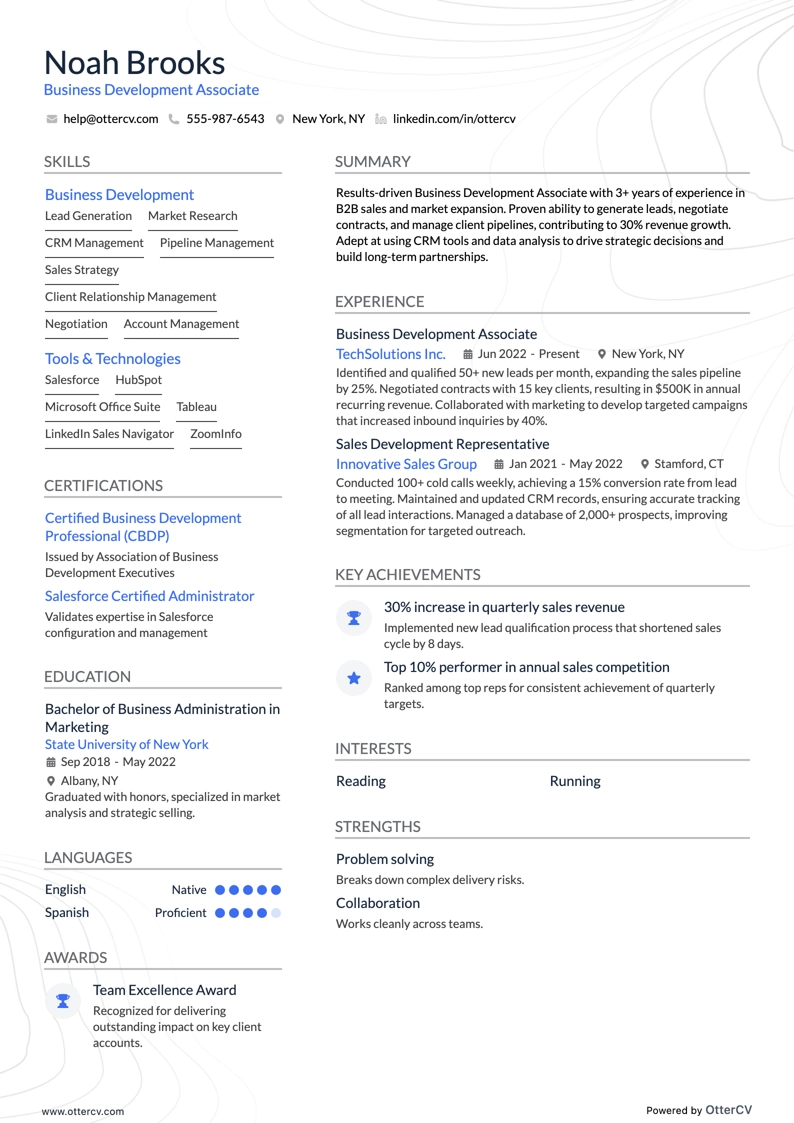
Business Development Associate resume example

Business Development Associate

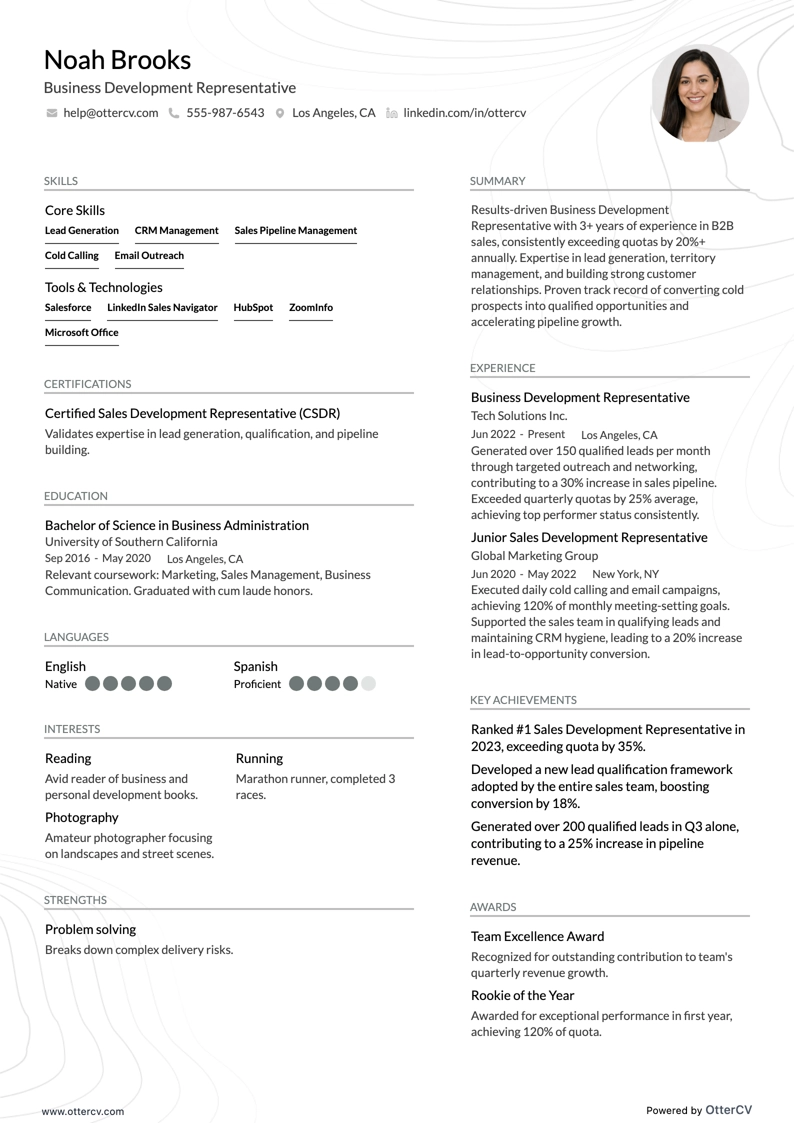
Business Development Representative resume example

Business Development Representative

Business development is often viewed as a relentless, highly competitive field. But succeeding in it takes more than strategy alone. It also requires qualities like creativity and empathy, which help you build meaningful professional relationships. Creativity, in particular, is a major driver of business success. One survey found that nearly 90% of high-growth companies recognize creativity's importance for long-term success.

A strong business development resume should reflect these qualities clearly. It should do more than list accomplishments. It needs to show that you can think creatively, understand client needs, and build lasting relationships. This guide will help you create a resume that highlights your unique mix of skills and tells a professional story that captures recruiters' attention.

In this guide, we'll cover:

  • Formatting your resume for clarity and professionalism
  • Highlighting relevant achievements and skills that match employer expectations
  • Tailoring your resume to job descriptions by using key phrases and terms from the posting
  • Essential industry-specific and soft skills, and how to present them on your business development resume
  • Positioning your education section strategically to improve your chances of getting noticed
  • Writing a personal statement that highlights your strengths and career goals
  • Adding extra sections to showcase your individuality

We've also gathered related business development resume guides and cover letter examples that may be useful:

Business development manager resume sample

Check out this business developer manager resume sample. It includes all the key sections you need and can serve as a framework for your own resume. To strengthen your application, you can also use the Echocv resume builder.

Kate Greene

Business Development Manager

kate.greene@echocv.com | LinkedIn | San Francisco, CA

Summary

Results-driven Business Development Manager with over 8 years of experience in growing brand recognition and financial performance. Experienced in working with executives, sales, and marketing teams to assess market trends and develop innovative business strategies. Proven ability to identify new business opportunities, negotiate contracts, and build strong client relationships.

Experience

Senior Business Development Manager
FutureVision Inc., San Francisco, CA
March 2020 – Present

  • Led market research initiatives that identified new revenue streams and increased annual sales by 25%.
  • Developed and executed strategic business plans with cross-functional teams.
  • Analyzed competitive market data to guide business strategy and product development.
  • Presented detailed reports and actionable recommendations to senior management.

Business Development Manager
Growth Solutions LLC, San Francisco, CA
July 2015 – February 2020

  • Directed a team of 10 in developing and implementing business strategies that improved company visibility and profitability.
  • Negotiated contracts with key clients, contributing to a 40% expansion of the client base.
  • Conducted detailed market analysis to identify trends and opportunities.
  • Worked closely with marketing and sales teams to align strategies and achieve business objectives.

Assistant Business Development Manager
BrightPath Co., San Francisco, CA
June 2012 – June 2015

  • Assisted in creating business proposals and presentations for prospective clients.
  • Conducted SWOT analysis to support strategic planning efforts.
  • Monitored market trends and competitor activity to provide actionable insights.
  • Supported senior managers in identifying and evaluating new business opportunities.

Education

Master of Business Administration (MBA)
Stanford University, Stanford, CA
Graduated: June 2012

Bachelor of Science in Business Administration
University of California, Berkeley, CA
Graduated: May 2010

Certifications

  • Certified Business Analysis Professional (CBAP)
  • Strategic Planning and Business Development Certification

Skills

  • Market Research and Analysis
  • Strategic Planning and Implementation
  • Client Relationship Management
  • Financial Analysis and Modeling
  • Competitive Analysis
  • Contract Negotiation
  • Data-Driven Decision Making
  • Team Leadership and Development

Languages

  • English (Native)
  • Spanish (Fluent)

Now let’s look more closely at how to format your resume.

How to format a business development resume

What makes a good resume that helps showcase your skills and experience? From layout to ATS compatibility, these formatting tips can help:

  • Resume format: For most business development roles, the reverse-chronological format works best. It presents your most recent experience first and gives recruiters a clear, cohesive view of your professional growth and work history.
  • Colors on a resume: A little color on your resume can help draw attention to your strengths. Choose a primary and secondary color, and consider an accent color for details like your job title, profile or portfolio links, or university name. Keep the palette elegant so the colors support your content rather than compete for attention.
  • Which font to choose: Go with modern classics such as Rubik, Lato, or Calibri. Arial is also a reliable choice for a serious business development role.
  • Resume length and margins: For most professionals, a 1-page resume is enough to present key achievements. A 2-page resume can work if you have extensive experience (>5 years), but always strive for conciseness. Recruiters have limited time, so clarity matters. A two-column format can also help save space, and ATS can read it without issue. For margins, 1” on each side is recommended, and our resume builder helps ensure they never drop below 0.5”.
  • Header, contact info, and photo: A clear header should include your name, job title, and contact information. Keeping this information in one place makes things easier for recruiters. In general, it’s best to skip the photo, though you should always check the specific job posting.
  • File formatting: Once you’ve set up your resume layout, preserve it by saving the file as a PDF. As a bonus, it is readable by ATS.

Once the format is in place, the next step is making sure the content is strong. Your resume should generally include these main sections:

  • Professional summary
  • Work experience
  • Skills
  • Education
  • Achievements and certifications

We’ll cover them in detail below.

Ready for an interview? Try out our ATS Resume Scanner!

Your resume should also match the target market. For example, Canadian applications may use a different layout.

How to write your business development experience

Let’s start with the most important part of your resume: your experience.

As a business developer, you carefully choose the right partnerships. Take the same approach with your resume. Your experience section should highlight the work that is most relevant to the role.

Here are some strong areas to include on your business development resume:

  • Revenue growth: Show how you helped drive revenue through strategic business development initiatives.
  • Client acquisition: Include examples of acquiring and managing key client accounts that led to sales growth.
  • Market expansion: Mention contributions to company growth through new market segments.
  • Partnership development: Highlight strategic partnerships you established and maintained to strengthen market position.
  • Sales strategy: Describe sales strategies you implemented that led to measurable growth and competitive advantage.
  • Market analysis: Show how you used market research to identify trends and growth opportunities.

It also helps to include concrete examples of your impact. Focus on measurable results that support a clear point, rather than listing numbers without context. For example: “Expertly negotiated partnership agreements and upselling strategies, boosting average deal size by 40%.”

Tailoring your resume to the job description is essential. Recruiters do not spend much time on an initial review. On average, the first scan takes 6 seconds, so align your application closely with the exact job description. Think of it as checking off the recruiter’s checklist.

Now let’s put that into practice by looking at the responsibilities and requirements from a real business development manager job description.

Business Development Manager

Business Development Manager

Requirements:

  • Proven business development experience
  • Strong commercial and negotiation skills, including experience in financial modeling
  • Experience negotiating contracts, interpreting legal documents, and completing agreements with attorneys
  • Strong communication and storytelling abilities, with proficiency in executive communication internally and externally
  • A keen sense of prioritization, both internally and with partners
  • Ability to recognize when it is right for Calm to decline a partnership

Responsibilities:

  • Develop, negotiate, close, and manage strategic agreements that support Calm’s mission and growth
  • Report to the Head of Partnerships (Americas) and collaborate cross-functionally with Legal, Marketing, Product, and other teams to launch and manage partnerships
  • Source and manage a pipeline of prospective partnerships
  • Identify, negotiate, manage, and renew strategic deals with partners
  • Build relationships and credibility within partner organizations
  • Identify new opportunities to grow partnerships and unlock additional value for both Calm and partners
  • Serve as the primary point of contact for partner needs, defining and executing long-term partner relationships
  • Ensure commitments in partner relationships are delivered by both Calm and partners, including marketing and reporting
  • Drive positive-sum outcomes and navigate internal and external dynamics toward optimal results
  • Lead cross-functional teams toward achieving deal objectives, including Legal, Marketing, Content, and Product

Experience

Business Development Manager

ABC Corp

09/2018 - 06/2024 · San Francisco

Led the development and management of strategic partnerships to drive growth and strengthen market presence for a leading wellness app.

  • Negotiated and closed 15 strategic partnerships with major health and wellness organizations, increasing the app user base by 40%.
  • Managed a pipeline of 50+ potential partnerships, evaluating opportunities and prioritizing high-impact collaborations.
  • Developed and implemented partnership renewal strategies, resulting in a 90% renewal rate and $5M in annual revenue.
RIGHT

This experience section will impress recruiters:

  • Quantifiable achievements: The example includes specific metrics, such as increasing the app user base by 40% and achieving a 90% partnership renewal rate, which show tangible results.
  • Relevant responsibilities: It clearly outlines work such as negotiating partnerships, managing pipelines, and strategizing renewals, directly aligning with the requirements of a business development manager role.
  • Impactful language: Action verbs like “led,” “negotiated,” “managed,” and “developed” convey leadership and proactive involvement in driving business growth through partnerships.

But what should you do if you don’t have much experience—or none at all? See the tips below.

How do I write a business development resume with no experience

Your starting point in the field will probably be a business development representative role. In that position, your main responsibility is prospecting and qualifying early-stage leads through cold calling and emailing. As a business development rep, you act as the link between marketing and sales, so any relevant experience in those areas can help. The role is also well suited to recent graduates because it offers a fast-paced environment where theoretical knowledge can be applied in a practical setting.

On your entry-level resume, focus on the following to win recruiters over:

  • Educational background: A bachelor’s degree in business, marketing, economics, or a related field provides foundational knowledge of market dynamics and business operations, which is useful for identifying growth opportunities.
  • Key skills: Strong communication helps you articulate value propositions to clients. Analytical skills support market data interpretation, project management helps execute initiatives effectively, and networking is important for expanding contacts and building partnerships.
  • Relevant experience: Internships or part-time roles in business development, sales, or marketing can provide practical insight into market needs and business processes.
  • Sales experience: This is helpful for building negotiation skills and understanding customer needs, both of which are essential for closing deals and developing long-term client relationships.
  • Certifications and training: Pursuing certifications like Certified business development Manager (CBDM) can show commitment to professional growth and expertise in business development strategies.
  • Transferable soft skills and traits: Consider which transferable skills could support your target role. These may include communication, strategic thinking, entrepreneurial spirit, and creativity.
  • Resume objective: A well-written resume objective can be especially effective on an entry-level resume because it focuses on your skills rather than your experience.

After outlining your experience, the next step is to highlight the valuable skills you’ve developed.

Business development skills on your resume

Skills on your resume help hiring managers understand what you can do. A list of abilities is useful, but it’s even better to include specific examples of how your skills helped you grow and contribute in your roles.

How Confidence Leads to Success

A strong example of confidence driving success is presenting a comprehensive market research analysis that clearly highlights consumer trends and their implications for product development.

With detailed insights and confident communication, management was persuaded to invest in the recommended product modifications.

Top Hard Skills for a Business Development Role

Your skills generally fall into two groups: industry-specific skills and people skills.

Industry-specific, or hard skills, are abilities that can be tested and measured. You can show proficiency through specific metrics or certifications. Because these skills are easier to verify, only include the ones you are fully confident in. Never lie on your resume, as it can damage your relationship with a future employer.

Include your hard skills in your experience, education, and achievements sections. You can also group them in a separate section to make them more visible and accessible to recruiters. It also helps to mention 2 or 3 specific abilities from the job ad in your BDR resume summary or objective.

Here’s a list of the top hard skills for a business development role:

Best hard skills for your business development resume

  • Sales forecasting supports more accurate revenue planning.
  • Contract negotiation shows you can secure favorable terms.
  • Proposal writing highlights your ability to win new business.
  • Business intelligence software demonstrates data-driven decision-making.
  • CRM software reflects strong pipeline and customer management skills.
  • Account management shows you can grow and retain client relationships.
  • Market research helps identify customer needs and market opportunities.
  • Financial modeling supports strategic planning and investment decisions.
  • Project management software shows you can keep initiatives organized.
  • Data analysis software strengthens reporting and performance evaluation.
  • Strategic planning demonstrates long-term business growth thinking.
  • Business case development shows you can justify new initiatives.
  • Performance metrics help track results and improve execution.
  • Sales funnel management reflects your ability to move leads toward conversion.
  • Pricing strategy shows you can balance value and profitability.
  • Lead generation highlights your ability to build new opportunities.
  • Multi-channel marketing supports broader outreach and engagement.
  • Partner relations shows strength in building strategic alliances.
  • New business development demonstrates a focus on growth.
  • Competitive analysis helps position products and services effectively.
  • Event management and planning supports outreach and relationship building.
  • Business process management software shows operational efficiency skills.

Soft skills are harder to measure, but they are crucial because they show recruiters how well you would fit into a team and company culture. They often make the difference by revealing how you connect with people.

That matters in every role, and even more for a business development representative. Strong communication and relationship-building skills are essential for pitching ideas effectively, negotiating deals, and maintaining long-term client relationships. Emotional intelligence and problem-solving also help you adapt quickly to challenges while supporting a collaborative, innovative environment.

These soft skills are key to driving business growth and success. Check out this list of top soft skills for a business developer:

Best soft skills for your business development resume

  • Communication skills help you present ideas clearly and build trust.
  • Relationship building supports long-term business partnerships.
  • Persuasion helps you influence decisions and win support.
  • Listening helps you understand client needs and respond effectively.
  • Time-management keeps priorities organized and work on track.
  • Problem-solving helps you address challenges and find practical solutions.
  • Creativity helps you spot new opportunities and fresh approaches.
  • Adaptability shows you can adjust to changing markets and goals.
  • Diplomacy helps you handle sensitive situations with professionalism.
  • Motivation shows drive and consistent effort.
  • Leadership helps you guide teams and support results.
  • Decision making shows you can evaluate options and act confidently.
  • Conflict resolution helps maintain productive relationships.
  • Empathy helps you understand others and communicate with care.
  • Intercultural competence supports effective work across diverse backgrounds.
  • Resilience helps you stay focused through setbacks and pressure.
  • Confidence helps you present ideas and pursue opportunities assertively.
  • Ethical behavior shows integrity and professionalism.
  • Patience helps you manage long sales cycles and ongoing negotiations.
  • Initiative shows you can take action without waiting for direction.

Your educational background is where you’ve built many of the skills that matter most. Here’s how to improve the certifications and education section on your resume.

How to list your certifications and education on your resume

Your academic background and specialized knowledge help show your ability to drive business growth. A good education section gives potential employers confidence in your capacity to analyze markets, negotiate deals, and position a company strategically for success. Educational achievements also validate your understanding of industry trends, which supports sustainable business expansion and profitability.

As a business developer, your education section should focus on qualifications that directly support identifying new opportunities and building growth strategies. For example, a Bachelor’s degree in Business Administration shows a strong foundation in market analysis and strategic planning, both of which are essential for understanding market trends and competitor activity. Finance courses reflect skills needed to make informed decisions in negotiations and partnerships. Certifications in Sales and Marketing demonstrate proficiency in client management and creating compelling sales pitches. Together, these achievements show your ability to understand complex business dynamics and apply innovative strategies for organizational success.

Let’s look at a strong business development education section:

Education

Master of Business Administration (MBA)

Stanford Graduate School of Business

09/2015 - 06/2017 | Stanford, CA

GPA: 3.9/4.0

  • Studied advanced negotiation strategies and financial modeling relevant to business development.
  • Developed strong executive communication skills crucial for effective stakeholder engagement and partnership building.
  • Gained insights into contract law and its implications in structuring and negotiating business agreements.
RIGHT

Here’s why it works

  • Relevance: An MBA from Stanford GSB signals proficiency in negotiation, financial modeling, and executive communication, which are critical skills for business development roles.
  • Credibility: Attending a top-tier institution like Stanford enhances credibility and suggests a strong academic foundation in business principles and strategy.
  • Practical application: Coursework in contract law and business agreements provides practical knowledge for interpreting legal documents and negotiating agreements, making it a direct fit for managing partnerships and strategic deals.

PRO TIP

You can leave out your GPA score if it’s below 3.5.

Certifications are another great way to demonstrate your competence. Even certificates that are not directly focused on BDR roles can still strengthen your skill set. Consider adding one or more of the following to your business development resume:

Best certifications for your business development resume

Now that you’ve covered your experience, education, and skills, return to the top of your business development resume, where your personal statement appears.

How to write your business development resume summary or objective

Your personal statement gives recruiters a quick overview of your application. It should explain who you are, what you want to achieve, and how you plan to achieve it. Choose between a resume summary or an objective based on your career stage.

  • A resume summary is best for experienced business developers. Keep it to 3–5 sentences and highlight key points, such as how your skills contributed to a previous company’s success. Use active voice, tailor it to the specific job posting, and use keywords from the job ad to catch recruiters’ attention.
  • A resume objective is more suitable for entry-level candidates or those changing careers. Keep it shorter, around 1–3 sentences, and focus on your willingness to learn new things and grow in your career.

Below is a well-written business development resume summary example tailored to the job posting above.

Summary

Seasoned business development professional with 8+ years of experience driving revenue growth through strategic partnerships and alliances. Expert in negotiating high-value agreements, contributing to a 30% revenue increase in previous roles. Skilled in financial modeling, contract negotiation, and building collaborative relationships to achieve mutual business objectives.

RIGHT

This summary stands out because it is:

  • Clear and concise: It condenses key qualifications and achievements into a direct, impactful statement.
  • Engaging: It uses active language and measurable results to capture attention and show capability.
  • Relevant to the job ad: It aligns directly with the role’s focus on revenue growth, partnership management, and negotiation skills.

Now that we’ve covered the main sections of a business development resume, let’s look at the additional sections and how to include them.

Additional sections for a business development resume

  • Achievements and awards: Highlight notable accomplishments and recognitions, such as “Recipient of the ‘Top Salesperson of the Year’ award for three consecutive years.”

  • Professional affiliations : Involvement with industry organizations can signal a strong professional network. For example, you might mention membership in the National business development Association.

  • Projects and case studies: Include specific projects that demonstrate problem-solving and strategic thinking. For example, “Led a market expansion project that resulted in a 25% increase in market share.”

  • Languages: Showing your proficiency in additional languages can be especially valuable for international roles or multilingual work environments.

  • Volunteer work and community involvement: Adding volunteer experience can reflect commitment and reliability. For instance, “Organized community outreach programs, enhancing leadership and project management skills.”

  • Speaking engagements: These can demonstrate thought leadership and subject-matter expertise. Mention published articles or speaking appearances at industry conferences.

  • Choose a reverse chronological format to clearly present your career path.

  • Keep it concise—a 1-page resume is best for most business development professionals.

  • Use subtle colors and modern fonts to add style while maintaining professionalism.

  • Save your resume as a PDF to preserve your tailored layout.

  • Customize your experience to the job description, and never lie on your resume.

  • Highlight key achievements related to the business development role.

  • Emphasize transferable skills if you do not have direct business development experience.

  • Include relevant industry-specific skills and personal traits throughout your resume.

  • Underline your education section to inspire confidence in your application.

  • Add extra sections to give more depth to your personality.

Business Development resume examples

Explore additional Business Development resume samples and guides and see what works for your level of experience or role.

By Experience

Lead Business Development Manager

Lead Business Development Manager resume preview

Senior Business Development Manager

Senior Business Development Manager resume preview

Business Development resume examples

Explore additional Business Development resume samples and guides and see what works for your level of experience or role.

By Role

Chief Business Development Officer

Chief Business Development Officer resume preview

Vice President of Business Development

Vice President of Business Development resume preview

Director of Business Development

Director of Business Development resume preview

Business Development Executive

Business Development Executive resume preview

Business Development Manager

Business Development Manager resume preview

Business Development Consultant

Business Development Consultant resume preview

Business Development Analyst

Business Development Analyst resume preview

Business Development Specialist

Business Development Specialist resume preview

Business Development Associate

Business Development Associate resume preview

Business Development Representative

Business Development Representative resume preview