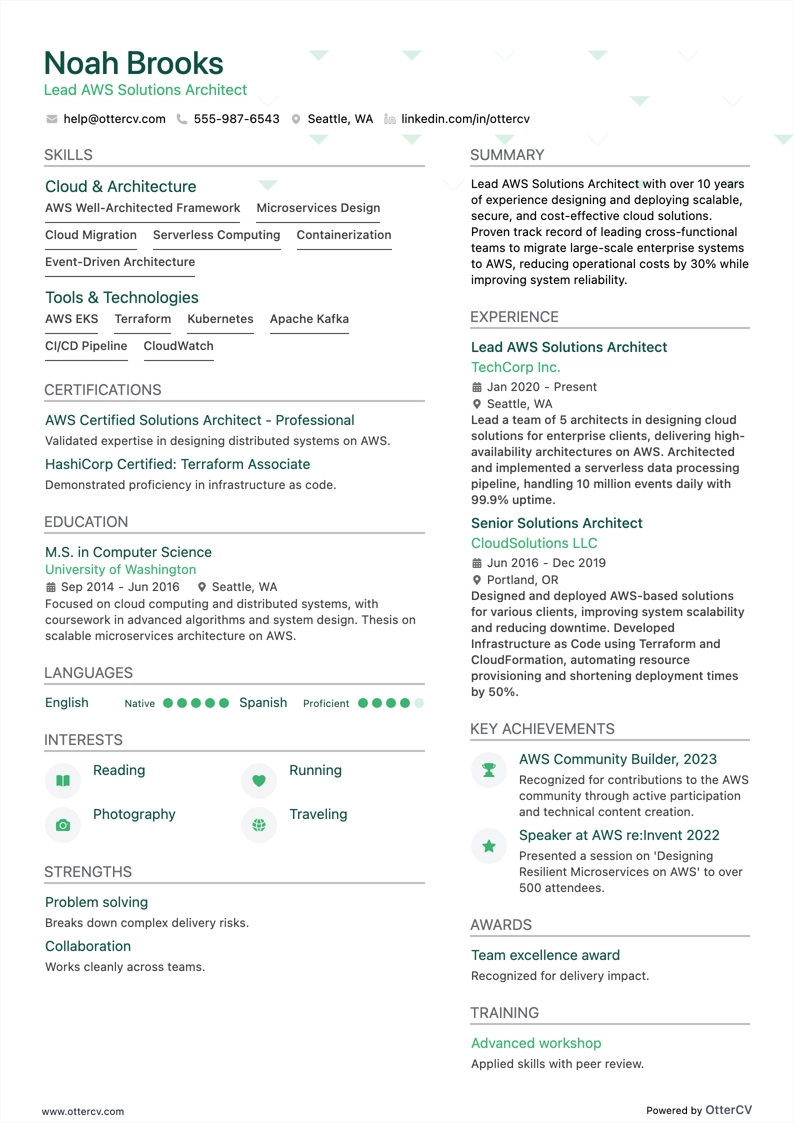
Lead AWS Solutions Architect full preview

26 AWS Resume Examples

OtterCV

Written by The OtterCV Team

Updated: 9/12/2023•8 min read

See all resume examples in this guide, or generate your own resume example with your personalized prompt

Lead AWS Solutions Architect resume example

Lead AWS Solutions Architect

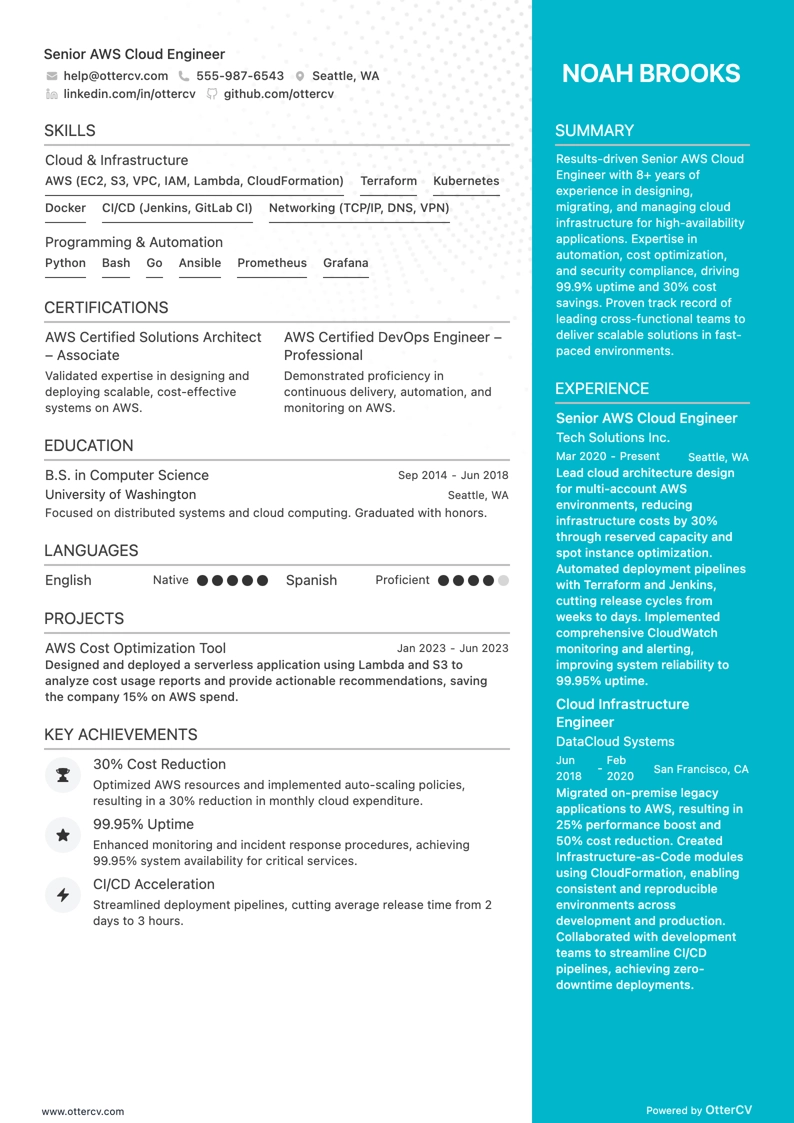
Senior AWS Cloud Engineer resume example

Senior AWS Cloud Engineer

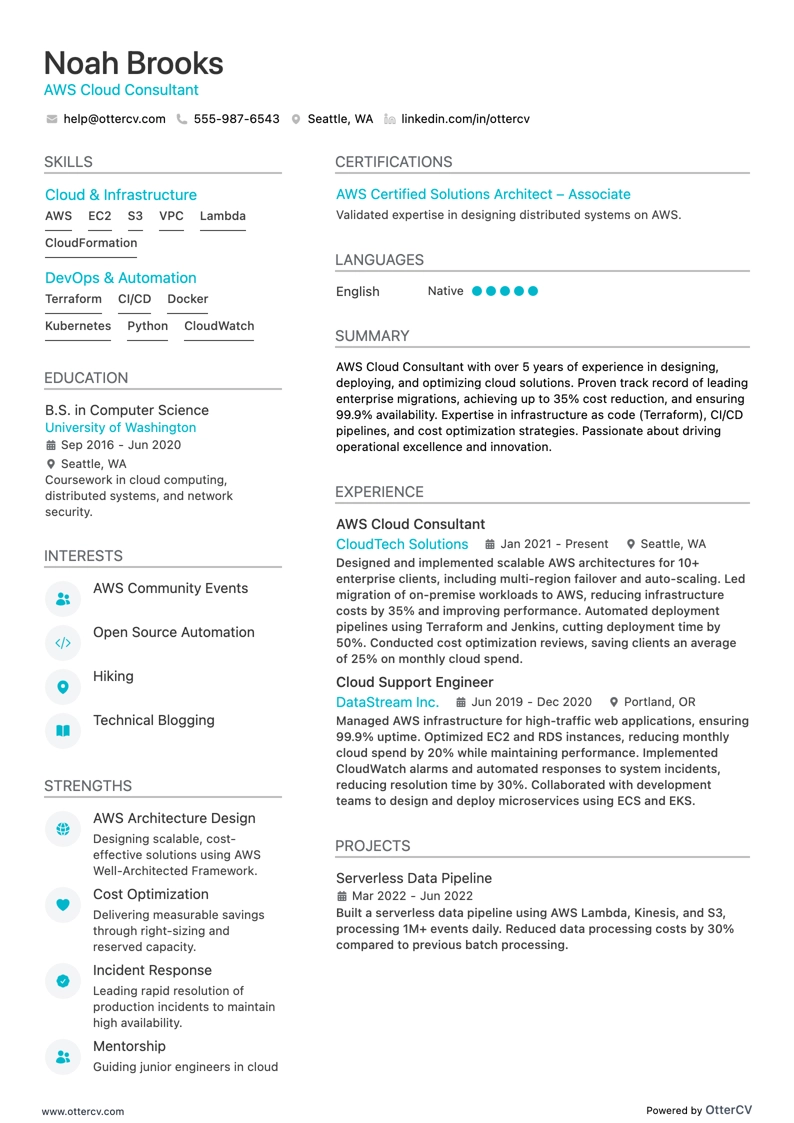
AWS Cloud Consultant resume example

AWS Cloud Consultant

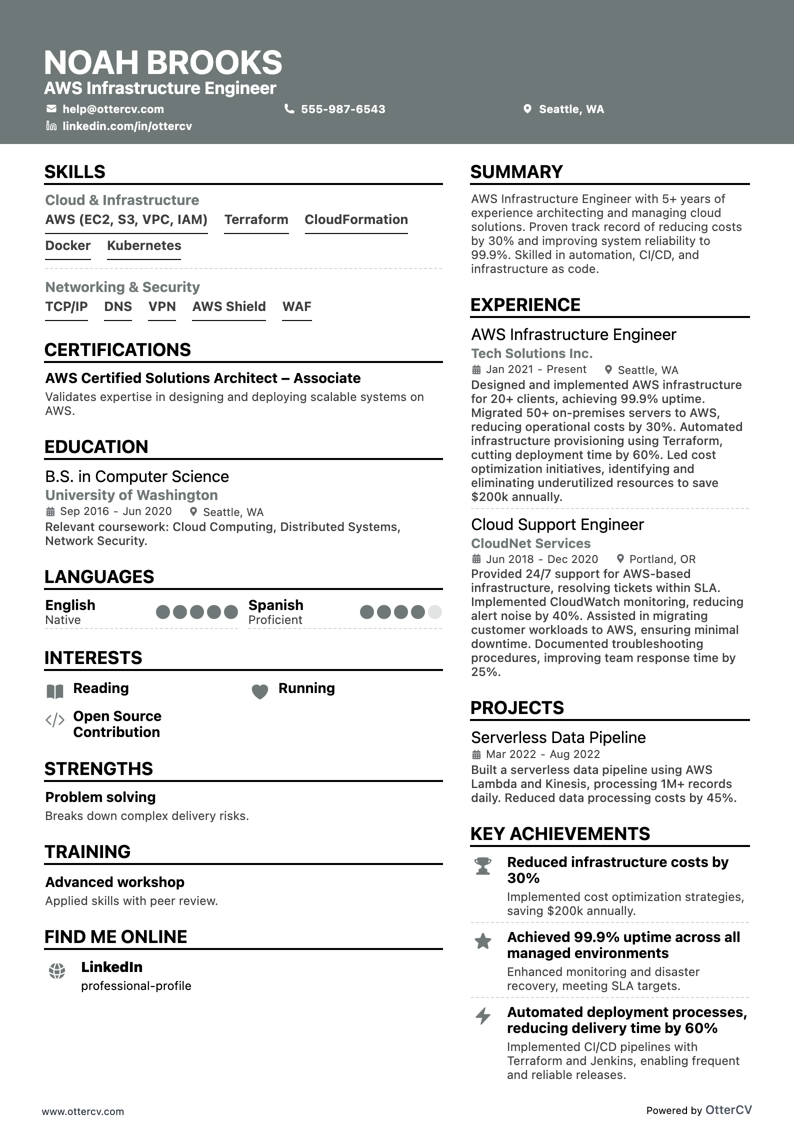
AWS Infrastructure Engineer resume example

AWS Infrastructure Engineer

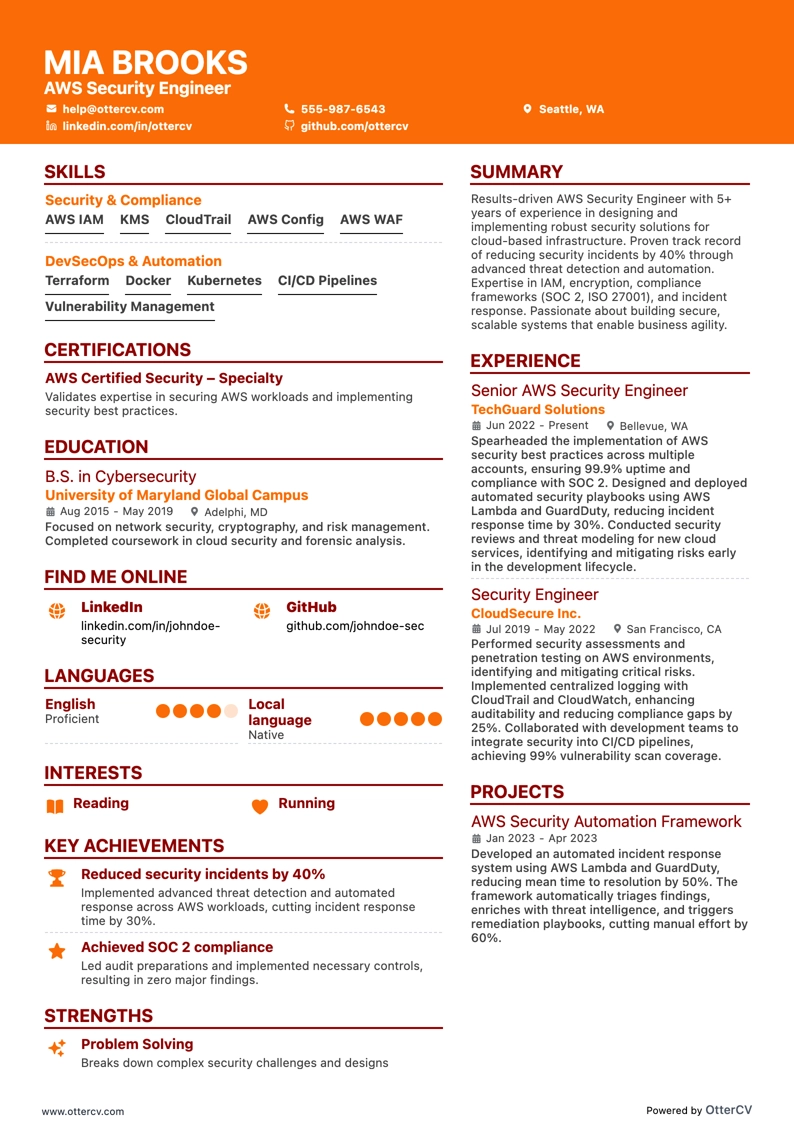
AWS Security Engineer resume example

AWS Security Engineer

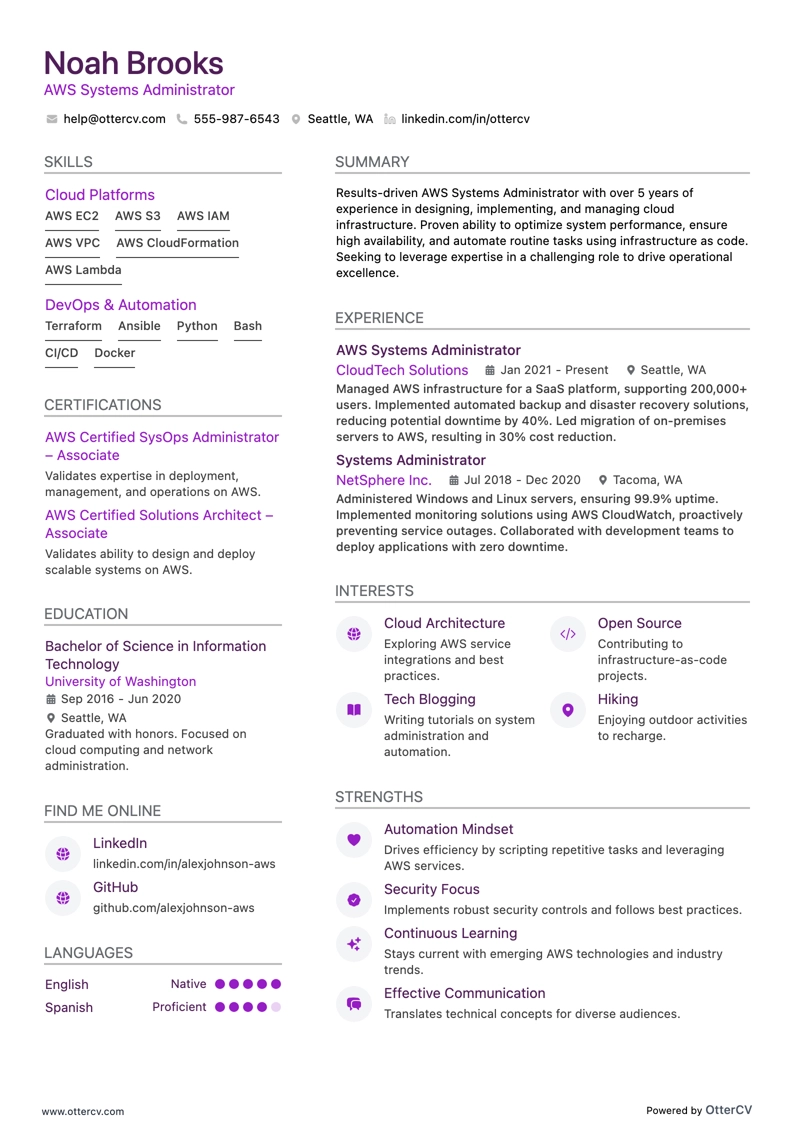
AWS Systems Administrator resume example

AWS Systems Administrator

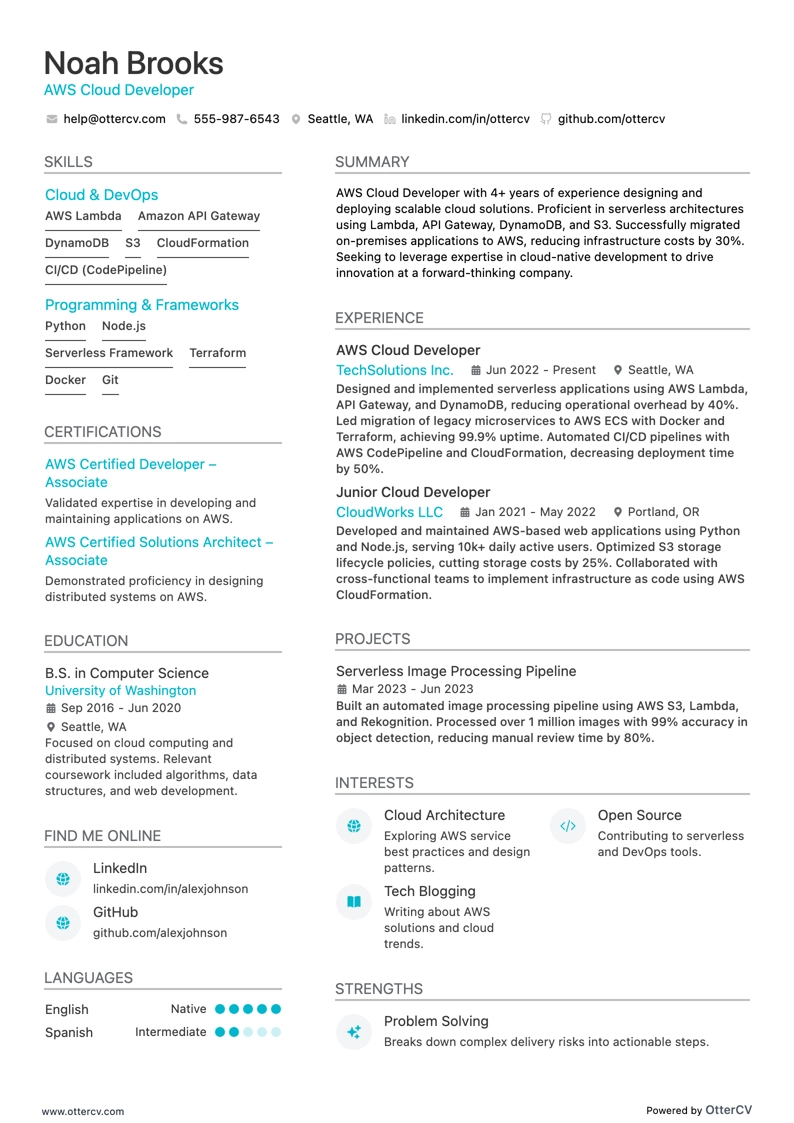
AWS Cloud Developer resume example

AWS Cloud Developer

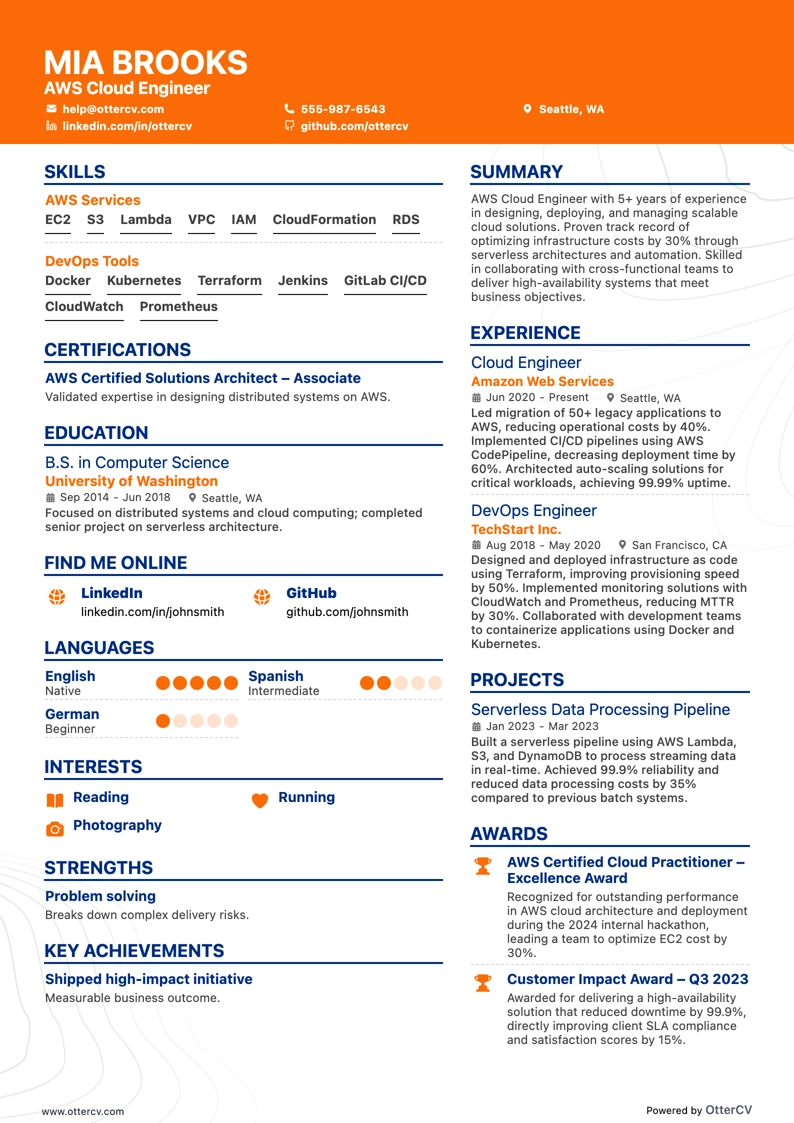
AWS Cloud Engineer resume example

AWS Cloud Engineer

Standing out to recruiters with an AWS resume can be difficult, especially when you need to show both technical expertise and non-technical strengths. In AWS roles, success is not only about knowing the tools. It also depends on your ability to adapt as AWS releases rapid updates each year.

This guide offers practical tips for tailoring your experience and skills to the AWS role you want. Whether you’re applying for an AWS Solutions Architect, an AWS DevOps Engineer, or another position, it will help you present your knowledge clearly while addressing common challenges candidates face.

Key takeaways

  • Use a reverse-chronological resume, a format recruiters often prefer for AWS roles.

  • Choose a clean template with subtle colors to showcase your cloud computing and technical skills.

  • Tailor your experience to the job and emphasize measurable results.

  • Highlight soft skills like problem-solving, collaboration, and adaptability in your summary or experience section.

  • Degrees in Computer Science, Information Technology, or Engineering, plus certifications such as AWS Certified Solutions Architect or SysOps Administrator, add value.

  • Add personality with sections covering achievements, cloud migration projects, or AWS infrastructure innovations.

Let’s look at a sample resume to see what the final result should look like.

AWS resume sample

Use Alex’s resume as a template: copy it and replace the fields with your own information. You can also start from scratch with our Echocv resume builder—it only takes minutes.

Alex Johnson

Cloud Solutions Architect

alex.johnson@echocv.com | LinkedIn | San Francisco, CA

Summary

Experienced Cloud Solutions Architect with 6+ years of expertise in designing, deploying, and optimizing AWS-based infrastructure. Skilled in automation, container orchestration, and cost management strategies. Strong in improving system performance, applying cloud security best practices, and building scalable serverless solutions that support highly available, cost-efficient enterprise applications.

Experience

Cloud Solutions Architect
AWS, San Francisco, CA
March 2020 – Present

  • Lead the design and deployment of scalable cloud architectures using AWS services, including EC2, Lambda, and RDS.
  • Automate infrastructure provisioning with AWS CloudFormation and Terraform, reducing manual effort by 40%.
  • Collaborate with development teams to implement container orchestration with Kubernetes, improving application performance by 25%.
  • Spearhead cloud cost optimization strategies, achieving an average of 20% in operational savings for clients.
  • Enforce AWS security best practices, including IAM policies, VPC configurations, and automated compliance monitoring.

Cloud Engineer
Google Cloud, San Francisco, CA
June 2017 – February 2020

  • Designed and managed cloud environments for enterprise clients, with a focus on AWS and GCP hybrid solutions.
  • Developed serverless applications using AWS Lambda and API Gateway, improving development cycle time by 30%.
  • Optimized resource utilization, cutting infrastructure costs by 15% through reserved instance planning and rightsizing.
  • Implemented CI/CD pipelines using AWS CodePipeline and Jenkins, reducing deployment time by 50%.
  • Provided training to internal teams on cloud architecture best practices and infrastructure as code (IaC) principles.

Education

Bachelor of Science in Computer Science
University of California, Berkeley
Graduated: 2016

Certifications

AWS Certified Solutions Architect – Professional
AWS Certified DevOps Engineer – Professional
Certified Kubernetes Administrator (CKA)

Skills

  • AWS Architecture Design
  • Container Orchestration (Kubernetes, Docker)
  • Infrastructure as Code (Terraform, CloudFormation)
  • Serverless Computing (AWS Lambda, API Gateway)
  • Cloud Security Best Practices
  • CI/CD Pipeline Automation
  • Cost Optimization Strategies
  • Monitoring & Logging (CloudWatch, Prometheus)

Languages

  • English (Native)
  • Spanish (Fluent)

Having reviewed a sample resume, let’s look at the best ways to format your credentials.

How to format an AWS resume

When writing your AWS resume, prioritize readability and structure. Your document should show the same attention to detail you bring to cloud infrastructure and operations.

Choose a traditional or simple resume template to keep your presentation professional. A clean layout signals efficiency and precision, which are important qualities for managing AWS services and maintaining reliable cloud operations.

Key resume sections for AWS roles

Here are the essential sections to include in an AWS resume:

  • Professional Summary
  • Technical Skills
  • AWS Project Experience
  • AWS Certifications/Education
  • References/Testimonials

These sections are explored in more detail later in the article.

Resume format

Use a reverse-chronological format to present your most recent experience first. This helps recruiters quickly understand your career progression in cloud infrastructure, automation, and AWS services.

Resume design

Follow these design tips for your AWS resume:

  • Aim for a one-page document when possible. Showing that you can summarize AWS projects and tools clearly and concisely is valuable.
  • If you have a strong background, such as multiple AWS certifications or experience with large-scale cloud projects, consider a two-column layout to make better use of space.
  • Keep one-inch margins for readability so the resume does not feel cramped.
  • Use subtle colors like dark blue, gray, or green, along with easy-to-read fonts such as Rubik, Calibri, or Lato.
  • Use dividing lines to separate sections clearly and keep the document organized.

Resume header

Place your contact information at the top in a clean header. AWS recruiters value precision, so make sure every detail is accurate and easy to read.

Include:

  • Your name, job title, and email address.
  • A link to your LinkedIn profile or GitHub account that highlights AWS projects, cloud architecture designs, or scripts.
  • A brief headline, such as “Certified AWS SysOps Administrator Specializing in Cloud Infrastructure” or “AWS Solutions Architect with Expertise in Automation and Cost Efficiency.”
  • A photo only if the job description asks for one, since it is usually unnecessary for AWS roles.

Also consider regional expectations. For example, a Canadian resume may use a different layout.

ATS and Resume Readability

ATS (Applicant Tracking Systems) often causes unnecessary fear. Contrary to popular belief, our tests showed that fonts, colors, columns, and resume length do not affect parsing.

Instead, focus on matching the language in the job description and on formatting details such as dates and bullet symbols, since those may affect your application. However, not all companies use ATS, so avoid keyword stuffing and keep your resume clear and readable.

File formatting

Save your resume with a professional filename: FirstName_LastName_AWSJobTitle (for example, John_Smith_AWSArchitect). Use a PDF to preserve your resume’s layout, unless the job listing requests a different format, such as Word.

Lastly, proofread your resume carefully to avoid errors. Accuracy is especially important for AWS roles, where attention to detail is key. Our free AI resume checker can help ensure your resume is polished and ready to submit.

With your format in place, it’s time to focus on presenting your experience effectively.

How to write your AWS resume experience

AWS roles vary, but no matter your specific job title, you can follow these general guidelines to create a standout experience section:

  • Highlight roles where you managed cloud infrastructure, implemented solutions, or automated processes that align with the AWS position you’re targeting. Whether you’ve worked as an AWS SysOps Administrator, Solutions Architect, or DevOps Engineer, focus on experience that directly matches the role.
  • For each position, include your job title, company name, location, and dates of employment.
  • Show initiative by using power words such as “implemented,” “configured,” “automated,” “optimized,” and “designed” to demonstrate how you drove cloud projects and improvements.
  • Use bullet points to keep your experience clear and easy to scan.
  • Emphasize results such as optimizing cloud environments, improving scalability, reducing costs, or enhancing security, and show how your AWS expertise led to operational improvements or cost savings.

Target the job posting

Regardless of the role you’re pursuing, the best strategy is to tailor your resume to the job posting. Matching your skills to the specific role shows effort and genuine interest. Do this by selecting achievements that are most relevant to the job and using keywords from the job description to quickly show HR that you’re a strong fit.

Next, let’s look at a real AWS job posting. We’ve highlighted the parts we’re going to target in the example entry below.

AWS Dedicated Cloud Engineer, Commerce Platform - Amazon Dedicated Cloud (ADC)

AWS Dedicated Cloud Engineer, Commerce Platform - Amazon Dedicated Cloud (ADC)

Company overview: Amazon Web Services (AWS) is the world’s most comprehensive and broadly adopted cloud platform. AWS pioneered cloud computing and continues to innovate, helping customers ranging from startups to Global 500 companies power their businesses with a robust suite of products and services.

Key job responsibilities: The ADC Commerce Platform team is looking for highly motivated engineers focused on operational excellence and troubleshooting complex system operations. Candidates should have a solid understanding of Linux, networking, and general cloud services, along with the ability to think big, simplify complex problems, and help ensure the best possible customer experience.

A day in the life: On a typical day, engineers may dive deep to find the root cause of a customer issue, investigate why a metric is trending in the wrong direction, or explore new ways to automate operational processes.

Basic qualifications:

  • Associate's degree, or Cloud+ or GICSP (Global Industrial Cyber Security Professional) or GSEC (GIAC Security Essentials) or SSCP (Systems Security Certified Practitioner)
  • 3+ years of systems administration experience (Linux/Windows)
  • Experience working with scripting languages
  • Current, active US Government Security Clearance of Top Secret or above

Preferred qualifications:

  • 3+ years experience with cloud computing technologies
  • 3+ years of experience with support procedures and methodologies for production computing environments
  • Experience automating routine tasks
  • Experience troubleshooting
  • Experience with performance and log analysis

Here is the targeted entry:

Professional Experience

Systems Administrator

Lockheed Martin

03/2019 - 09/2023 | Bethesda, MD

  • Managed daily operations for over 500 Linux-based systems, improving uptime by 15% through proactive monitoring and troubleshooting.
  • Automated routine system administration tasks with Python and Bash scripting, reducing manual workload by 25%.
  • Collaborated with a cross-functional team to resolve critical security vulnerabilities, improving overall system security by 20%.
  • Led a project that improved network performance by 30% through traffic analysis and configuration troubleshooting.
  • Mentored five junior engineers on system operations and cloud computing best practices, resulting in a 40% improvement in incident response times.
  • Worked directly with customers to troubleshoot and resolve system issues, maintaining a 98% customer satisfaction rate.
RIGHT

Here's why this entry works:

  • It emphasizes managing daily operations and improving uptime, which reflects a strong focus on operational excellence.
  • It highlights automating tasks with scripting languages, directly addressing the need for automation experience.
  • It includes mentoring junior engineers and collaborating with teams, demonstrating communication, teamwork, and other soft skills relevant to the role.

Next, strengthen your experience section by quantifying your achievements so they feel more measurable and impactful.

How to quantify your AWS experience on a resume

Quantifying your experience is especially important for AWS roles because it shows the real impact of your work. It also helps you stand out from other candidates by providing tangible evidence of your ability to deliver meaningful improvements in real-world scenarios.

Here are some practical tips:

How to quantify your AWS impact

  • Highlight the percentage of cost savings achieved by optimizing AWS resource usage to show the business value of your work.
  • Specify the number of security vulnerabilities you identified and resolved in AWS deployments to demonstrate your role in protecting critical data.
  • Detail the amount of data you managed or migrated in AWS to reflect your ability to handle large-scale cloud data operations.
  • Document any decrease in incident response times resulting from automation practices you implemented to show improvements in operational efficiency.
  • Quantify any system performance gains driven by your AWS architectural changes to demonstrate your ability to enhance system capacity.

How do i write an AWS resume with no experience?

If you lack direct experience, focus your resume on relevant skills and accomplishments instead.

If you're aiming to work in AWS without direct experience, it’s important to structure your resume strategically. Rather than relying on traditional work history, use a functional or hybrid resume format to highlight your skills, certifications, and projects. A functional resume emphasizes skills and qualifications over work history, while a hybrid resume combines skills with experience.

Make sure to:

  • Emphasize your transferable skills, such as cloud computing, scripting languages (Python, Bash), and networking.
  • Highlight any AWS certifications, such as AWS Certified Cloud Practitioner or AWS Certified Solutions Architect – Associate.
  • Include hands-on AWS projects, even if they were self-driven or completed through courses.
  • Mention any cloud computing courses or boot camps, especially those focused on AWS services.
  • List the tools and platforms you’ve used, such as Docker, Linux, or Terraform.

To make your resume stand out, add a tailored objective statement. Keep it short, up to three sentences, and make sure it reflects your career goals while aligning with the company’s needs and what you want to achieve in the future.

Objective

AWS Certified SysOps Administrator with over three years of experience in cloud infrastructure management, seeking to apply expertise in automation and security to optimize cloud environments at XYZ Company. Eager to support the continuous improvement of AWS operations while aligning efforts with the company’s growth goals.

RIGHT

After addressing different levels of experience, let’s focus on the important role hard and soft skills play on an AWS resume.

AWS skills on your resume

AWS roles require a mix of cloud computing, technical, and problem-solving skills. Your skills section should highlight your ability to work with AWS services, manage cloud infrastructure, and support system scalability.

Include AWS-specific competencies, but do not exaggerate your abilities, since they can be measured and tested easily.

List your industry-specific knowledge in a separate section. Here’s what it might cover:

Best hard skills for your AWS resume

  • Amazon S3.
  • Amazon EC2.
  • AWS Elastic Beanstalk.
  • AWS Lambda.
  • AWS Glacier.
  • Amazon RDS.
  • Amazon DynamoDB.
  • AWS Management Console.
  • Amazon CloudFront.
  • Amazon Route 53.
  • Amazon VPC.
  • AWS CodeStar.
  • AWS CloudFormation.
  • AWS Auto Scaling.
  • AWS Identity and Access Management (IAM).
  • Amazon Redshift.
  • AWS Elastic Load Balancer.
  • Amazon Elasticsearch Service.
  • Amazon Aurora.
  • AWS Step Functions.

For soft skills, the best approach is to show them through specific examples in your summary or experience sections. Simply listing skills one by one tells recruiters very little, but adding context makes them more meaningful.

Here are some soft skills you can include on your resume:

With your skills outlined, the next step is to present your education and certifications clearly.

How to list your certifications and education on your AWS resume

To build a strong education section on an AWS resume, highlight both your formal education and any relevant certifications that support your technical skills. This section shows your foundational knowledge, specialized training, and commitment to the field, which can help distinguish you from other candidates.

Your education entry should include:

  • The degree and major earned (for example, Bachelor of Science in Computer Science).
  • The name of the university or institution where you earned the degree.
  • The year you graduated.
  • Coursework that directly applies to AWS, with a few key subjects listed, mainly for entry-level candidates.

Here’s what a strong education section looks like:

Education

Associate of Applied Science in Network Systems Administration
Western Governors University
2018 - 2020 · Salt Lake City, UT
GPA: 3.8 / 4.0

  • Completed coursework in network security, Linux systems, and cloud infrastructure.
RIGHT

This entry highlights relevant coursework that aligns with key job responsibilities and preferred qualifications, such as Linux systems and cloud infrastructure.

How to add AWS certifications on a resume?

Additional training helps validate your proficiency in AWS tools and services. Make sure the certifications you list match the job description.

After listing your academic credentials, the next step is to turn that information into a strong resume summary.

How to write your AWS resume summary

A resume summary is a concise statement of up to five sentences placed at the top of your AWS resume. It should highlight your most relevant skills, experience, and achievements.

Your summary should quickly show how your cloud computing expertise, troubleshooting skills, and operational excellence match the job requirements.

Here’s an example:

Objective

Results-driven Systems Administrator with over three years of experience in cloud computing and Linux/Windows environments. Proven track record in automating operational tasks, troubleshooting complex system issues, and ensuring optimal performance. Skilled in using scripting languages to streamline processes, with a strong understanding of AWS tools. Holds an active Top Secret Security Clearance and brings expertise in performance and log analysis to support operational excellence in high-stakes environments.

RIGHT

This summary works well because it connects the candidate's qualifications to the job's specific needs, highlighting key skills such as automation, troubleshooting, and cloud computing technologies. Mentioning an active Top Secret Clearance further reinforces their value for sensitive roles and strengthens their appeal to AWS.

Finally, strengthen your resume by adding sections that highlight your unique qualifications and interests.

Additional sections for an AWS resume

Optional sections can strengthen your AWS resume by highlighting relevant projects or extracurricular activities that show hands-on cloud experience and a commitment to continuous learning.

Our top suggestions include:

  • Specific cloud projects, such as designing scalable infrastructure or automating deployments using AWS services. This helps showcase practical skills.
  • Any cloud-related articles, blog posts, or white papers you've written to demonstrate thought leadership and expertise in the AWS ecosystem.
  • Relevant industry events you've attended or presented at, such as AWS re or cloud-focused webinars, to show active participation in the cloud community.
  • Volunteer roles where you implemented or supported AWS solutions, showing initiative and dedication to cloud technology in different environments.

In conclusion

Our AWS resume guide provides key examples and actionable tips on formatting, highlighting relevant experience, including technical and non-technical skills in your application, and presenting your education effectively.

By strategically tailoring your resume to the specific AWS role you're targeting, you'll improve your chances of impressing recruiters and landing your ideal job in the cloud computing industry.

AWS resume examples

Explore additional AWS resume samples and guides and see what works for your level of experience or role.

By Experience

Lead AWS Solutions Architect

Lead AWS Solutions Architect resume preview

Senior AWS Cloud Engineer

Senior AWS Cloud Engineer resume preview

AWS resume examples

Explore additional AWS resume samples and guides and see what works for your level of experience or role.

By Role

AWS Cloud Consultant

AWS Cloud Consultant resume preview

AWS Infrastructure Engineer

AWS Infrastructure Engineer resume preview

AWS Security Engineer

AWS Security Engineer resume preview

AWS Systems Administrator

AWS Systems Administrator resume preview

AWS Cloud Developer

AWS Cloud Developer resume preview

AWS Cloud Engineer

AWS Cloud Engineer resume preview