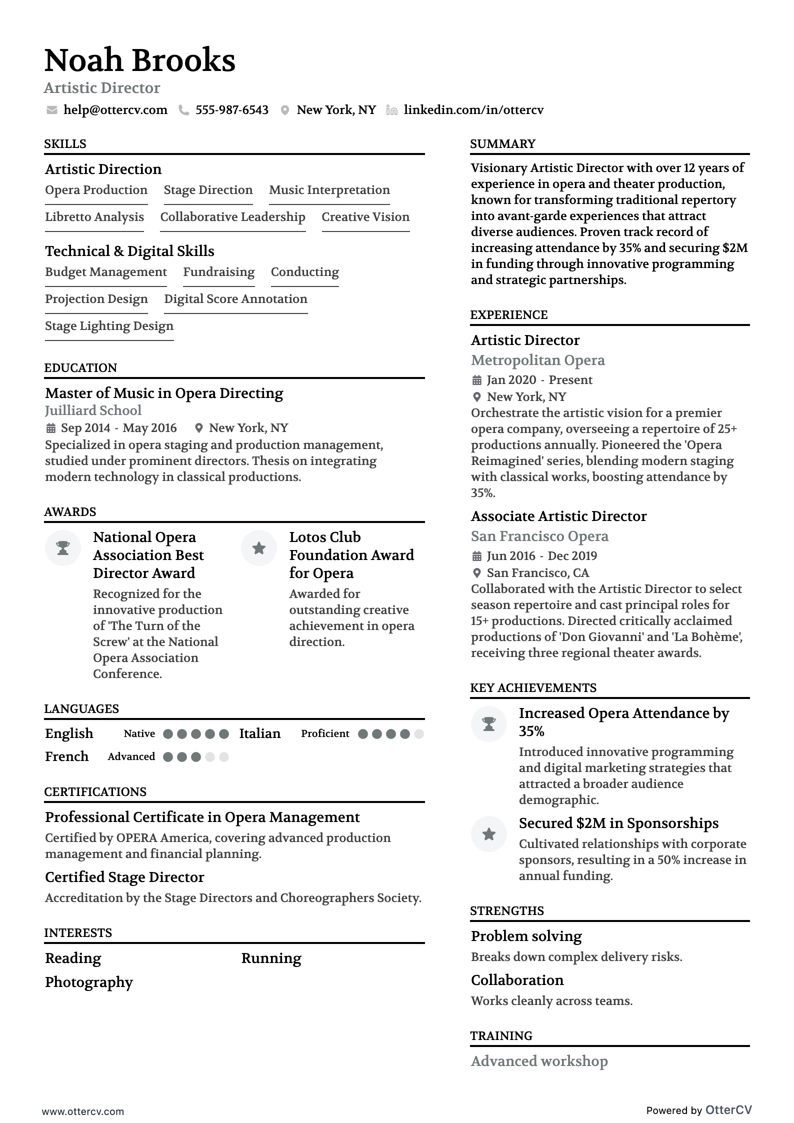
Opera Artistic Director full preview

10 Artistic Director Resume Examples

OtterCV

Written by The OtterCV Team

Updated: 1/21/2024•8 min read

See all resume examples in this guide, or generate your own resume example with your personalized prompt

Opera Artistic Director resume example

Opera Artistic Director

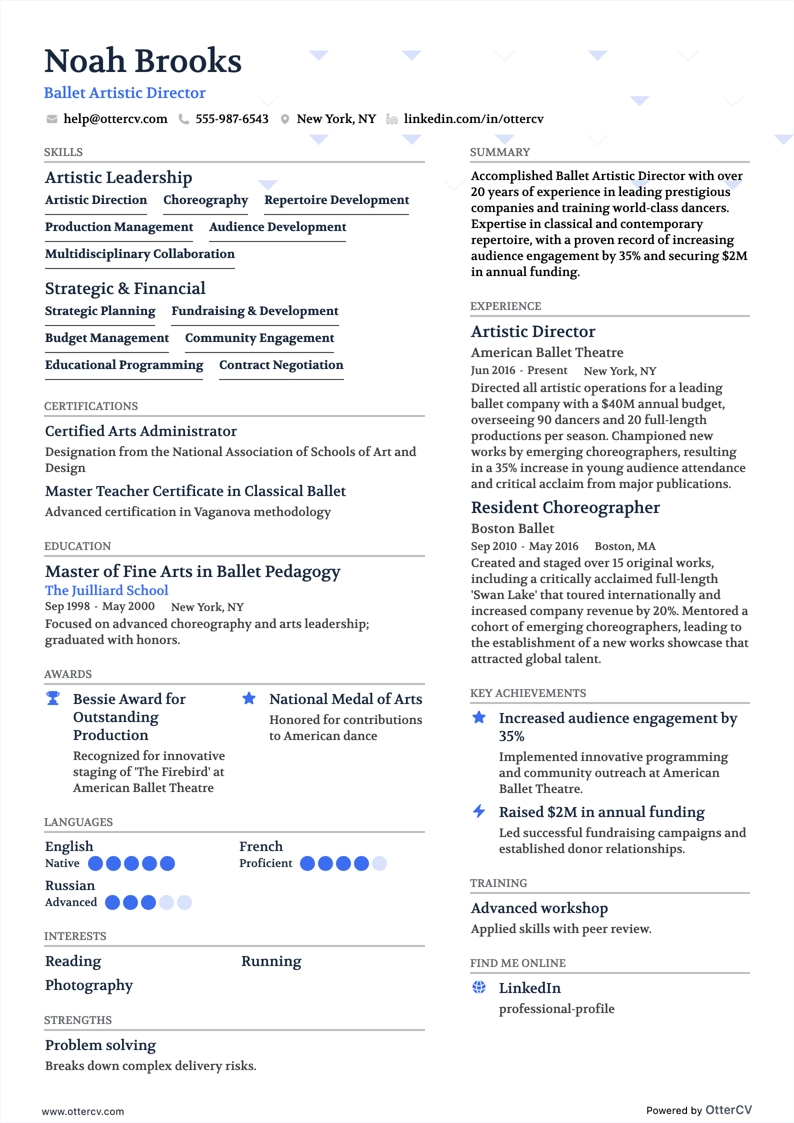
Ballet Artistic Director resume example

Ballet Artistic Director

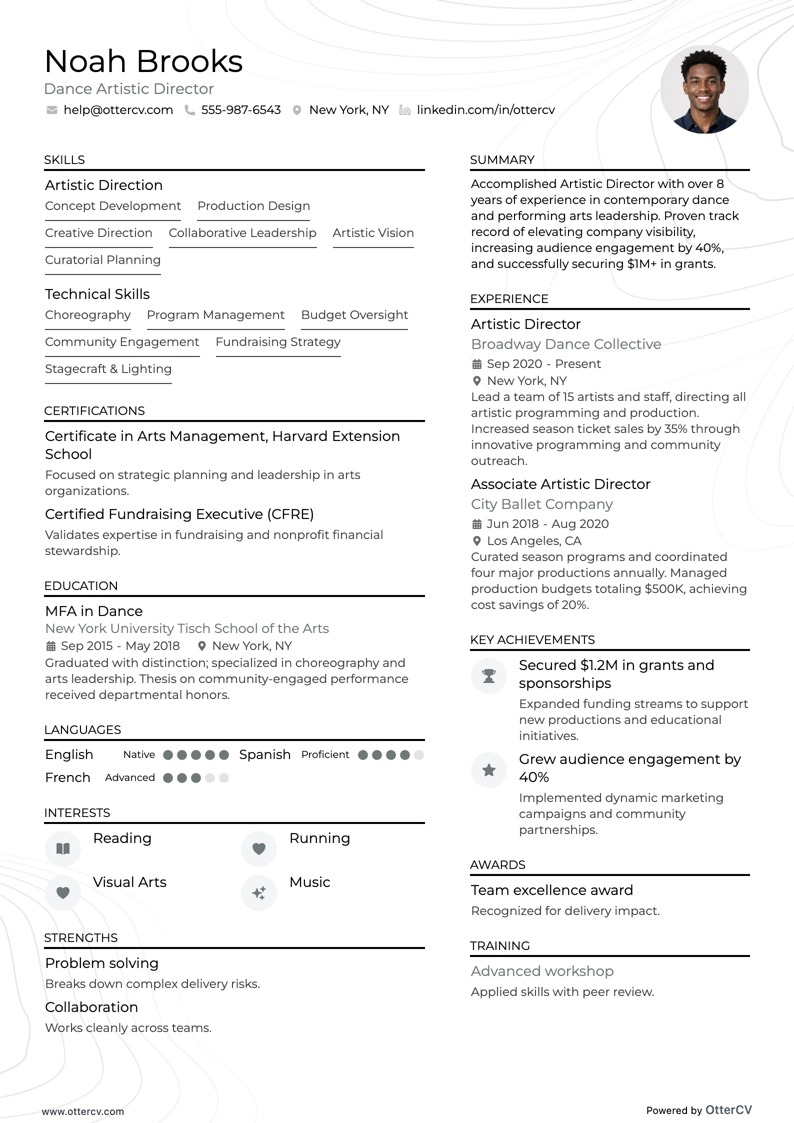
Dance Artistic Director resume example

Dance Artistic Director

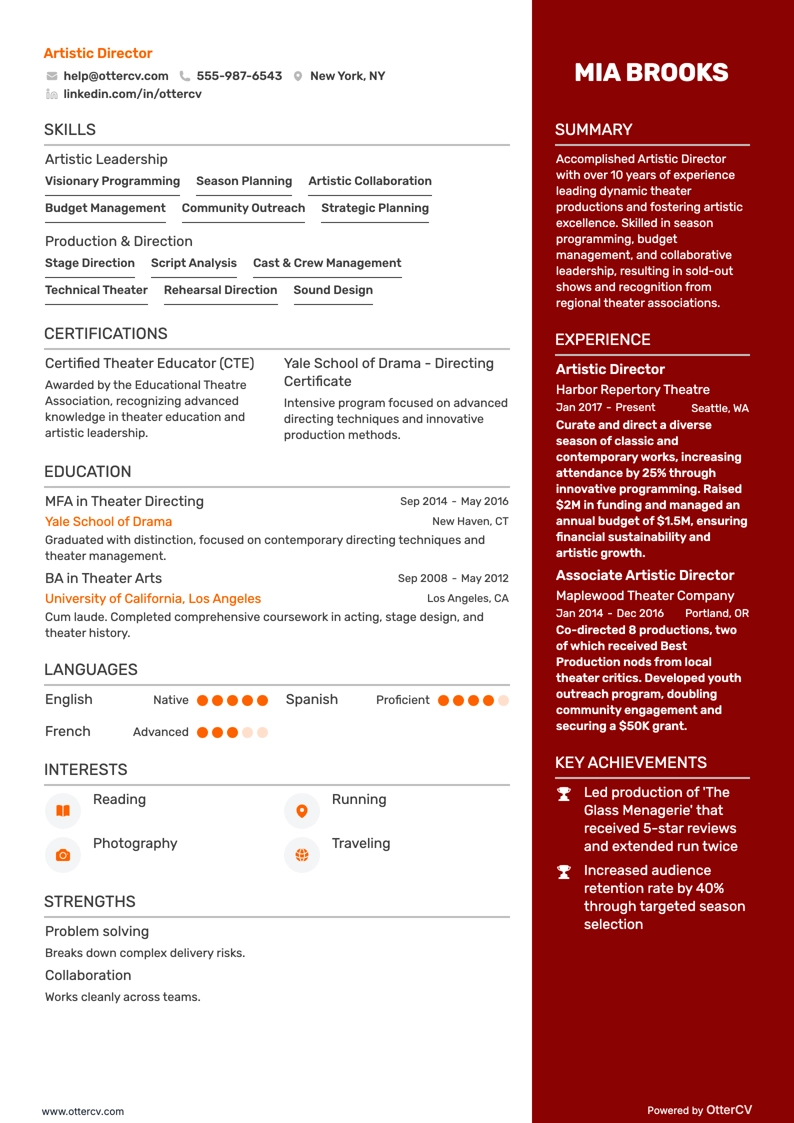
Theater Artistic Director resume example

Theater Artistic Director

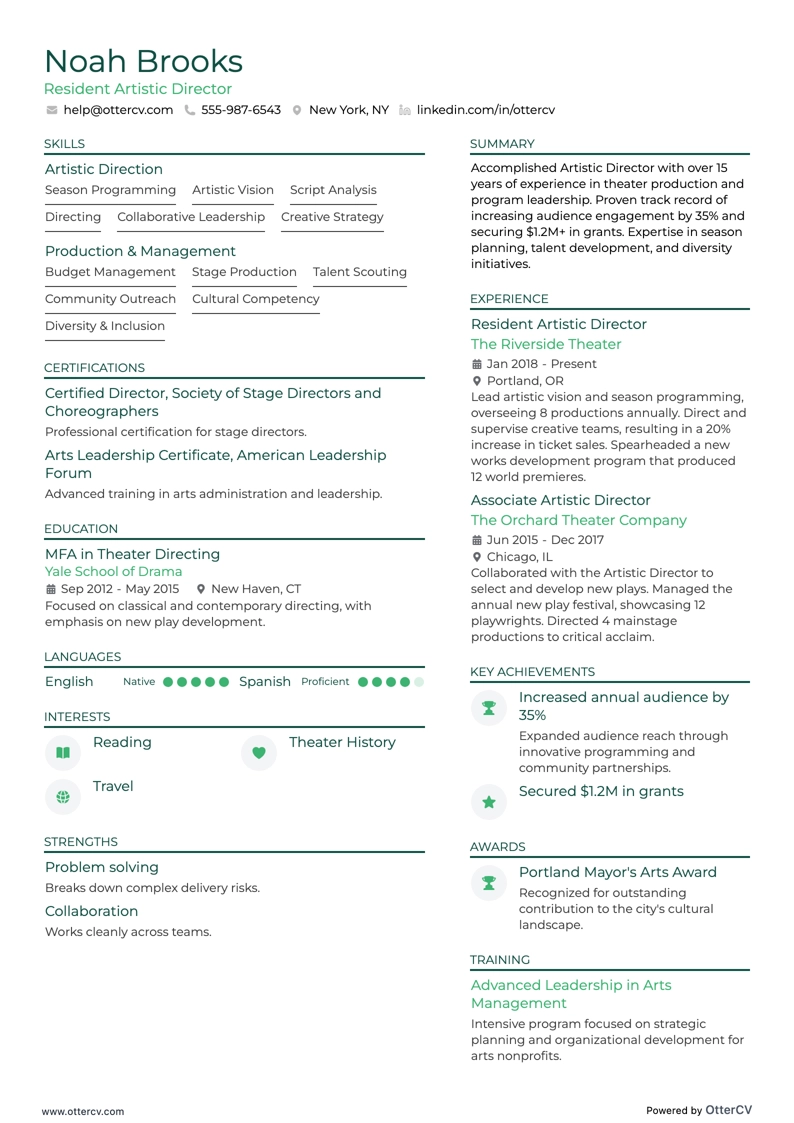
Resident Artistic Director resume example

Resident Artistic Director

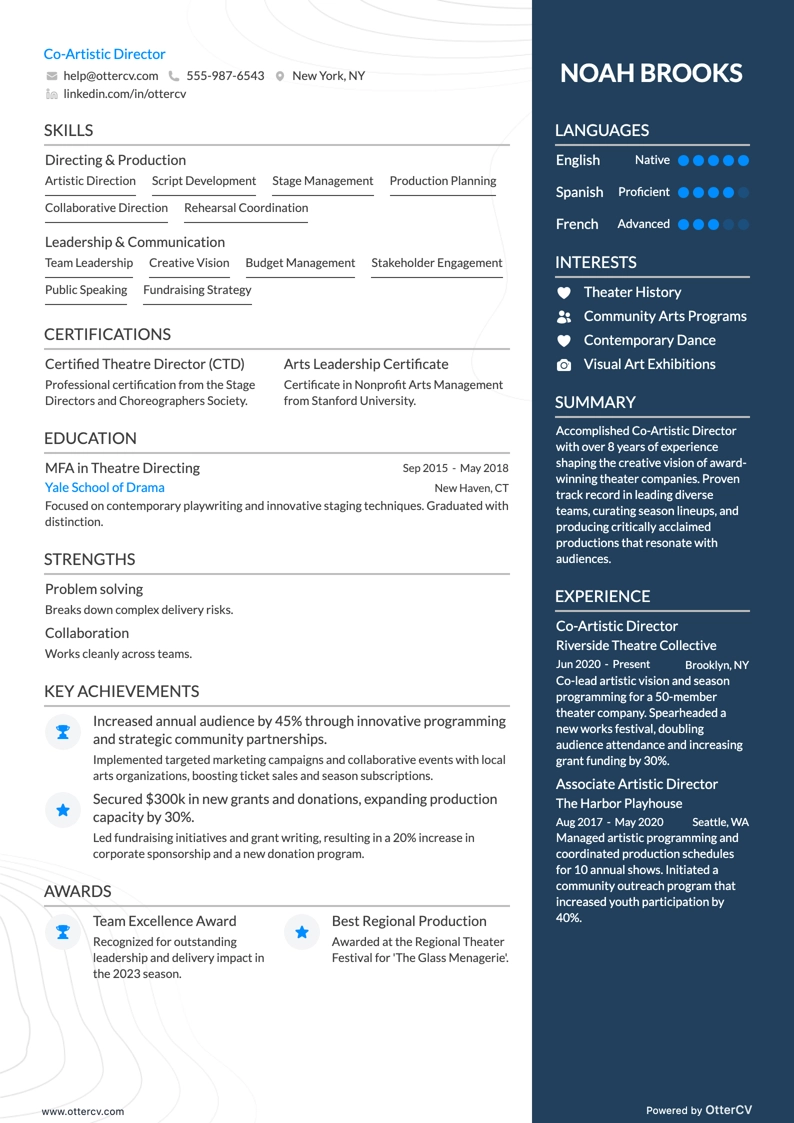
Co-Artistic Director resume example

Co-Artistic Director

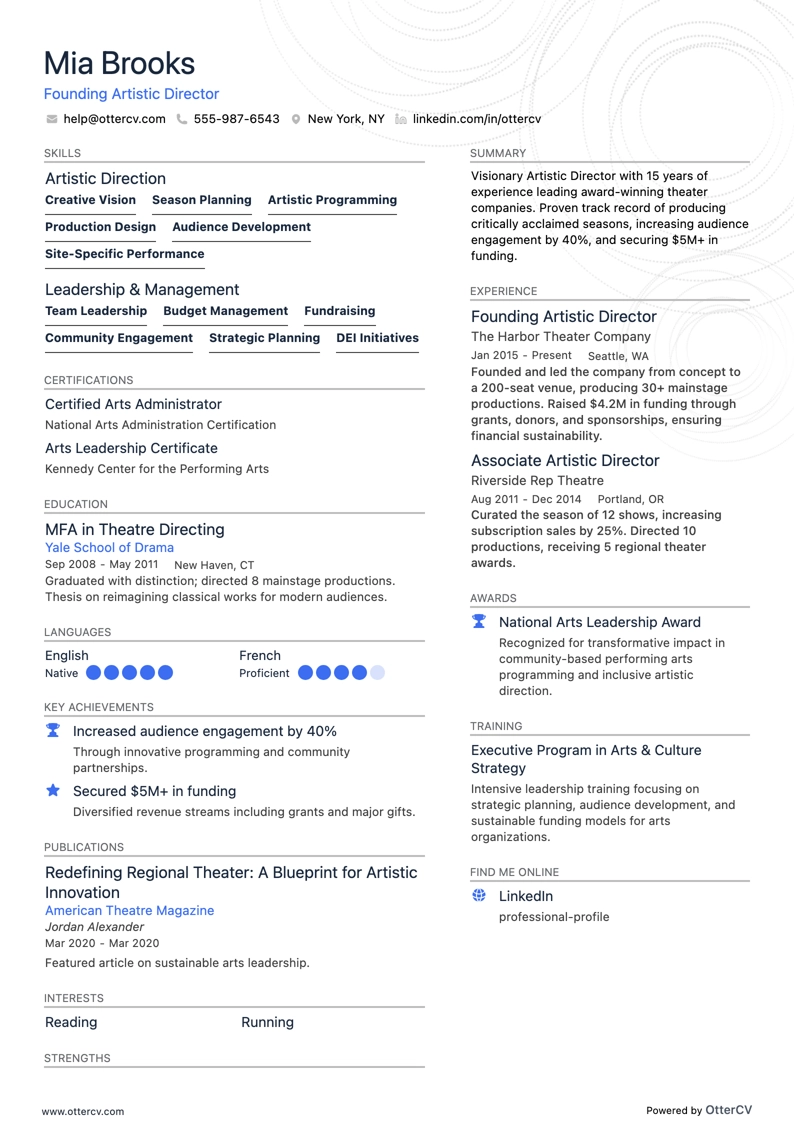
Founding Artistic Director resume example

Founding Artistic Director

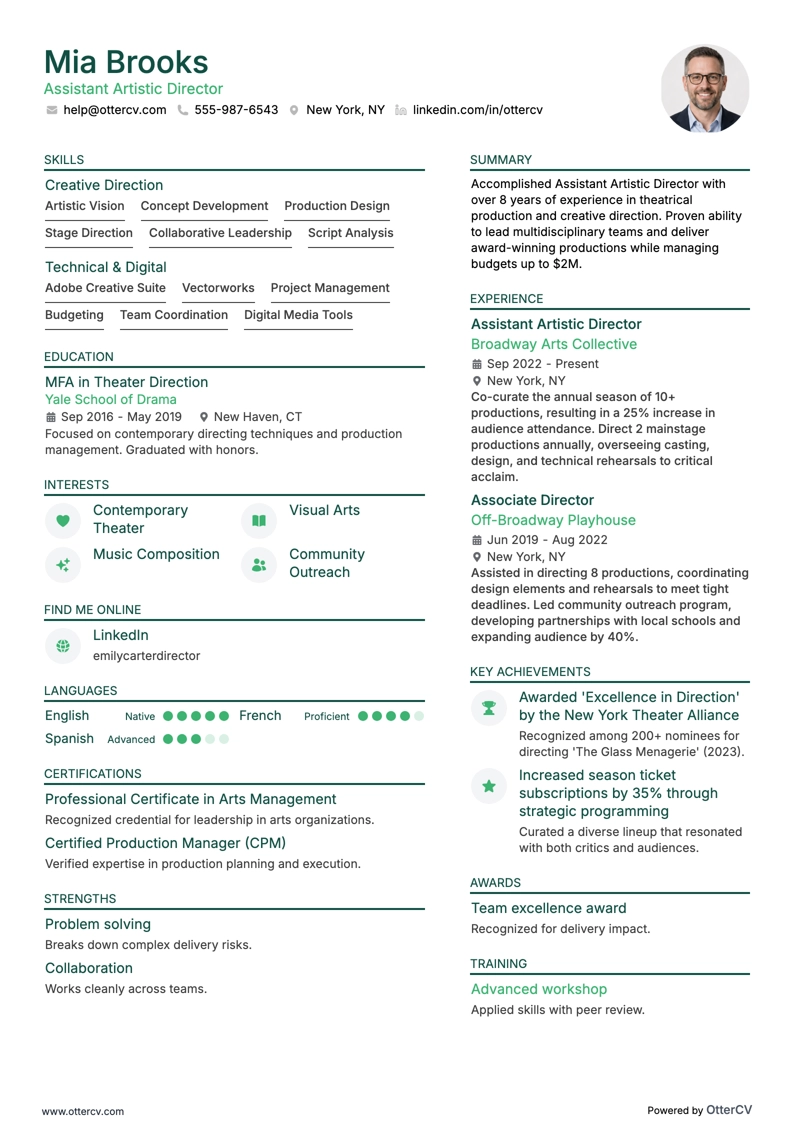
Assistant Artistic Director resume example

Assistant Artistic Director

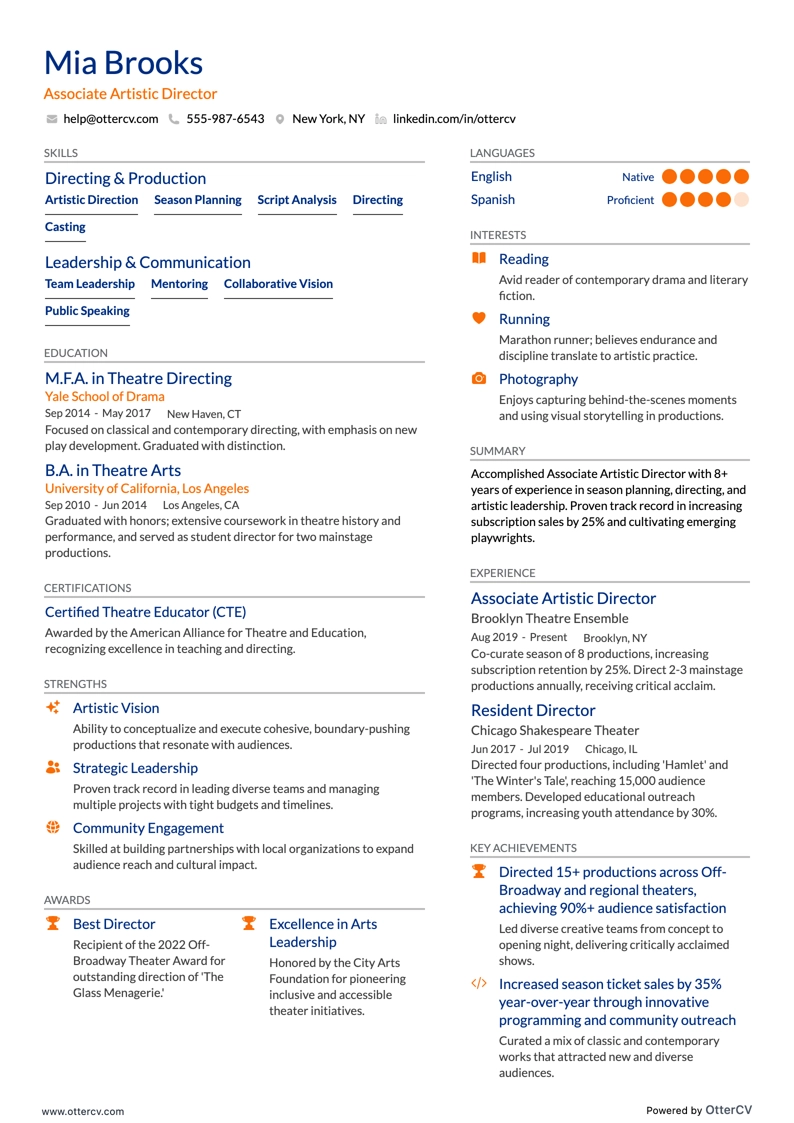
Associate Artistic Director resume example

Associate Artistic Director

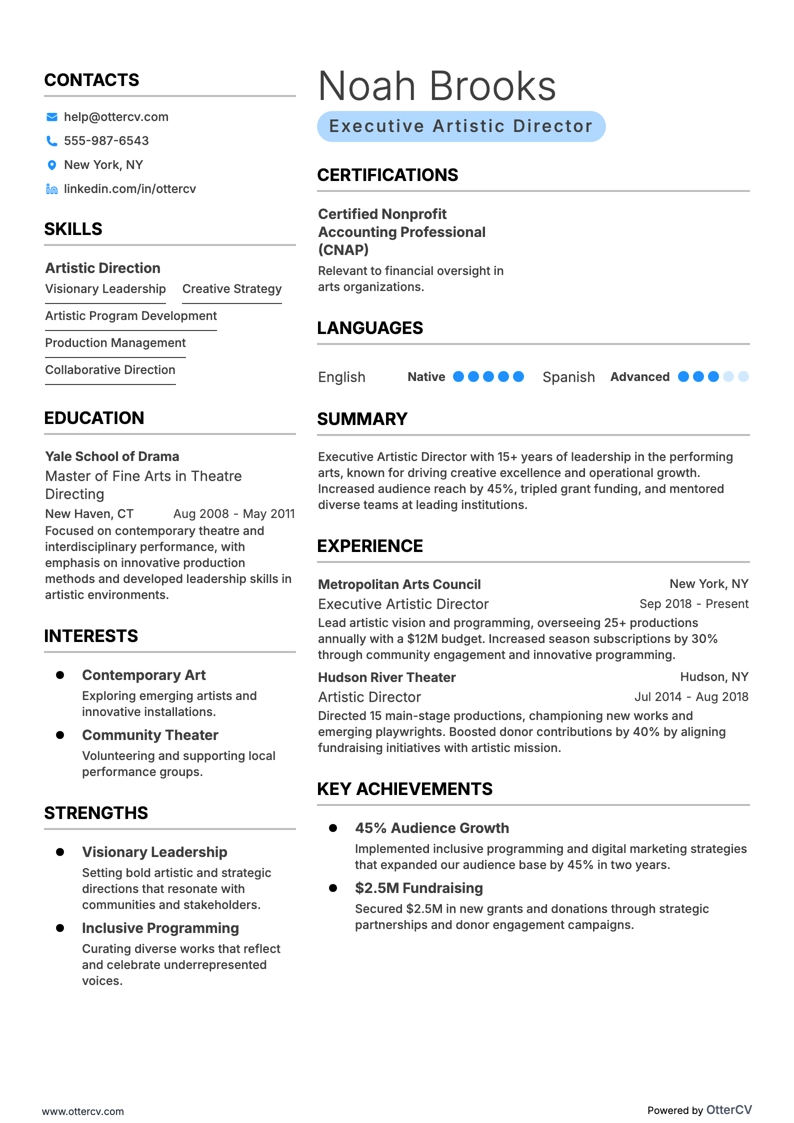
Executive Artistic Director resume example

Executive Artistic Director

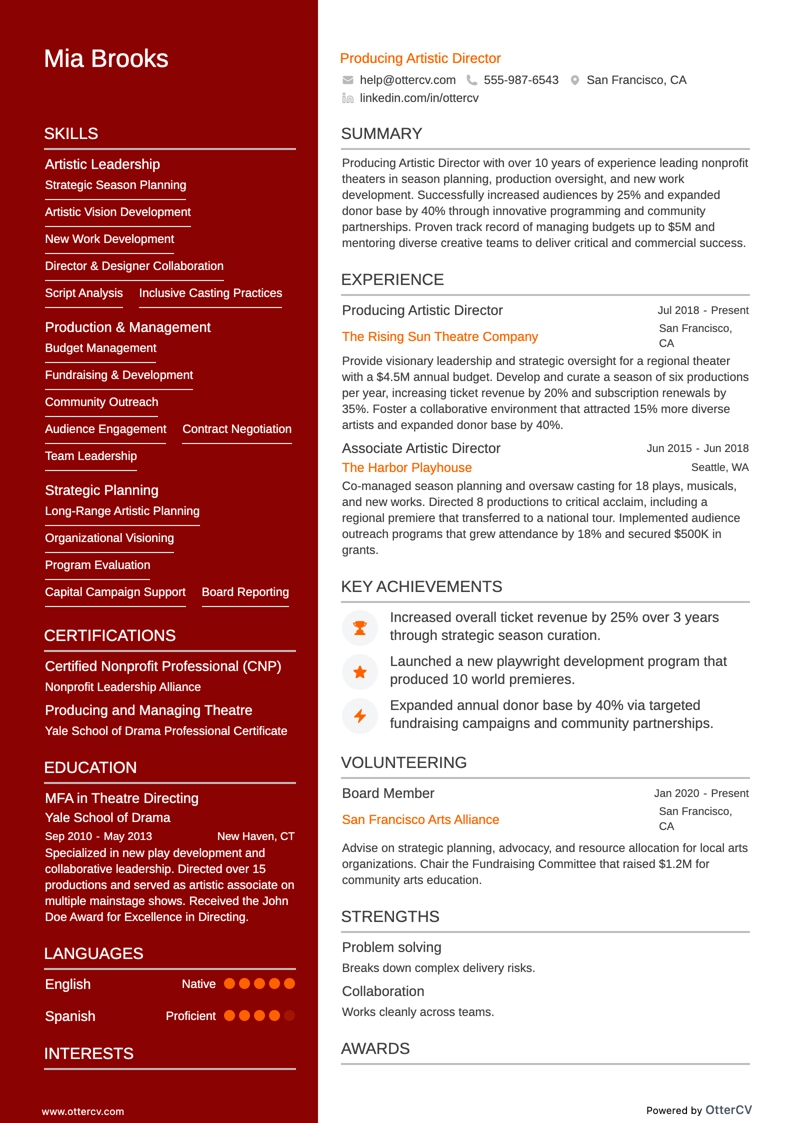
Producing Artistic Director resume example

Producing Artistic Director

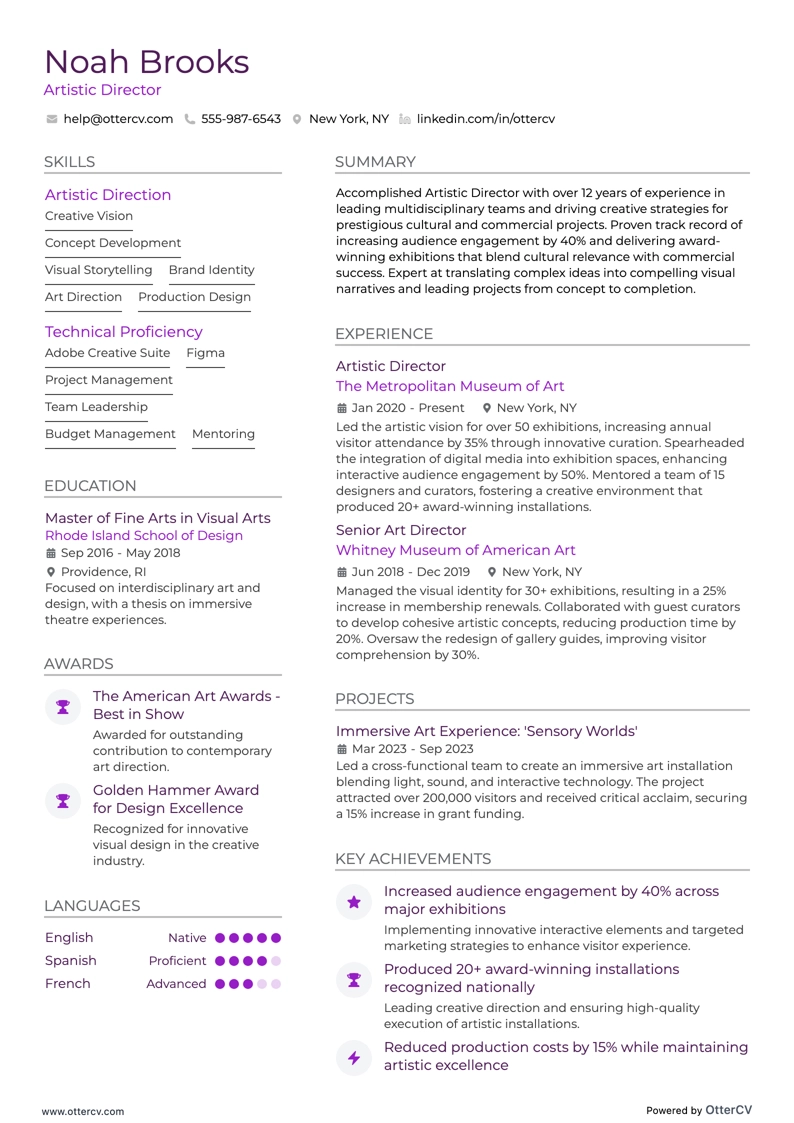
Artistic Director resume example

Artistic Director

Most artistic director resume submissions fail because they read like portfolios in prose rather than decision documents. An artistic director resume needs scannable proof of leadership and results, or it may be filtered out by ATS screening and dismissed during rapid recruiter scans.

A strong resume shows what changed because you led the work. Knowing how to make your resume stand out means highlighting campaign lift, audience growth, budget ownership, team size, on-time launches, brand consistency gains, award wins, and quality improvements measured by fewer revisions.

Key takeaways

  • Use a reverse-chronological format to present your creative leadership progression clearly.

  • Quantify each experience bullet with metrics such as revenue, audience growth, or efficiency gains.

  • Tailor your resume to each job posting by reflecting its tools, terms, and priorities.

  • Show your skills through achievements in your experience section, not only in a standalone list.

  • Open your summary with outcomes and scope instead of vague phrases like "creative visionary."

  • Use Echocv's Bullet Point Generator to turn routine duties into measurable, recruiter-ready bullets.

  • Stop using AI once your resume accurately reflects your real experience, and never fabricate claims.

How to format a artistic director resume

Recruiters reviewing artistic director candidates look for clear evidence of creative leadership scope, strategic vision that influenced organizational direction, and measurable results tied to audience growth, revenue, or brand positioning. A reverse-chronological format brings these signals forward immediately, helping hiring committees follow your progression from creative contributor to decision-maker without searching through disconnected sections.

I have significant experience in this role—which format should I use?

I have significant experience in this role—which format should I use?

Use a reverse-chronological format. It is the strongest choice for an artistic director with a proven leadership track record.

Do:

  • Lead each role entry with your scope of oversight, including team size, budget authority, number of productions or campaigns directed, and institutional partnerships you owned.
  • Highlight domain-specific expertise such as season programming, brand identity development, casting direction, cross-departmental collaboration with marketing and development teams, and proficiency with tools like Adobe Creative Suite, Vectorworks, or project management platforms.
  • Quantify business and creative impact in every bullet by tying your artistic decisions to attendance figures, fundraising results, critical recognition, or audience engagement metrics.

Example bullet: “Conceived and directed a five-production inaugural season that increased subscriber renewals by 34% and generated $1.2M in new ticket revenue, establishing the company's regional reputation within two years.”

Why hybrid and functional resumes don't work for senior roles

Why hybrid and functional resumes don't work for senior roles

Hybrid formats weaken your leadership narrative by separating key competencies into a standalone skills section, removing the institutional context and timeline that show you delivered results at scale. Functional formats go even further by eliminating chronological accountability, making it harder for reviewers to understand how your creative vision developed, how your scope of authority grew, and how your decisions built on one another across roles.

For artistic director positions, avoid both hybrid and functional resumes. If you need to explain a gap or a more complex career path, do it in a brief summary statement or cover letter rather than giving up the progression-based structure hiring committees expect. For more guidance, see our complete guide to resume format.

  • A functional format may be acceptable only if you're moving into artistic direction from a closely related field, such as lead choreographer or creative director in advertising, and do not have a sequence of leadership titles to show. Even then, every skill should be tied to a specific project, production, or measurable outcome instead of being listed on its own.
Once your layout and formatting create a clean, readable foundation, the next step is choosing sections that give every part of your resume a clear purpose.

What sections should go on a artistic director resume

Recruiters want to quickly understand your creative leadership, production track record, and measurable results across teams, budgets, and audiences. Knowing what to put on a resume helps ensure each section earns its place.

Use this structure for maximum clarity:

  • Header
  • Summary
  • Experience
  • Skills
  • Projects
  • Education
  • Certifications
  • Optional sections: Awards, Publications, Languages

Strong experience bullets should highlight your creative direction impact, audience or revenue outcomes, ownership of budgets and timelines, team size, and the scope of the productions or campaigns you led.

Now that you’ve identified the essential components to include, the next step is to write your artistic director resume experience section so those details show clear, role-relevant impact.

How to write your artistic director resume experience

Your experience section should prove that you’ve shaped and delivered creative work through vision-setting, directorial leadership, and role-specific methods such as brand storytelling, production oversight, or visual identity development—and that your work led to measurable results. A targeted resume helps hiring managers see demonstrated impact instead of a list of duties, so each bullet should connect your artistic decisions to tangible outcomes.

Each entry should include:

  • Job title
  • Company and location (or remote)
  • Dates of employment (month and year)

Include three to five concise bullet points that explain what you owned, how you executed the work, and what results you delivered:

  • Ownership scope: the creative programs, productions, visual identities, seasonal campaigns, ensembles, or design teams you were directly responsible for as artistic director.
  • Execution approach: the directorial frameworks, design tools, production methodologies, creative review processes, or aesthetic standards you used to guide work from concept to final delivery.
  • Value improved: the changes you drove in creative quality, brand consistency, audience engagement, production efficiency, or artistic reputation relevant to the organization’s mission.
  • Collaboration context: how you worked with producers, designers, marketing teams, external artists, venue operators, or executive leadership to align creative vision with organizational goals.
  • Impact delivered: the outcomes your artistic direction produced, expressed through audience growth, critical reception, brand evolution, revenue influence, or institutional recognition rather than daily task lists.

Experience bullet formula

Experience bullet formula

Action verb + technology + what you built or fixed + measurable result

A artistic director experience example

Artistic Director

Lumen Studio | Brooklyn, NY
2021–Present

Brand and product design studio delivering multi-channel campaigns for direct-to-consumer and enterprise clients.

  • Led end-to-end creative direction for eight integrated campaigns per quarter using Adobe Creative Cloud (Photoshop, Illustrator, After Effects) and Figma, increasing conversion rate by 18% and reducing creative rework by 22%.
  • Built and maintained a modular design system and brand guidelines in Figma and Zeroheight, aligning ten designers, two product managers, and six engineers while cutting production time from ten days to seven days.
  • Directed photo and video production for paid social and web, including storyboards, shot lists, and on-set art direction, improving click-through rate by 14% and lowering cost per acquisition by 11% across Meta and TikTok.
  • Partnered with marketing, product, and analytics teams to run A/B tests on landing pages and email creative using Optimizely and Google Analytics, lifting revenue per session by 9% and increasing email revenue by 12%.
  • Managed a team of six across design, motion, and copywriting using Asana and Slack, and implemented critique rituals and QA checklists that reduced brand compliance issues by 35% and improved on-time delivery to 96%.

Now that you've seen how to structure your experience section, focus on aligning it with the specific requirements of each job posting.

How to tailor your artistic director resume experience

Recruiters review artistic director resumes through both human screening and applicant tracking systems, so tailoring your resume to the job description is essential. This helps your creative leadership, vision, and production expertise reflect what the hiring organization actually needs.

Ways to tailor your artistic director experience:

  • Match the creative software and production tools named in the job description.
  • Mirror the exact terminology used for artistic standards or methodologies.
  • Reflect the audience engagement or programming KPIs the posting prioritizes.
  • Include relevant genre or discipline experience, such as theater or dance.
  • Emphasize grant writing or fundraising involvement if the role requires it.
  • Highlight collaboration with designers and performers using the employer's framework language.
  • Align your season planning approach with the organization's stated vision.
  • Reference accessibility or equity initiatives when the posting mentions them.

Tailoring means aligning your real creative achievements with the role's stated requirements, not forcing disconnected keywords into your experience section.

Resume tailoring examples for artistic director

Resume tailoring examples for artistic director

Job description excerptUntailoredTailored

Once you’ve aligned your experience with the role’s priorities, the next step is to quantify your artistic director achievements so hiring teams can quickly see the impact you delivered.

How to quantify your artistic director achievements

Quantifying your work shows how your creative direction drove results, not just aesthetics. Focus on revenue lift, audience growth, production efficiency, stakeholder approval speed, and quality consistency across campaigns, shoots, and brand systems. For more strategies on quantifying achievements, review examples across different roles and industries.

Quantifying Examples for Artistic Director

MetricExample
Revenue impactRedesigned an ecommerce visual system in Figma and led photo direction, improving conversion rate from 2.1% to 2.6% and adding $480K in quarterly revenue.
Production efficiencyBuilt a reusable shot list and asset pipeline across photo and video, cutting average campaign turnaround from 18 days to 12 days for ten launches.
Quality consistencyIntroduced a brand QA checklist and color-management workflow, reducing rework rounds from three to two and lowering final-delivery defects by 35%.
Stakeholder approval speedAligned marketing, product, and legal through weekly creative reviews, reducing approval time from nine business days to five across eight campaigns.
Audience engagementLed art direction for paid social and email creatives, increasing click-through rate from 1.4% to 1.9% and lifting subscriber growth by 22% in six months.

Once you have strong, results-driven bullet points, make sure your skills section clearly highlights the hard and soft skills that define your expertise as an artistic director.

How to list your hard and soft skills on a artistic director resume

Your skills section shows how you turn creative vision into brand-consistent work. Recruiters and applicant tracking systems scan it for role keywords, tool fit, and leadership scope, so most artistic director resumes should present a balanced mix of hard skills and soft skills.

Artistic director roles require a blend of:

  • Product strategy and discovery skills.
  • Data, analytics, and experimentation skills.
  • Delivery, execution, and go-to-market discipline.
  • Soft skills.

Your skills section should be:

  • Scannable, with bullet-style grouping.
  • Relevant to the job post.
  • Backed by proof in your experience bullets.
  • Updated with current tools.

Place your skills section:

  • Above experience if you're junior or switching careers.
  • Below experience if you're mid/senior and have strong achievements.

Hard skills

  • Brand identity systems.
  • Art direction and visual storytelling.
  • Creative concept development.
  • Typography, layout, and grid systems.
  • Adobe Creative Cloud: Photoshop, Illustrator, and InDesign.
  • Figma and Adobe XD.
  • Motion design with After Effects and Premiere Pro.
  • Design systems and component libraries.
  • Print production, prepress, and color management.
  • Photo shoot production and set design.
  • Digital campaign assets and social content.
  • Accessibility standards (WCAG).

Soft skills

  • Aligns creative vision across teams.
  • Collaborates effectively across functions.
  • Delivers constructive critique clearly.
  • Manages stakeholder expectations.
  • Translates creative briefs into actionable direction.
  • Prioritizes work under tight deadlines.
  • Makes decisions within constraints.
  • Mentors and coaches team members.
  • Directs vendors and freelancers.
  • Resolves conflicts during reviews.
  • Maintains quality control and consistency.
  • Takes ownership of end-to-end delivery.

How to show your artistic director skills in context

Skills should not live only in a dedicated skills list. Explore our resume skills resource to see how top candidates weave their abilities throughout their resumes.

Show your skills in:

  • Your summary, which presents your high-level professional identity
  • Your experience, which proves your skills through outcomes

Here is what that looks like in practice.

Artistic director with 12 years of experience in regional theater, specializing in production design, casting, and brand storytelling with Vectorworks and Adobe Creative Suite. Led a seasonal rebrand that increased subscription renewals by 34%.

  • Clearly reflects senior-level experience.
  • Directly names tools relevant to the role.
  • Includes a concrete, measurable outcome.
  • Signals leadership and creative vision.

Experience Example

Artistic Director

Bellweather Theatre Collective | Portland, OR

June 2018–Present

  • Directed 28 productions across four seasons, increasing average audience attendance by 41% through bold programming and community partnerships.
  • Collaborated with a 15-person creative team using Figma and Vectorworks to align set, lighting, and costume design across productions.
  • Launched a new works incubator program that secured $220K in grant funding and built relationships with 12 emerging playwrights.
  • Each bullet includes measurable proof.
  • Skills are shown naturally through achievements.

Once you’ve shown your directing strengths through concrete examples, the next step is applying that same approach to an artistic director resume with no experience so you can present relevant skills without relying on formal roles.

How do I write a artistic director resume with no experience

Even without full-time experience, you can demonstrate readiness through projects such as:

  • Student theater production art direction
  • Short film visual concept development
  • Gallery or pop-up exhibition design
  • Brand style guide personal project
  • Community mural planning and execution
  • Freelance set dressing for shoots
  • Volunteer creative lead for events
  • Social media campaign art direction

Our guide on building a resume without work experience offers detailed strategies for showcasing these types of projects effectively.

Focus on:

  • Portfolio links with final visuals
  • Clear scope, role, and deliverables
  • Tools used: Adobe Creative Suite
  • Measurable results: reach, sales, attendance

Resume format tip for entry-level artistic director

Resume format tip for entry-level artistic director

Use a combination resume to highlight projects and tools first, while still including relevant experience such as internships, volunteer work, and freelance roles.

Do:

  • Lead with a “Projects” section.
  • Add portfolio links beside projects.
  • List tools with proficiency levels.
  • Quantify outcomes with real metrics.
  • Match keywords to each job post.

Example project bullet:

  • Art directed a student theater production using Adobe Photoshop and InDesign, delivered a cohesive visual system, and increased ticket sales by 18% over last semester.

Even without direct experience, your education can provide a strong foundation for an artistic director resume when presented clearly.

How to list your education on a artistic director resume

Your education section helps hiring teams confirm you have the creative and strategic foundation the role requires. It also shows relevant training in visual arts, theater, or design leadership.

Include:

  • Degree name
  • Institution
  • Location
  • Graduation year
  • Relevant coursework (for juniors or entry-level candidates)
  • Honors and GPA (if 3.5 or higher)

Avoid listing specific months or days. Using only the graduation year creates a cleaner, more professional presentation.

Here’s a strong education entry tailored for an artistic director resume.

Example education entry

Master of Fine Arts in Theater Directing

Yale School of Drama, New Haven, CT

Graduated 2018

GPA: 3.8/4.0

  • Relevant Coursework: Advanced Stage Direction, Visual Storytelling, Creative Leadership, and Production Design
  • Honors: Dean's Award for Excellence in Directing

How to list your certifications on a artistic director resume

Certifications can demonstrate an artistic director's commitment to learning, proficiency with creative tools, and alignment with current industry standards and workflows.

Include the following details:

  • Certificate name
  • Issuing organization
  • Year
  • Optional: credential ID or URL
  • List certifications below education when they are older, less role-specific, or secondary to your degree and core artistic director experience.
  • List certifications above education when they are recent, highly relevant, or required for the artistic director role you are targeting.

Best certifications for your artistic director resume

  • Adobe Certified Professional (ACP) in Graphic Design & Illustration Using Adobe Illustrator.
  • Adobe Certified Professional (ACP) in Visual Design Using Adobe Photoshop.
  • Adobe Certified Professional (ACP) in Video Design Using Adobe Premiere Pro.
  • Autodesk Certified Professional: AutoCAD for Design and Drafting.
  • Scrum Alliance Certified ScrumMaster (CSM).
  • Google Project Management: Professional Certificate.
  • AIGA Design Business and Ethics Certificate Program.

Once you’ve positioned your credentials to reinforce your expertise, you’re ready to write your artistic director resume summary so your value is clear from the start.

How to write your artistic director resume summary

Your resume summary is often the first thing a recruiter reads, so it should quickly communicate your value. For an artistic director, that means showing creative leadership, strategic vision, and measurable impact within seconds.

Keep it to three to four lines and include:

  • Your title and total years of experience in creative or artistic leadership.
  • Your area of specialization, such as theater, advertising, publishing, or digital media.
  • Core skills like brand strategy, creative direction, team leadership, or production oversight.
  • One or two quantified achievements, such as audience growth, revenue impact, or awards won.
  • Soft skills tied to real outcomes, such as cross-functional collaboration that improved production timelines.

PRO TIP

At the director level, lead with outcomes and scope instead of listing tools or day-to-day tasks. Focus on the decisions you owned, the teams you built, and the business results you drove.

Avoid vague phrases like "passionate visionary" or "creative thinker." Use specifics instead, such as budget sizes, audience figures, or campaign performance. Skip motivational language entirely.

Example summary for a artistic director

Artistic director with 12 years of experience leading creative teams across theater and branded content. Grew a seasonal subscriber base by 34% while managing a $2.1M production budget. Known for aligning artistic vision with organizational revenue goals.

Now that your summary reflects your creative vision and leadership strengths, make sure your resume header includes the contact details recruiters need to reach you.

What to include in a artistic director resume header

A resume header includes your main identifying and contact details. For a artistic director role, it also helps improve visibility, credibility, and recruiter screening.

Essential resume header elements:

  • Full name
  • Tailored job title and headline
  • Location
  • Phone number
  • Professional email
  • GitHub link
  • Portfolio link
  • LinkedIn

A LinkedIn link helps recruiters quickly verify roles, dates, and recommendations, which supports faster screening.

Do not include photos on a artistic director resume unless the role is explicitly front-facing or appearance-dependent.

Keep your header consistent with your portfolio branding, and match your job title to the posting to reduce screening friction.

Example

Once your header clearly identifies you and makes it easy for hiring managers to contact you, strengthen your resume by adding the most relevant additional sections.

Additional sections for artistic director resumes

If your core sections do not fully reflect the breadth of your creative leadership, additional sections can help set you apart from other artistic director candidates. For example, listing language skills can be especially useful for roles involving international productions or multilingual audiences.

  • Languages
  • Awards and honors
  • Publications and critical writing
  • Festival and jury participation
  • Board memberships and arts affiliations
  • Speaking engagements and panels
  • Notable collaborations

Once your resume shows the full scope of your expertise, the next step is pairing it with a cover letter that helps hiring committees connect the dots.

Do artistic director resumes need a cover letter

A cover letter is not required for an artistic director role, but it often helps in competitive searches or when a hiring team expects one. If you are unsure about the basics, learn what a cover letter is and when it can make the biggest difference. It can help you stand out when your resume needs more context or when you need to show clear fit quickly.

Use a cover letter to provide context your resume cannot:

  • Explain your fit for the role and team by aligning your leadership style with the organization’s creative process, stakeholders, and pace.
  • Highlight one or two relevant projects or outcomes, and connect your decisions to measurable results such as engagement, revenue, or production efficiency.
  • Show that you understand the product, users, or business context by referring to the audience, brand constraints, and success metrics.
  • Address career transitions or less obvious experience by explaining the throughline, your transferable skills, and why the move makes sense for this artistic director role.

Using AI to improve your artistic director resume

Once you’ve decided whether to include a cover letter to add context beyond your resume, you can use AI to strengthen your artistic director resume more quickly and consistently.

AI can improve your resume’s clarity, structure, and impact. It can help refine language and highlight measurable results, but overusing it can make your resume feel less authentic. Once your content is clear and aligned with the role, step away from AI entirely. For practical prompts and strategies, see our guide on ChatGPT resume writing.

Here are 10 practical prompts to strengthen specific sections of your artistic director resume:

  1. Sharpen your summary. “Rewrite my artistic director resume summary to emphasize leadership scope, creative vision, and measurable audience or revenue outcomes in under four sentences.”
  2. Quantify experience bullets. “Review my artistic director experience bullets and suggest specific metrics—like attendance growth, budget size, or productions led—to replace vague language.”
  3. Tighten skills relevance. “Evaluate my skills section and remove entries that don't directly support an artistic director role in a mid-size theater or arts organization.”
  4. Strengthen action verbs. “Replace weak or repeated verbs in my artistic director experience section with precise, high-impact alternatives that convey creative leadership.”
  5. Align with job postings. “Compare my artistic director resume against this job description and identify missing keywords or qualifications I should address.”
  6. Refine project descriptions. “Rewrite my project entries to clearly show my artistic director responsibilities, creative decisions made, and final production outcomes.”
  7. Improve education relevance. “Reorganize my education section to highlight coursework, honors, or thesis work most relevant to an artistic director career path.”
  8. Clarify certification value. “Review my certifications and suggest which ones to prioritize on an artistic director resume based on industry recognition.”
  9. Eliminate filler language. “Identify and remove unnecessary adjectives, clichés, or redundant phrases throughout my artistic director resume without losing meaning.”
  10. Tailor for career level. “Adjust the tone and depth of my artistic director resume to reflect a senior leadership candidate with ten-plus years of experience.”

Stop using AI once your resume sounds accurate, specific, and grounded in real experience. AI should never invent experience or inflate claims—if it didn’t happen, it doesn’t belong here.

Conclusion

A strong artistic director resume shows impact through measurable results, role-specific skills, and a clear structure. Use numbers to highlight audience growth, budget performance, fundraising totals, and on-time delivery across productions and teams.

Keep your resume easy to scan with focused sections and consistent formatting. This approach shows you’re prepared for today’s hiring market and the next hiring cycle, while helping employers trust your leadership, taste, and execution.

Artistic Director resume examples

Explore additional Artistic Director resume samples and guides and see what works for your level of experience or role.

By Experience

Assistant Artistic Director

Assistant Artistic Director resume preview

Associate Artistic Director

Associate Artistic Director resume preview

Executive Artistic Director

Executive Artistic Director resume preview

Artistic Director resume examples

Explore additional Artistic Director resume samples and guides and see what works for your level of experience or role.

By Role

Opera Artistic Director

Opera Artistic Director resume preview

Ballet Artistic Director

Ballet Artistic Director resume preview

Dance Artistic Director

Dance Artistic Director resume preview

Theater Artistic Director

Theater Artistic Director resume preview

Resident Artistic Director

Resident Artistic Director resume preview

Co-Artistic Director

Co-Artistic Director resume preview

Founding Artistic Director

Founding Artistic Director resume preview

Producing Artistic Director

Producing Artistic Director resume preview

Artistic Director

Artistic Director resume preview