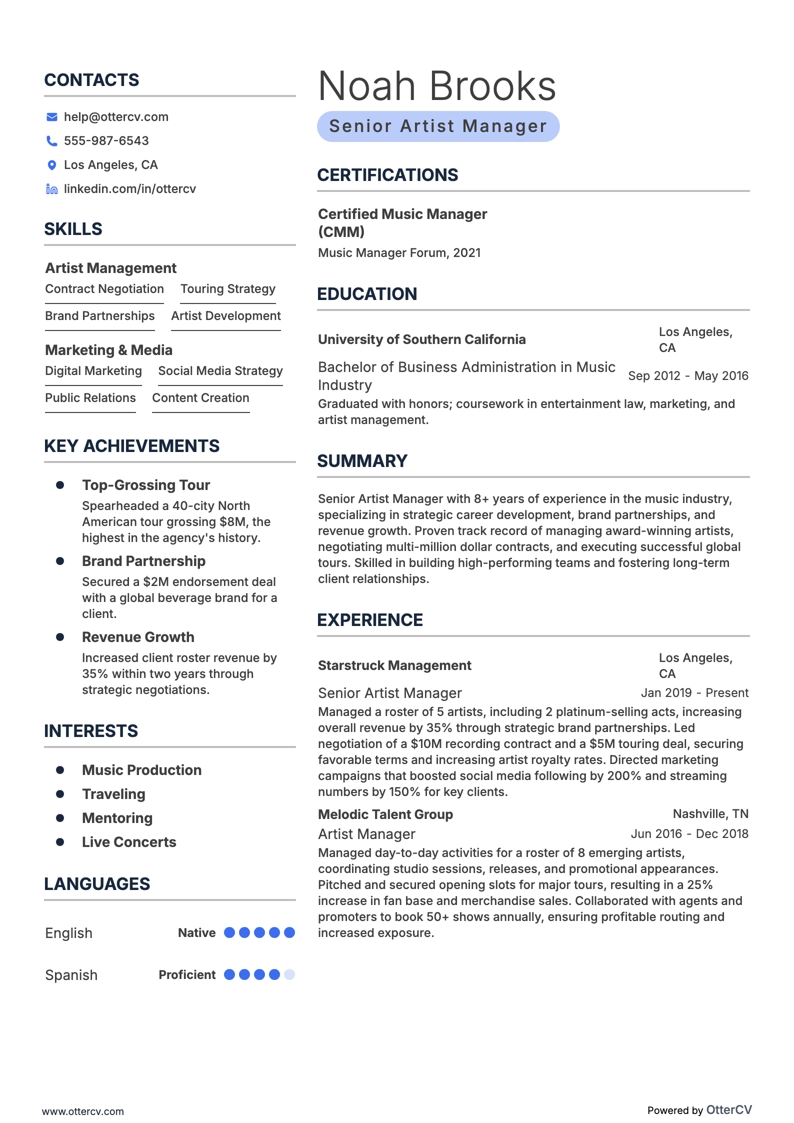
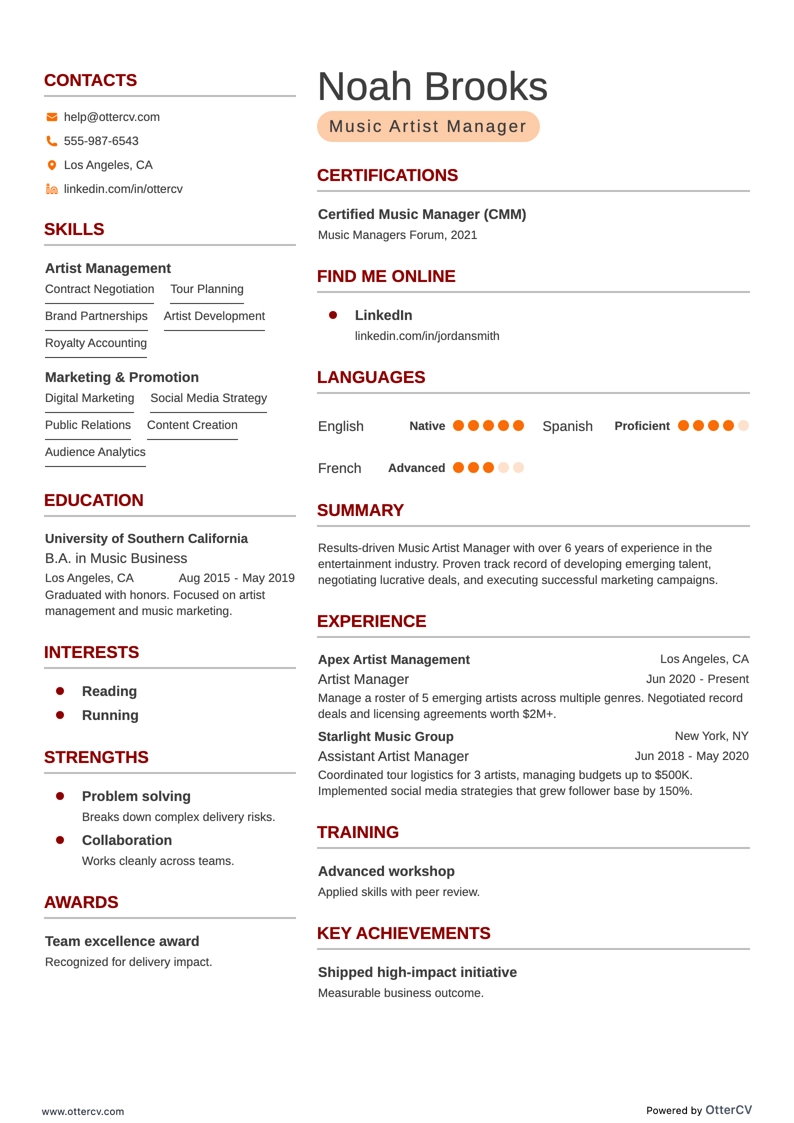
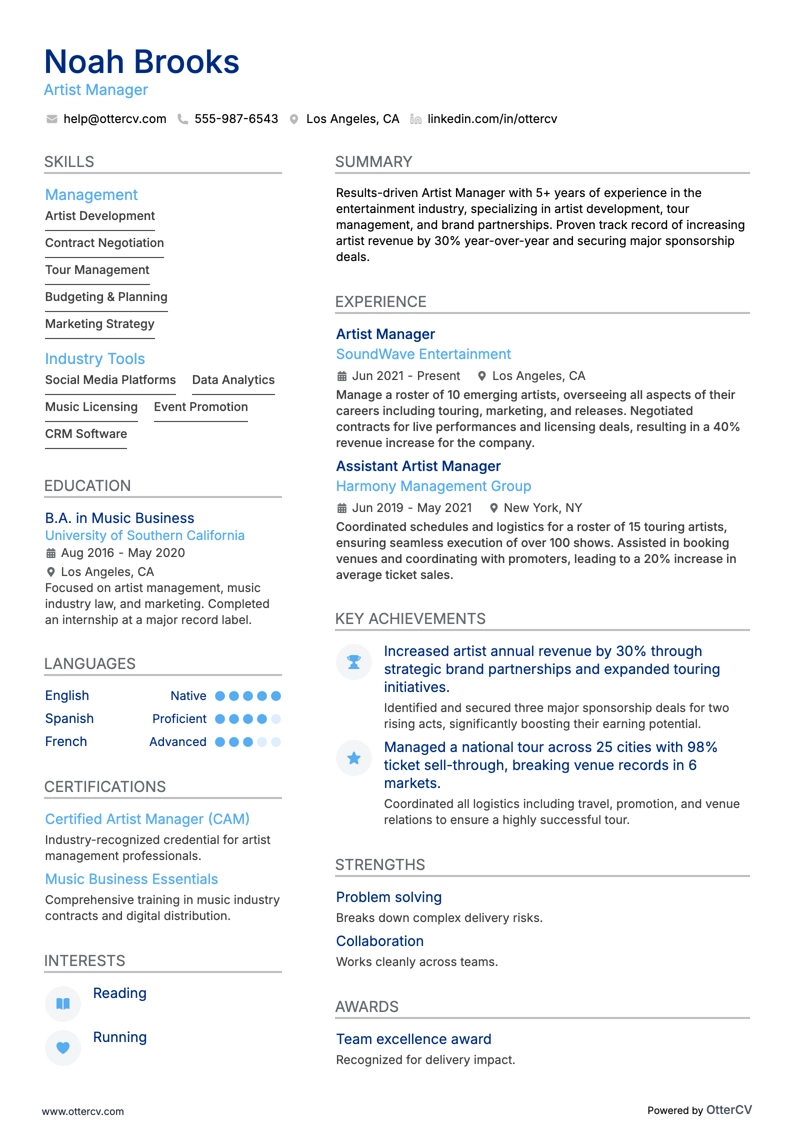
Senior Artist Manager full preview

10 Artist Manager Resume Examples

OtterCV

Written by The OtterCV Team

Updated: 6/21/2025•8 min read

See all resume examples in this guide, or generate your own resume example with your personalized prompt

Senior Artist Manager resume example

Senior Artist Manager

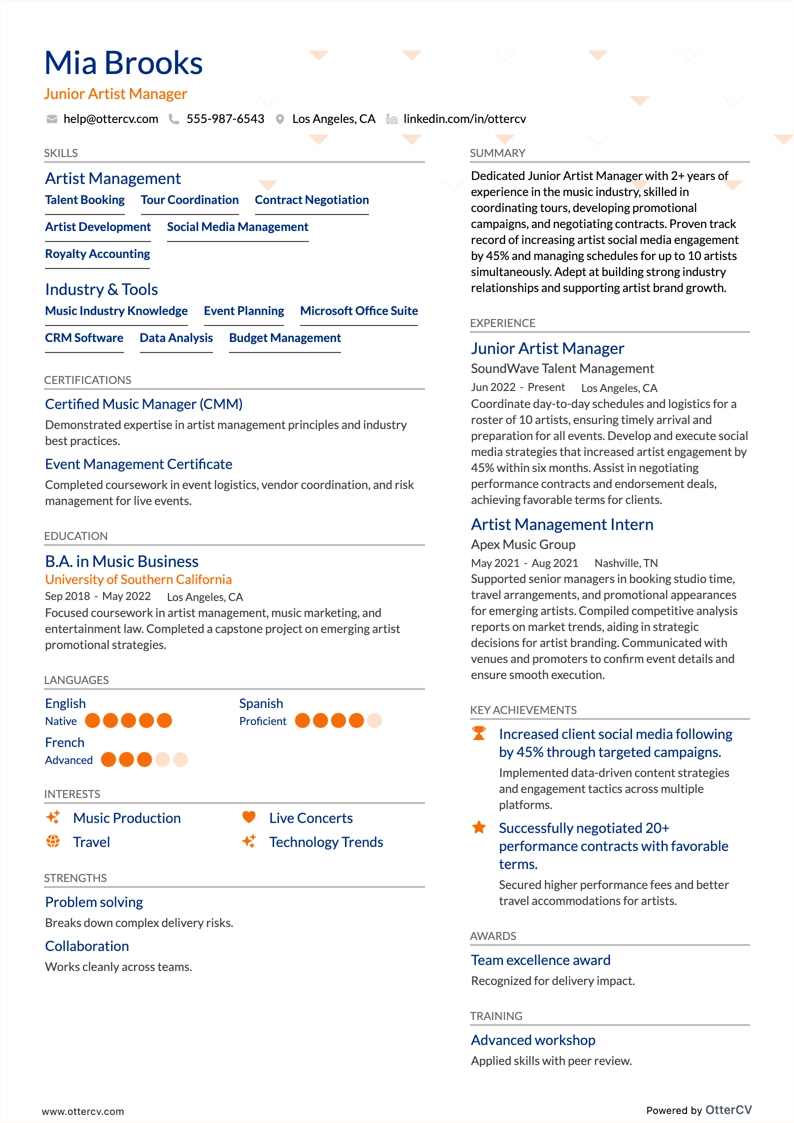
Junior Artist Manager resume example

Junior Artist Manager

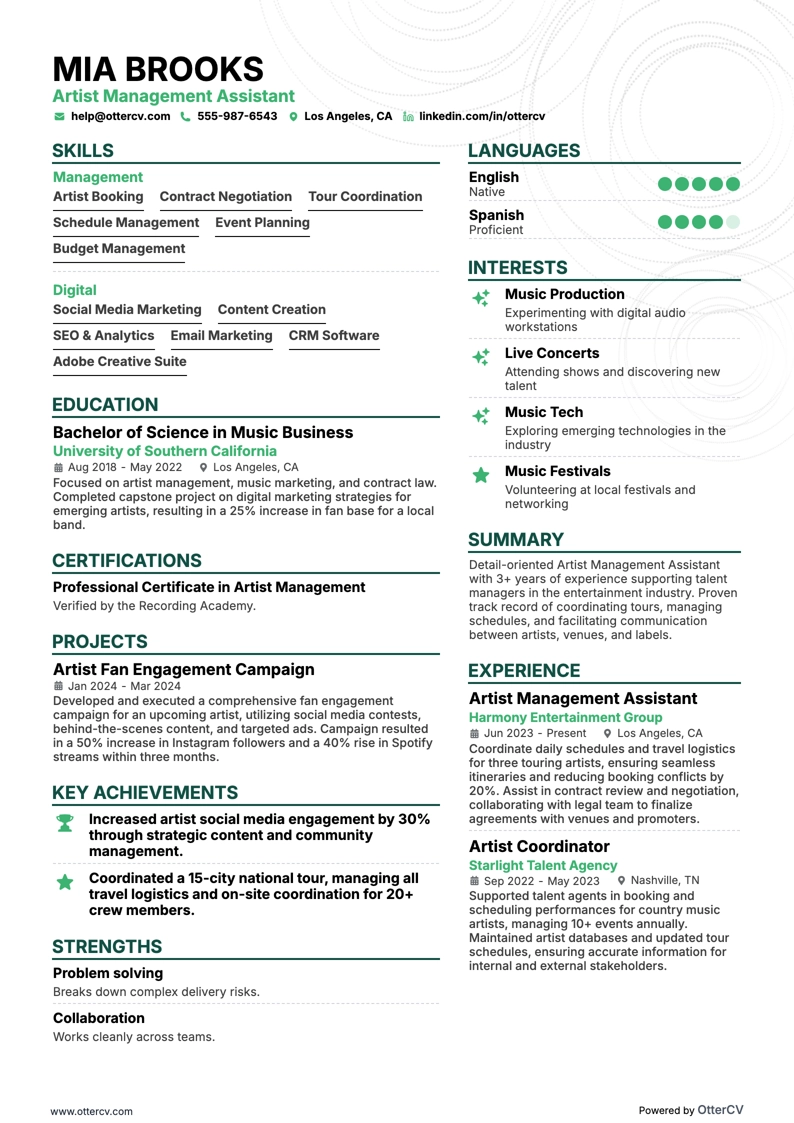
Artist Management Assistant resume example

Artist Management Assistant

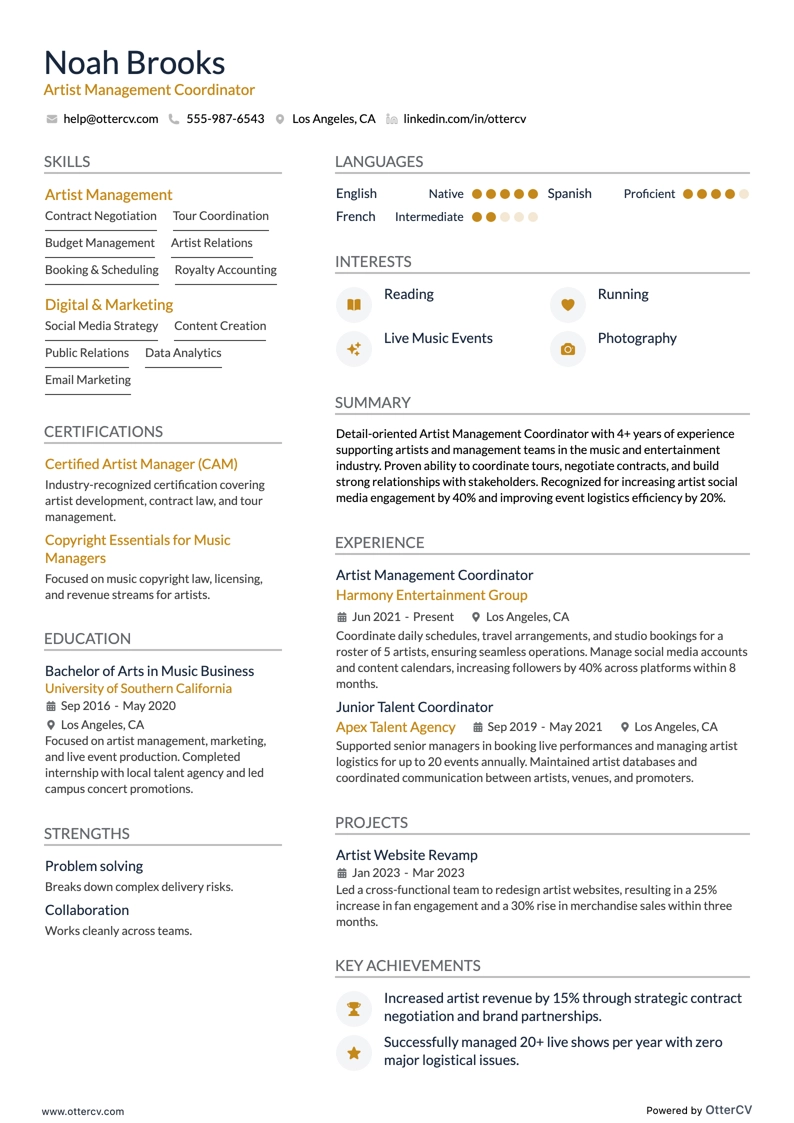
Artist Management Coordinator resume example

Artist Management Coordinator

Day-to-Day Artist Manager resume example

Day-to-Day Artist Manager

Personal Manager resume example

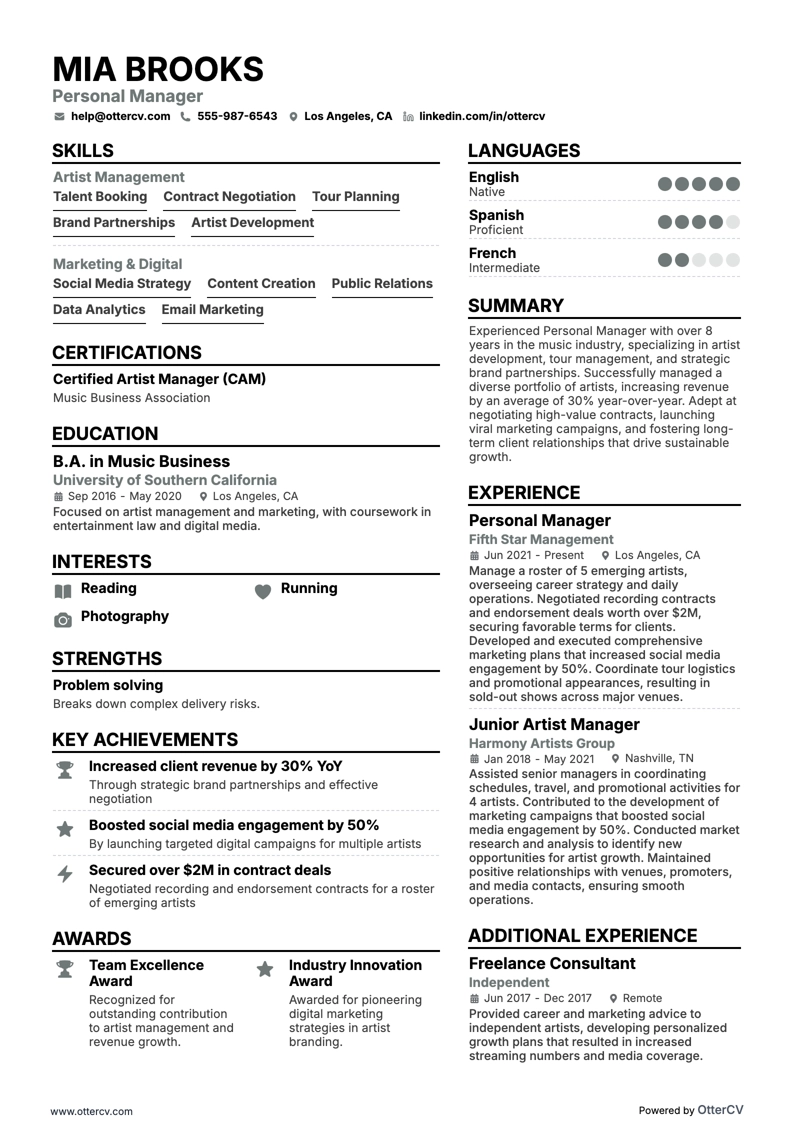
Personal Manager

Band Manager resume example

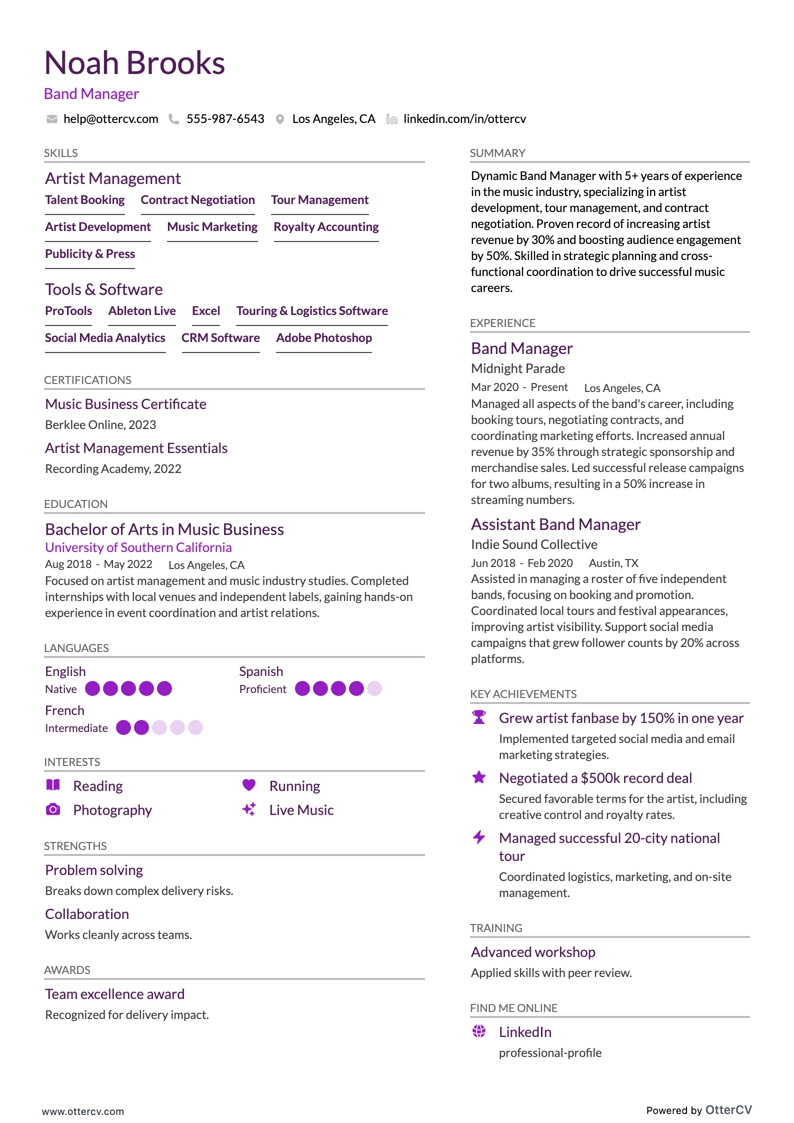
Band Manager

Talent Manager resume example

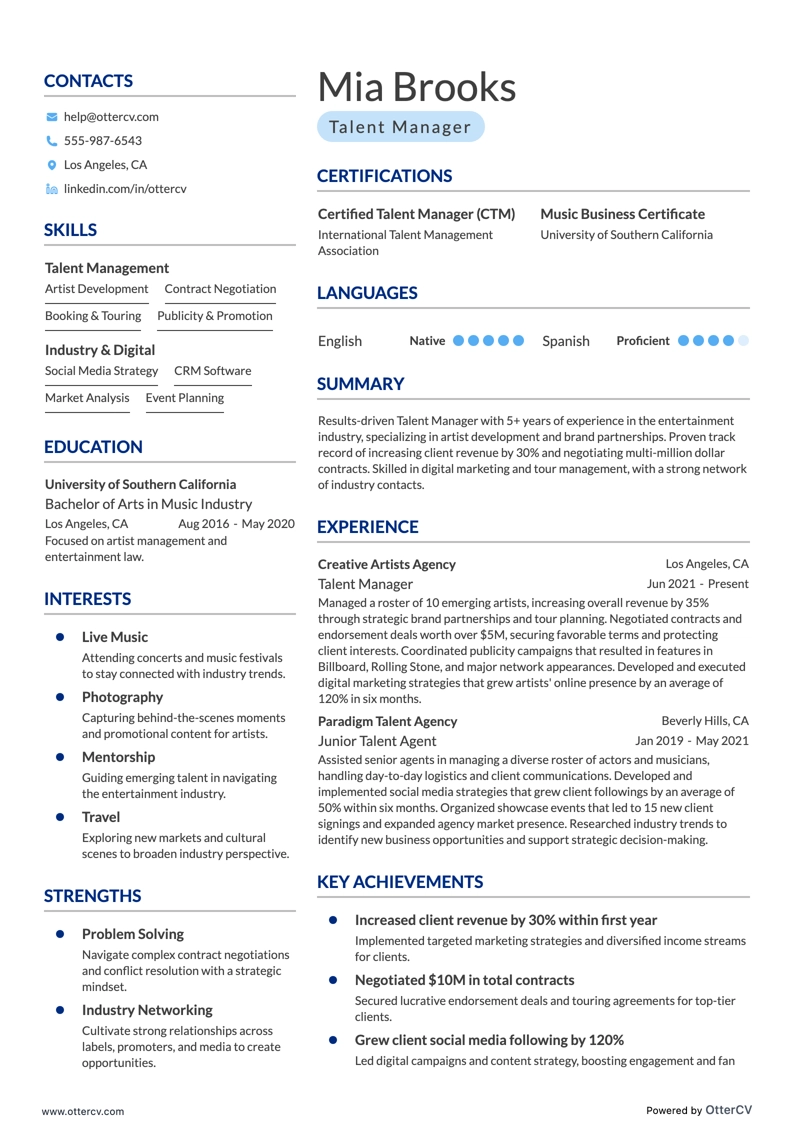
Talent Manager

Music Artist Manager resume example

Music Artist Manager

Artist Manager resume example

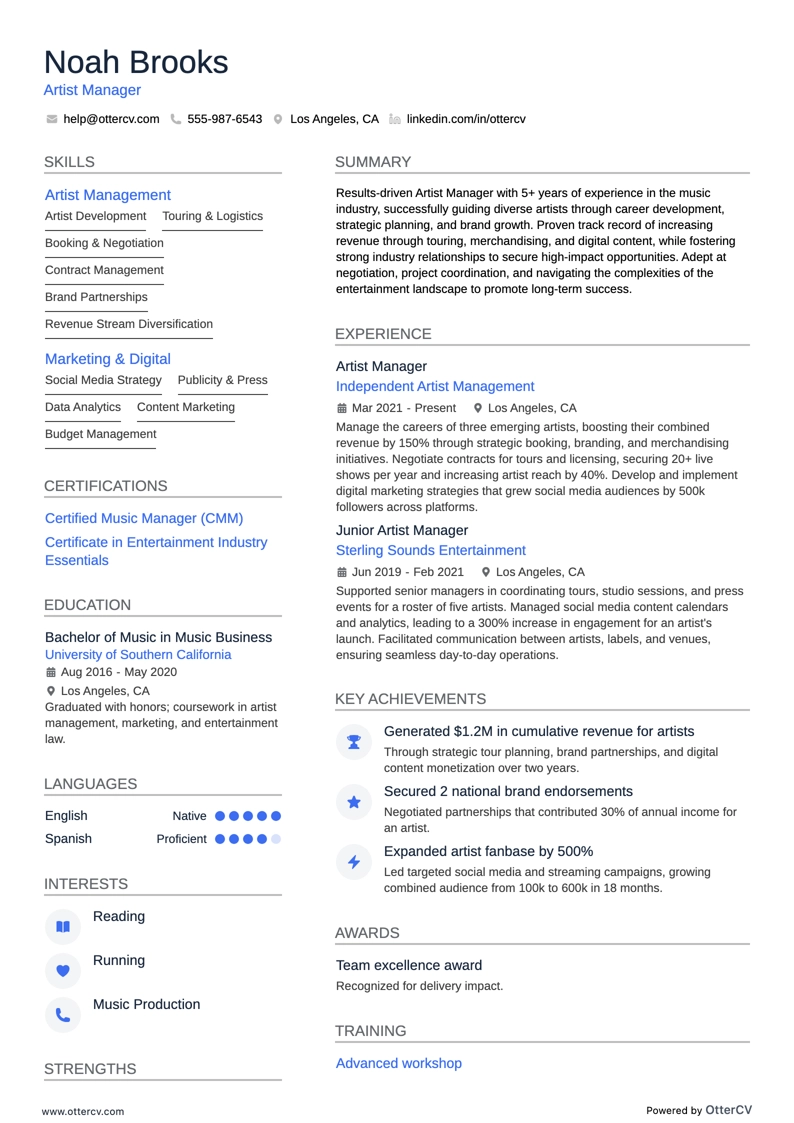
Artist Manager

Most artist manager resumes fail because they read like task logs and hide measurable impact inside long project lists. In today’s hiring process, ATS software filters quickly, recruiters scan in seconds, and competition is intense.

A strong resume shows what you delivered and why it mattered. Knowing how to make your resume stand out is essential in this field. Highlight revenue growth, tour gross, improved deal terms, streaming lift, brand partnership value, budget size managed, sell-through rates, and fanbase growth across platforms. Show scale, timelines, and outcomes.

Key takeaways

  • Quantify achievements in every bullet, including revenue growth, tour profit, and streaming gains.

  • Use a reverse-chronological format if you have direct artist management experience.

  • Tailor your experience bullets to match each job posting’s language and priorities.

  • Place skills above experience if you’re junior or transitioning into artist management.

  • Tie every listed skill to a measurable outcome or specific project.

  • Use Echocv’s tools to strengthen bullet points and align your resume with role requirements.

  • Pair your resume with a cover letter when applying to a specific roster or a competitive role.

How to format a artist manager resume

Recruiters reviewing artist manager resumes look for a clear record of client roster growth, revenue generation, deal negotiation, and strategic career development for talent. The right resume format makes these strengths immediately visible instead of burying them in generic skills lists or disjointed sections.

I have significant experience in this role—which format should I use?

I have significant experience in this role—which format should I use?

Use a reverse-chronological format to show how your responsibilities have grown across artist rosters, deal complexity, and revenue milestones.

  • Start with your most recent management role, highlighting roster size, genre scope, and your decision-making authority over touring, licensing, and brand partnerships.
  • Include industry-specific tools and domains such as contract negotiation, royalty management platforms, booking systems, and label/distributor relations.
  • Quantify your business impact with revenue figures, audience growth metrics, and deal values directly tied to your strategic decisions.

Example: "Managed a roster of 12 artists across three genres, negotiating touring and licensing deals that generated $4.2M in combined annual revenue—a 35% increase over two years."

I'm junior or switching into this role—what format works best?

I'm junior or switching into this role—what format works best?

A hybrid format works best. It lets you lead with relevant skills while still showing a chronological work history that demonstrates momentum.

  • Place a skills section near the top with core competencies such as talent scouting, social media strategy, event coordination, and contract basics.
  • Include project-based experience, such as managing an independent artist's release campaign, coordinating showcases, or running promotional events, even outside traditional employment.
  • Connect each action to a measurable or observable result so recruiters can assess your potential impact.

Example scaffold: Social media marketing → designed and executed a 90-day content rollout for an emerging artist's debut EP → grew the artist's streaming audience by 8,000 monthly listeners within the campaign period.

Why not use a functional resume?

Why not use a functional resume?

A functional resume removes the timeline recruiters use to understand how your skills developed in real artist management settings, which makes it harder for them to judge your readiness for the role.

This format may only make sense if you are transitioning from a related field such as music marketing, booking, or A&R and do not have direct management titles. Even then, each skill should be tied to a specific project, collaboration, or measurable result.

If you have any relevant work history, avoid a functional resume. Most applicant tracking systems and hiring managers look for clear chronological career progression.

Once you’ve established a clean, readable format, the next step is choosing sections that clearly reinforce your qualifications as an artist manager.

What sections should go on a artist manager resume

Recruiters want a clear snapshot of the artists you’ve managed, the revenue and growth you drove, and the partnerships you secured. Understanding what to put on a resume helps you prioritize the most relevant information for this role.

Use this structure for maximum clarity:

  • Header
  • Summary
  • Experience
  • Skills
  • Projects
  • Education
  • Certifications
  • Optional sections: Awards, Leadership, Languages

Strong experience bullets should highlight measurable impact, including revenue, audience growth, deal terms, tour outcomes, and the scope of artists, budgets, and stakeholders you managed.

Once your resume has the right structure in place, the next step is to write an artist manager experience section that supports it with clear, role-specific detail.

How to write your artist manager resume experience

The experience section is where you show that you’ve delivered real results for artists, labels, and industry partners, not just managed schedules. Hiring managers want to see impact through negotiations closed, revenue grown, tours executed, and careers advanced rather than a list of routine responsibilities.

Each entry should include:

  • Job title
  • Company and location (or remote)
  • Dates of employment (month and year)

Add three to five concise bullet points that explain what you owned, how you executed, and what results you delivered:

  • Ownership scope: the artists, rosters, revenue streams, brand partnerships, or creative projects you were directly responsible for building and sustaining.
  • Execution approach: the industry tools, contract negotiation strategies, booking platforms, marketing channels, or relationship-building methods you used to advance artist careers and make strategic decisions.
  • Value improved: changes to an artist’s earning potential, audience reach, brand visibility, release performance, or career trajectory that resulted from your management.
  • Collaboration context: how you worked with record labels, booking agents, publicists, legal teams, producers, and other stakeholders to align creative and commercial goals.
  • Impact delivered: outcomes such as career milestones reached, deal terms secured, audience growth achieved, or revenue generated, framed as results instead of routine activity.

Experience bullet formula

Experience bullet formula

Action verb + technology + what you built or fixed + measurable result

A artist manager experience example

Artist Manager

Indigo Meridian Management | Los Angeles, CA
2021–Present

Boutique artist management firm representing emerging and mid-career recording artists across pop and alternative, with national touring and label partnerships.

  • Negotiated and executed sixteen performance and brand partnership agreements using DocuSign and Airtable deal tracking, increasing annual gross revenue by 38% and improving average contract turnaround time from nine days to four.
  • Built a release and campaign operating system in Asana integrated with Google Workspace and Slack, aligning label, public relations, and creative teams to deliver twelve releases with 95% on-time milestones and zero missed distributor deadlines.
  • Directed tour routing and budget planning in Master Tour and Excel, reducing per-show costs by 12% and increasing net tour profit by $84K across a twenty-eight-date run through tighter settlements and vendor renegotiations.
  • Launched a fan growth program using Shopify, Mailchimp, and Meta Ads Manager, lifting direct-to-fan revenue by 27% and growing email subscribers from 18K to 26K with segmented drops and automated flows.
  • Produced weekly performance reporting in Chartmetric and Spotify for Artists, translating insights into pitching and content decisions with the artist, label team, and playlist partners, driving a 22% increase in monthly listeners over six months.

How to tailor your artist manager resume experience

Now that you’ve seen how to structure your experience entries, the next step is customizing them for the specific artist manager role you’re targeting.

Recruiters review artist manager resumes through both human screening and applicant tracking systems, looking for clear alignment between your background and the role’s needs. Tailoring your resume to the job description helps your most relevant accomplishments stand out in both review processes.

Ways to tailor your artist manager experience:

  • Match the touring platforms and booking software named in the job posting.
  • Use the job description’s terminology for royalty collection processes.
  • Reflect the specific revenue or growth KPIs the employer prioritizes.
  • Highlight experience in the listed music genres or entertainment sectors.
  • Emphasize contract negotiation frameworks referenced in the role description.
  • Include cross-functional collaboration with labels and publishing teams when mentioned.
  • Align your brand development strategies with the employer’s stated artist goals.
  • Reference the digital distribution channels or streaming analytics tools they specify.

Tailoring means aligning your real achievements with what the employer is asking for, not forcing in keywords that do not naturally fit.

Resume tailoring examples for artist manager

Resume tailoring examples for artist manager

Job description excerptUntailoredTailored

Once you’ve aligned your experience with the role’s priorities, the next step is to quantify your artist manager achievements so employers can see the impact behind each responsibility.

How to quantify your artist manager achievements

Quantifying your achievements shows that you drove outcomes, not just activity. For artist managers, this means tracking revenue, retention, campaign conversion, turnaround time, and risk reduction across tours, releases, partnerships, and budgets.

Quantifying examples for artist manager

MetricExample
Revenue growthGrew gross show revenue 28% in six months by renegotiating guarantees, tightening settlement reviews, and routing ten dates with a $2.4M total gross.
Fan conversionIncreased email-to-ticket conversion from 2.1% to 3.4% using Mailchimp segmentation and A/B offers across four on-sale campaigns.
RetentionRenewed three brand partnerships worth $180K by improving reporting cadence, adding quarterly recaps, and meeting all deliverables on time.
Cycle timeCut approval time for social and press assets from five days to two by implementing a Trello workflow and weekly stakeholder check-ins.
Risk reductionReduced contract errors by 60% by standardizing rider and deal memo templates and running a pre-sign checklist for twenty-five agreements.

With strong bullet points in place, the next step is making sure your artist manager resume shows the right mix of hard and soft skills to support them.

How to list your hard and soft skills on a artist manager resume

Your skills section should show that you can grow revenue, protect the artist's brand, and execute releases and tours. Recruiters and ATS often scan this section for role-specific keywords and overall fit, so include a balanced mix of hard skills and job-specific soft skills.

Artist manager roles require a blend of:

  • Product strategy and discovery skills
  • Data, analytics, and experimentation skills
  • Delivery, execution, and go-to-market discipline
  • Soft skills

Your skills section should be:

  • Scannable, with bullet-style grouping
  • Relevant to the job post
  • Backed by proof in your experience bullets
  • Updated with current tools

Place your skills section:

  • Above experience if you're junior or switching careers
  • Below experience if you're mid/senior with strong achievements

Hard skills

  • Contract negotiation and deal memos.
  • Music licensing and rights management.
  • Royalty accounting and statement review.
  • PRO registration, including ASCAP, BMI, and SESAC.
  • DSP pitching through Spotify for Artists and Apple Music for Artists.
  • YouTube Studio and Content ID management.
  • Tour budgeting and settlement reconciliation.
  • Release planning and rollout calendars.
  • CRM and email marketing with HubSpot and Mailchimp.
  • Social analytics using TikTok Analytics and Meta Business Suite.
  • Project management with Asana, Trello, and Airtable.
  • Press and radio servicing workflows.

Soft skills

  • Align stakeholders on priorities.
  • Set clear expectations and deadlines.
  • Lead difficult negotiations calmly.
  • Communicate updates with context.
  • Make fast tradeoff decisions.
  • Protect the artist's boundaries.
  • Manage conflict between partners.
  • Hold teams accountable for deliverables.
  • Run efficient cross-functional meetings.
  • Anticipate risks and escalation paths.
  • Build long-term industry relationships.
  • Stay composed under tour pressure.

How to show your artist manager skills in context

Skills should not appear only in a dedicated skills section. Explore resume skills examples to see how other professionals present their competencies effectively.

Show your skills in:

  • Your summary, where you define your high-level professional identity
  • Your experience, where you prove those skills through outcomes

Here’s how that looks in practice.

Artist manager with 12 years of experience in indie and electronic music, with expertise in tour routing, sync licensing, and brand partnership negotiation. Increased roster revenue by 180% using Chartmetric analytics and cross-platform marketing strategies.

  • Clearly reflects senior-level experience
  • Mentions industry-specific tools and methods
  • Quantifies revenue growth with a specific metric
  • Signals relationship-driven leadership ability

Experience example

Senior Artist Manager

Bright Noise Management | Los Angeles, CA

June 2018–Present

  • Grew combined roster streaming revenue by 145% over three years by using Spotify for Artists and Chartmetric data to refine release strategies.
  • Negotiated 22 brand partnership deals averaging $35K each, working closely with legal counsel, publicists, and label A&R teams.
  • Coordinated 14 national tours across 90+ venues, reducing per-show logistics costs by 18% through optimized routing and vendor consolidation.
  • Every bullet includes measurable proof.
  • Skills surface naturally through real outcomes.

How do I write a artist manager resume with no experience

Once you’ve grounded your management strengths in real examples, the next step is applying that same approach to an artist manager resume so your potential comes through clearly.

Even without full-time experience, you can show readiness through transferable projects and early wins. If you're building a resume without work experience, focus on initiative and measurable results from relevant involvement such as:

  • Self-managed gig and release planning
  • Volunteer venue or festival coordination
  • Internship at a label or agency
  • Campus concert booking and promotion
  • Social media campaign management
  • Press outreach and media pitching
  • Contract, invoice, and budget tracking
  • Tour routing and show advancing

Focus on highlighting:

  • Quantified promotion and ticket results
  • Organized budgets, contracts, and invoices
  • Proven outreach across press and venues
  • Clear tools used and outcomes

Resume format tip for entry-level artist manager

Resume format tip for entry-level artist manager

Use a hybrid resume format to highlight project results and tools first while still showing a clear timeline of relevant involvement.

Do:

  • Lead with a Projects section.
  • Add metrics to every relevant bullet.
  • List tools like Airtable and Google Sheets.
  • Include links to an artist manager portfolio.
  • Mirror job keywords in section titles.

Example project bullet:

  • Managed a four-week single rollout in Airtable and Google Sheets, pitching ten blogs and scheduling twenty posts, driving 12,400 streams in 30 days.

Even without direct experience, your education section can highlight relevant knowledge and credentials that strengthen your artist manager resume.

How to list your education on a artist manager resume

Your education section shows hiring teams that you have foundational knowledge in music business, communications, or management. It helps validate your readiness for an artist manager role.

Include:

  • Degree name
  • Institution
  • Location
  • Graduation year
  • Relevant coursework (for juniors or entry-level candidates)
  • Honors and GPA (if 3.5 or higher)

Skip the month and day details and list the graduation year only.

Here’s a strong education entry tailored for an artist manager resume.

Example education entry

Bachelor of Science in Music Business

Belmont University, Nashville, TN

Graduated 2021

GPA: 3.7/4.0

  • Relevant coursework: Artist Development, Entertainment Law, Music Marketing, Contract Negotiation, and Touring Logistics
  • Honors: Dean's List, Magna Cum Laude

How to list your certifications on a artist manager resume

Certifications show your commitment to learning, your proficiency with key tools, and your industry relevance as an artist manager. They also add credibility when you manage contracts, budgets, marketing, and touring.

Include:

  • Certificate name
  • Issuing organization
  • Year
  • Optional: credential ID or URL
  • Place certifications below education when your degree is recent and more relevant than any certification.
  • Place certifications above education when they are recent, role-relevant, or required for the artist manager roles you target.

Best certifications for your artist manager resume

  • Certified Music Manager (CMM).
  • Berklee College of Music—Music Business Certificate.
  • Coursera—Music Business Foundations (Berklee College of Music).
  • HubSpot Content Marketing Certification.
  • Google Analytics Certification.
  • Meta Certified Digital Marketing Associate.
  • Project Management Professional (PMP).

How to write your artist manager resume summary

Once your key credentials are easy for hiring teams to spot, write an artist manager resume summary that reinforces those qualifications in context.

Your resume summary is often the first thing a recruiter reads, so it should quickly show that you are a strong fit for the role.

Keep it to three to four lines and include:

  • Your title and total years of experience in artist or talent management.
  • Your area of specialization, such as music, visual arts, or entertainment.
  • Core skills like contract negotiation, tour coordination, or brand partnerships.
  • One or two measurable wins, such as revenue growth or audience expansion.
  • Soft skills connected to results, such as relationship building that secured long-term deals.

PRO TIP

At this level, focus on relevant skills, specific tools, and the early results you’ve delivered.

Highlight concrete contributions instead of vague ambitions. Avoid phrases like “passionate self-starter” or “seeking new opportunities.” Recruiters want proof of what you’ve done, not promises about what you hope to do.

Example summary for a artist manager

Artist manager with two years of experience in music talent management. Negotiated brand deals totaling $120K and increased client social media reach by 45%. Skilled in contract coordination, tour logistics, and Spotify for Artists.

Now that your summary highlights your management expertise and career achievements, make sure your resume header presents your contact details clearly and professionally.

What to include in a artist manager resume header

A resume header includes your key identifiers and contact details, helping a artist manager stand out through visibility, credibility, and faster recruiter screening.

Essential resume header elements

  • Full name
  • Tailored job title and headline
  • Location
  • Phone number
  • Professional email
  • GitHub link
  • Portfolio link
  • LinkedIn

A LinkedIn link helps recruiters quickly verify roles, dates, and recommendations, which supports faster screening.

Don't include a photo on a artist manager resume unless the role is explicitly front-facing or appearance-dependent.

Match your header title and headline to the exact artist manager role and genre focus, and keep every link current and easy to read.

Once your contact details and role focus are clear at the top, strengthen the rest of your application with additional sections that add relevant context to your artist manager resume.

Additional sections for artist manager resumes

If your core experience does not fully reflect your industry depth, extra sections can highlight what sets you apart as an artist manager. For example, listing language skills can show your ability to work with international artists, labels, and audiences.

  • Languages
  • Industry conferences and panels
  • Publications and media features
  • Professional affiliations and music industry memberships
  • Hobbies and interests
  • Awards and recognitions

Once you’ve strengthened your resume with these supplementary sections, the next step is pairing it with a well-crafted cover letter to make an even stronger impression.

Do artist manager resumes need a cover letter

An artist manager cover letter isn’t always required, but it can help in competitive searches or when hiring teams want context beyond a resume. If you’re unsure about the format, learn what a cover letter is and how it complements your application. It can make a difference when your resume needs a clearer narrative or when you’re targeting a specific roster.

Use your cover letter to add details your resume can’t:

  • Explain role and team fit by naming the roster size, genres, and how you partner with agents, labels, and publicists.
  • Highlight one or two relevant projects or outcomes, such as tour routing wins, sponsorship deals, or revenue growth tied to your work.
  • Show understanding of the business context by referencing the artist’s audience, release strategy, and how you balance creative goals with budgets.
  • Address career transitions or less obvious experience by connecting transferable work to artist manager priorities, like negotiation, scheduling, and stakeholder management.

Even if you decide not to include a cover letter, using AI to improve your artist manager resume can help you strengthen and tailor your application materials efficiently.

Using AI to improve your artist manager resume

AI can improve your resume’s clarity, structure, and impact. It can refine your language and help highlight results. But overusing it can make your resume feel less authentic. Once your content is clear and aligned with the role, step away from AI. If you’re comparing tools, check out which AI is best for writing resumes to find the right fit for your needs.

Here are 10 practical prompts to strengthen specific sections of your artist manager resume:

  1. Strengthen your summary. “Rewrite my resume summary to highlight my experience as an artist manager, focusing on career development, brand partnerships, and revenue growth.”
  2. Quantify tour results. “Add measurable outcomes to this experience bullet about managing touring logistics as an artist manager, including revenue or attendance figures.”
  3. Refine contract skills. “Improve my skills section to emphasize contract negotiation and deal structuring relevant to an artist manager role.”
  4. Sharpen brand partnerships. “Rewrite this experience bullet to clearly show how I secured brand partnerships and sponsorships as an artist manager.”
  5. Clarify project scope. “Edit my projects section to specify the scale, timeline, and outcome of campaigns I led as an artist manager.”
  6. Align education details. “Revise my education section to highlight coursework and training directly applicable to working as an artist manager.”
  7. Highlight digital strategy. “Rewrite this bullet to showcase social media growth and digital marketing results I achieved as an artist manager.”
  8. Improve certification relevance. “Edit my certifications section to emphasize credentials most valued for an artist manager position in the music industry.”
  9. Tighten financial impact. “Revise this experience bullet to clearly communicate budget management and revenue results from my work as an artist manager.”
  10. Simplify dense language. “Simplify this resume bullet while preserving specific accomplishments and outcomes from my role as an artist manager.”

Stop using AI once your resume sounds accurate, specific, and grounded in your real experience. AI should never invent experience or inflate claims—if it didn’t happen, it doesn’t belong here.

Conclusion

A strong artist manager resume demonstrates impact through measurable results, role-specific skills, and a clear structure. Lead with outcomes such as revenue growth, tour profitability, streaming gains, press coverage, and partnership wins.

Keep each section easy to scan with consistent titles, dates, and metrics. This focus shows that you can handle today’s demands and adapt confidently to near-future hiring needs.

Artist Manager resume examples

Explore additional Artist Manager resume samples and guides and see what works for your level of experience or role.

By Experience

Senior Artist Manager

Senior Artist Manager resume preview

Junior Artist Manager

Junior Artist Manager resume preview

Artist Manager resume examples

Explore additional Artist Manager resume samples and guides and see what works for your level of experience or role.

By Role

Artist Management Assistant

Artist Management Assistant resume preview

Artist Management Coordinator

Artist Management Coordinator resume preview

Day-to-Day Artist Manager

Day-to-Day Artist Manager resume preview

Personal Manager

Personal Manager resume preview

Band Manager

Band Manager resume preview

Talent Manager

Talent Manager resume preview

Music Artist Manager

Music Artist Manager resume preview

Artist Manager

Artist Manager resume preview