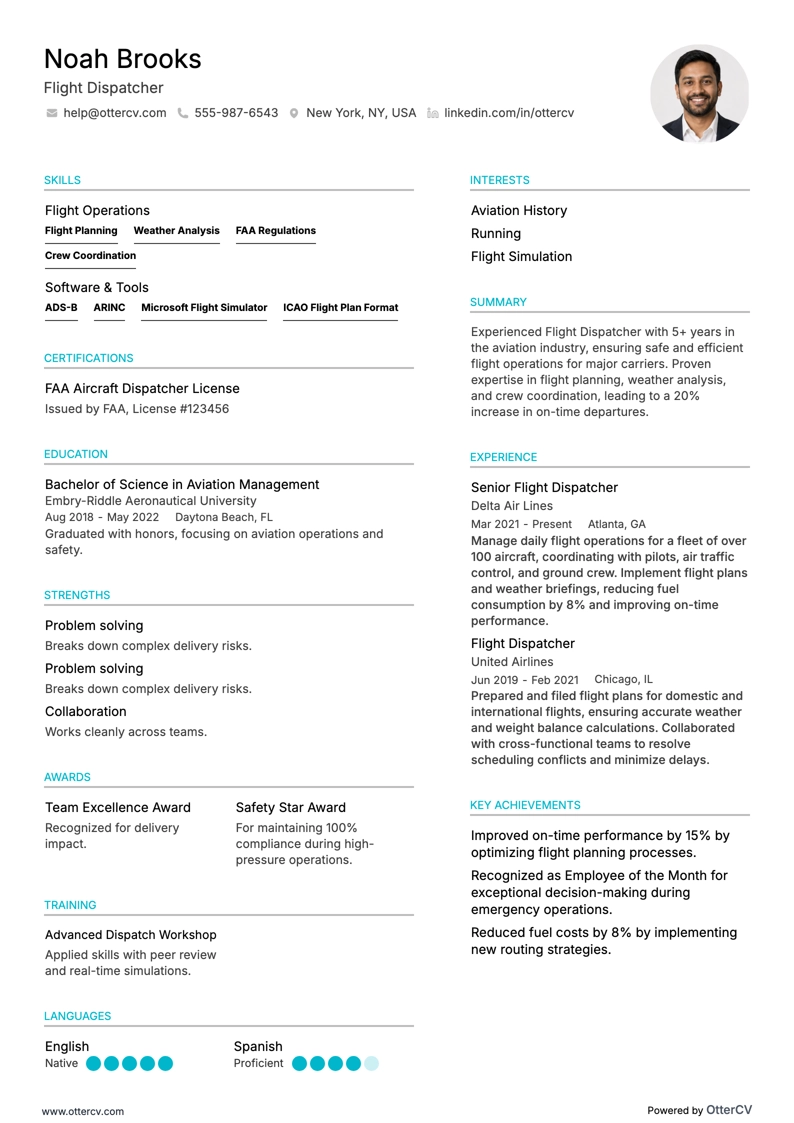
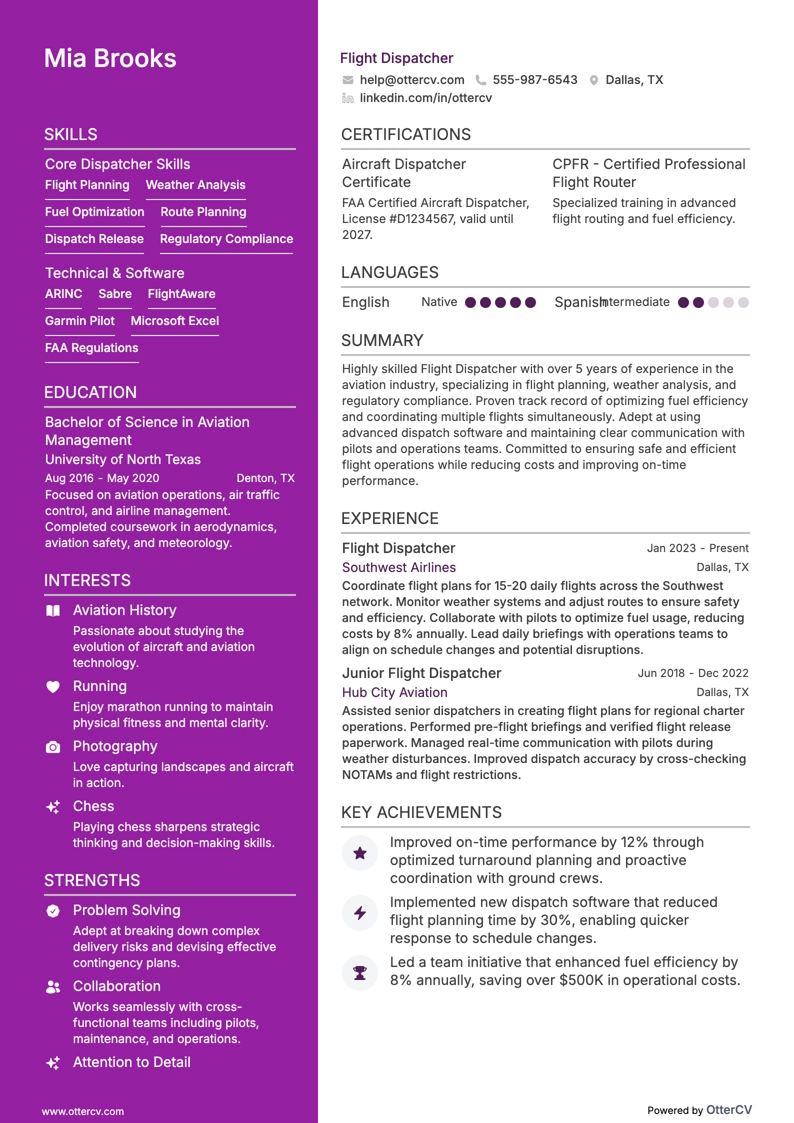
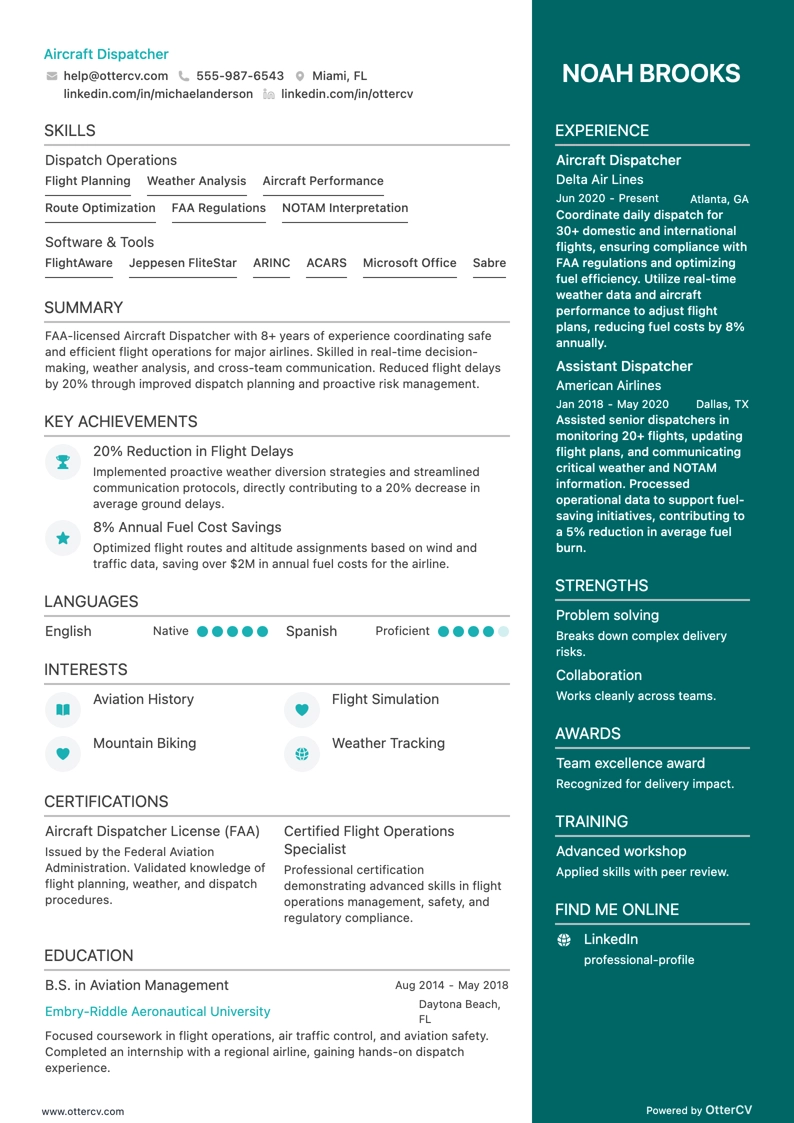
Chief Aircraft Dispatcher full preview

10 Aircraft Dispatcher Resume Examples

OtterCV

Written by The OtterCV Team

Updated: 12/22/2024•8 min read

See all resume examples in this guide, or generate your own resume example with your personalized prompt

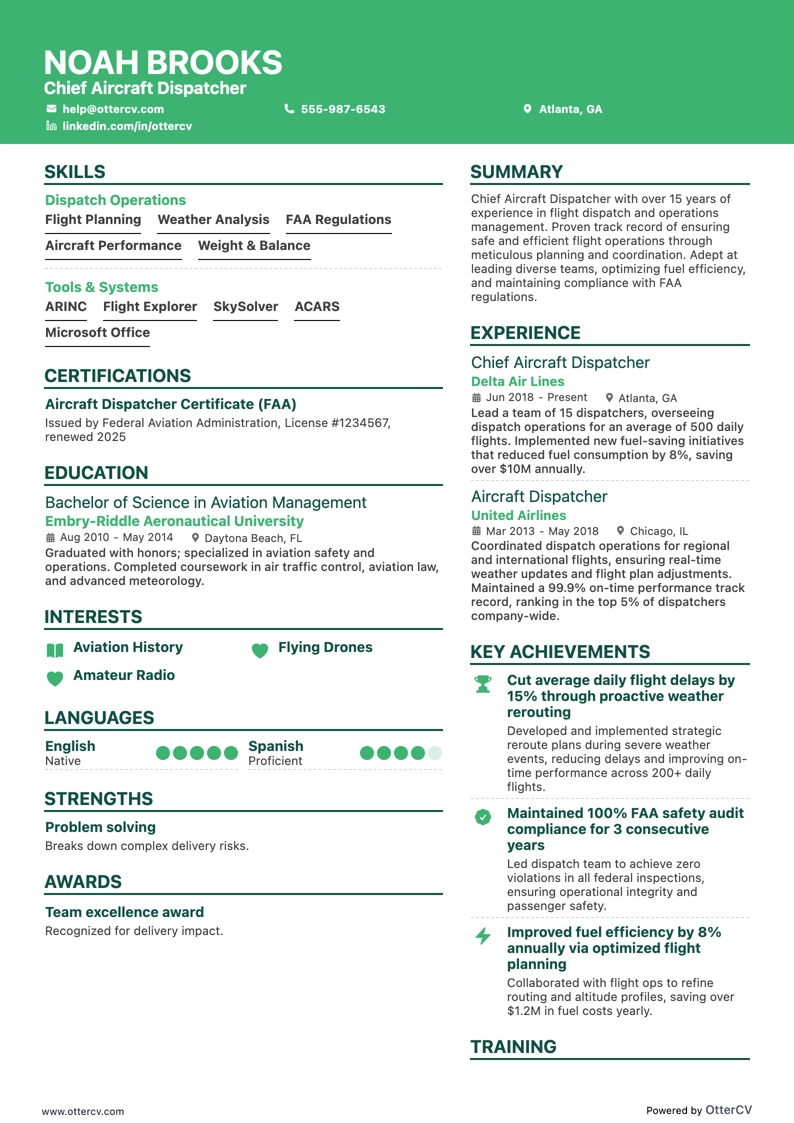
Chief Aircraft Dispatcher resume example

Chief Aircraft Dispatcher

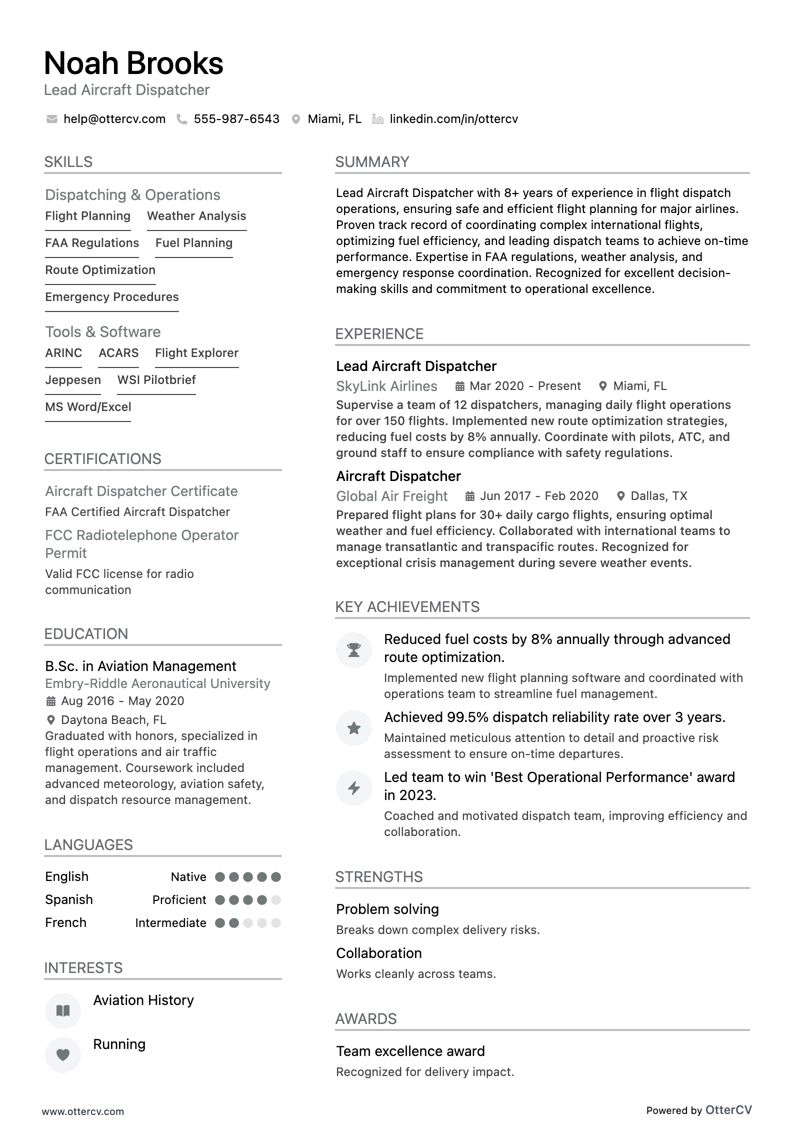
Lead Aircraft Dispatcher resume example

Lead Aircraft Dispatcher

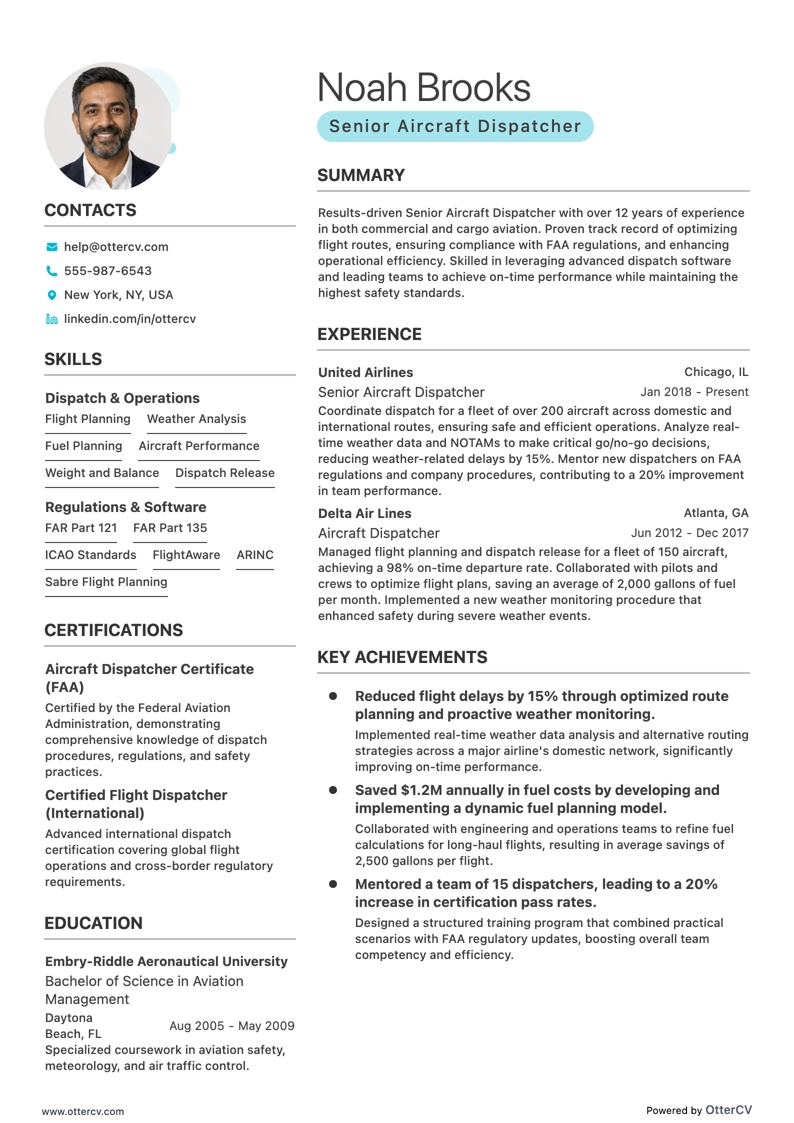
Senior Aircraft Dispatcher resume example

Senior Aircraft Dispatcher

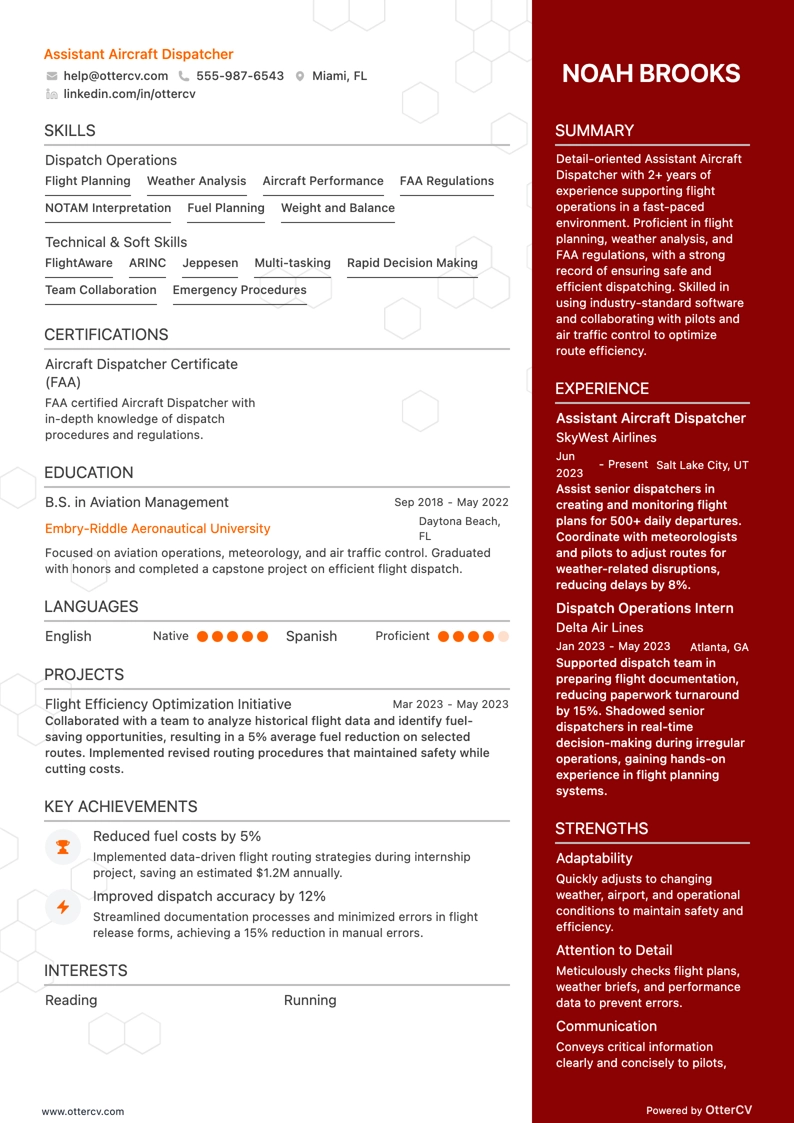
Assistant Aircraft Dispatcher resume example

Assistant Aircraft Dispatcher

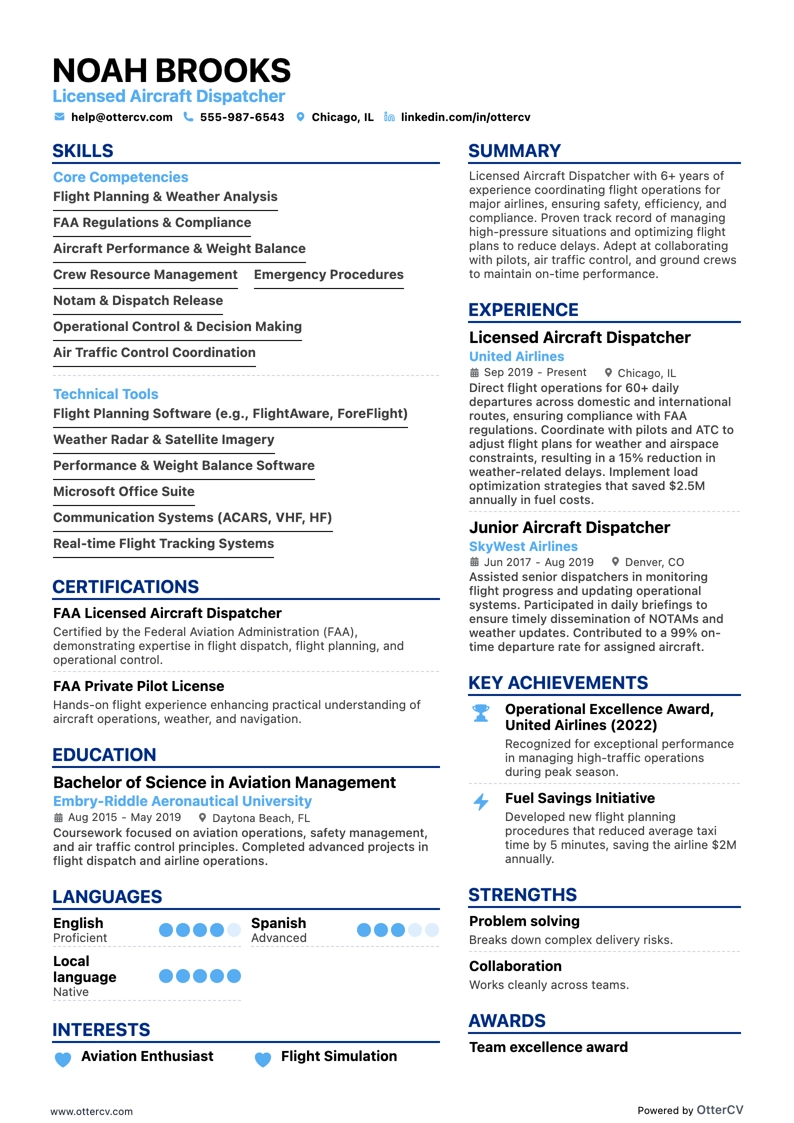
Licensed Aircraft Dispatcher resume example

Licensed Aircraft Dispatcher

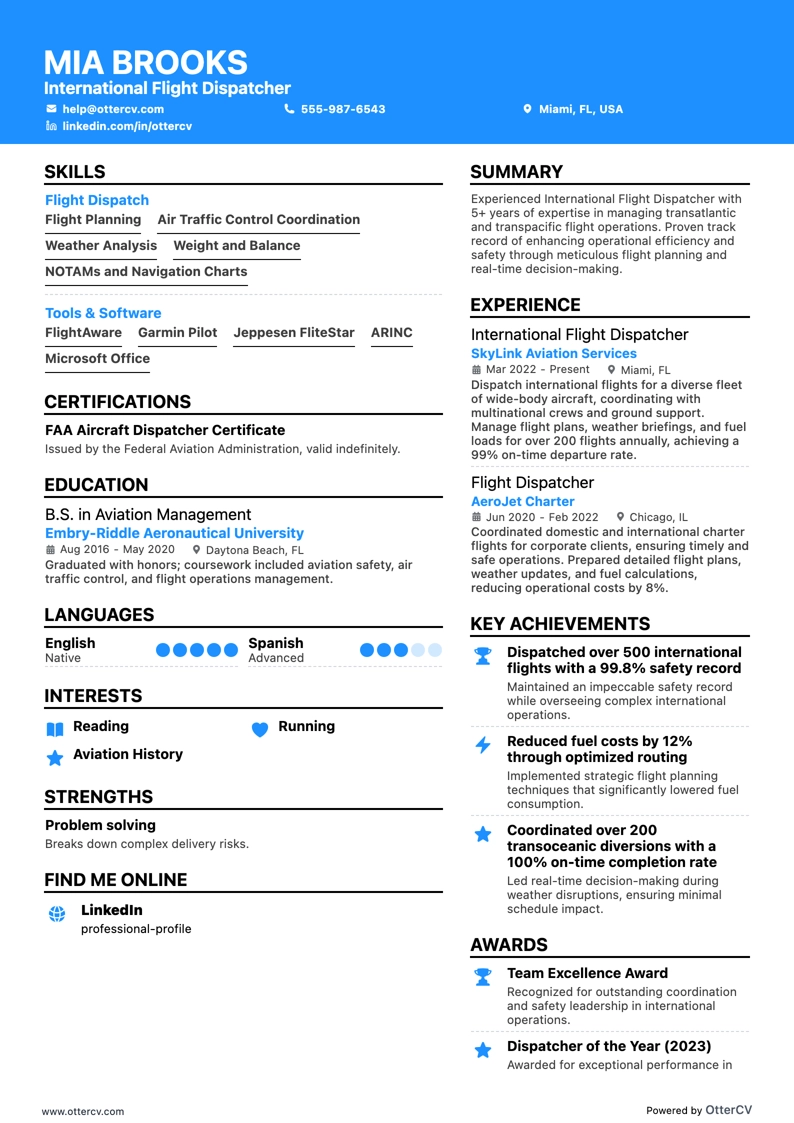
International Flight Dispatcher resume example

International Flight Dispatcher

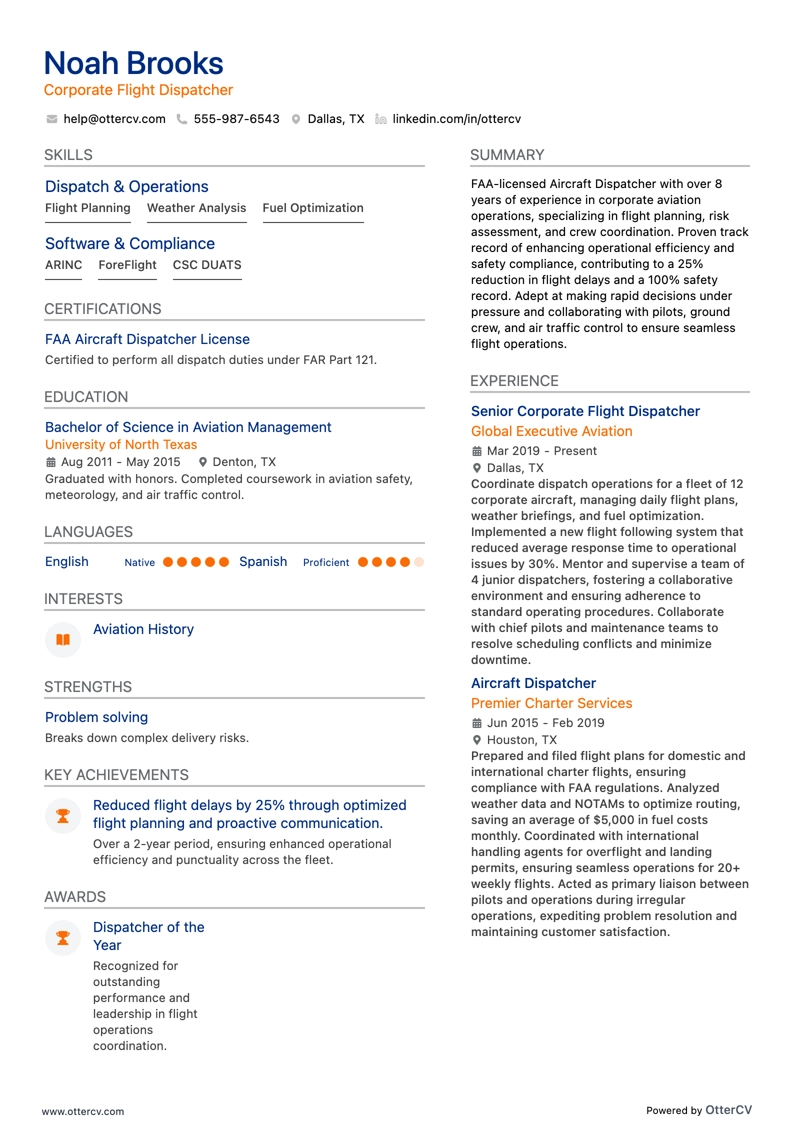
Corporate Flight Dispatcher resume example

Corporate Flight Dispatcher

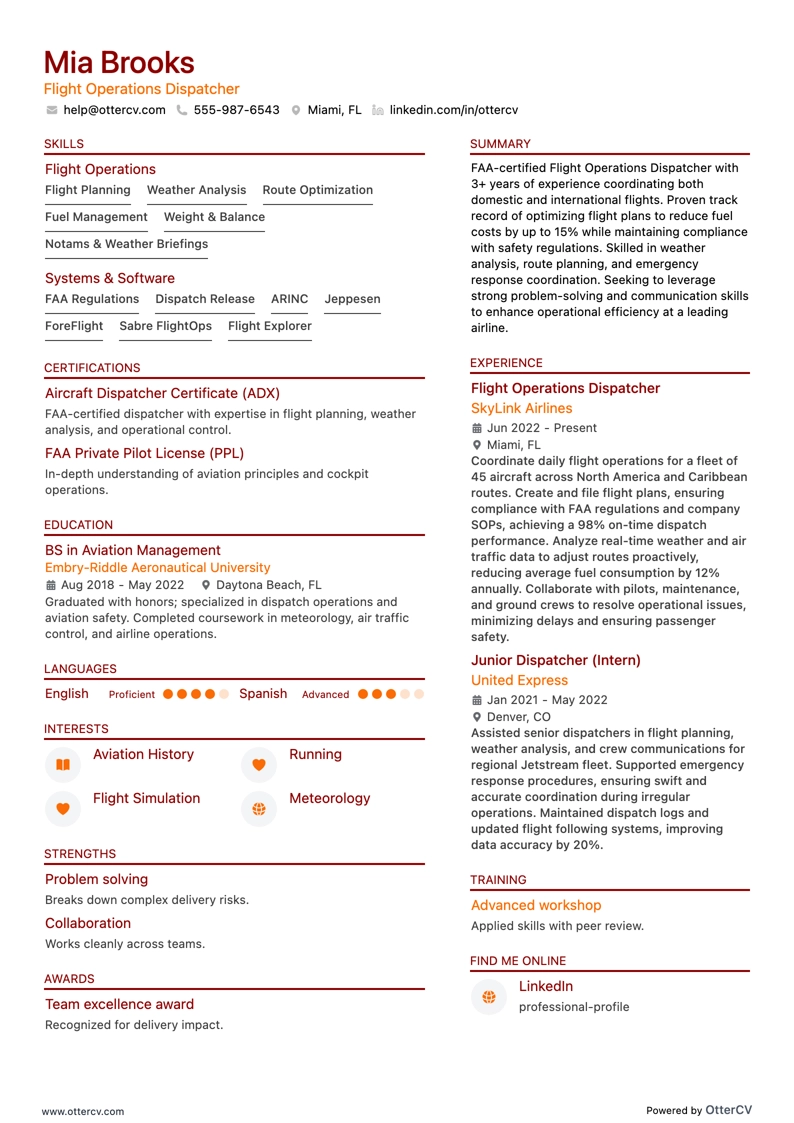
Flight Operations Dispatcher resume example

Flight Operations Dispatcher

Airline Flight Dispatcher resume example

Airline Flight Dispatcher

Flight Dispatcher resume example

Flight Dispatcher

Aircraft Dispatcher resume example

Aircraft Dispatcher

Most aircraft dispatcher resumes fall short because they read like shift logs instead of decision-ready summaries, which buries key qualifications. In an aircraft dispatcher resume, that becomes a problem when ATS systems filter quickly and recruiters skim through heavy applicant volume.

A strong resume shows what changed because you were on the desk. Knowing how to make your resume stand out means highlighting on-time performance gains, fewer delay minutes, safer reroutes in adverse weather, higher dispatch release accuracy, smoother irregular operations recovery, and measurable cost savings from fuel planning.

Key takeaways

  • Quantify dispatch outcomes in every bullet, including on-time gains, fuel savings, and delay reductions.

  • Use a reverse-chronological format if you have dispatcher experience, or a hybrid format if you are changing careers.

  • Match the exact tools, regulations, and terminology used in each job posting to improve ATS alignment.

  • Place your FAA Aircraft Dispatcher Certificate where recruiters can find it within seconds.

  • Show skills through measurable results in your experience section, not only in a skills list.

  • Write a three- to four-line summary that connects your title, tools, and one specific achievement.

  • Use Echocv to turn vague dispatch duties into concise, recruiter-ready resume bullets faster.

How to format a aircraft dispatcher resume

Recruiters reviewing aircraft dispatcher resumes look first for FAA dispatch certification, operational decision-making experience, flight planning proficiency, and knowledge of weather analysis and regulatory compliance. A clean, well-structured resume format helps these qualifications stand out quickly in both human review and applicant tracking system (ATS) scans.

I have significant experience in this role—which format should I use?

I have significant experience in this role—which format should I use?

Use a reverse-chronological format to show your dispatch career as a clear, progressive timeline that highlights increasing operational responsibility.

  • Start with your most recent position and emphasize scope, including the number of flights dispatched daily, fleet types covered, and coordination with departments such as flight ops, crew scheduling, and maintenance control.
  • Highlight role-specific tools and knowledge areas, including flight planning systems such as Jeppesen, Sabre, and LIDO, along with weather interpretation platforms, NOTAMs, MEL/CDL management, and FAA Part 121 regulatory knowledge.
  • Quantify results tied to safety, efficiency, or cost savings to show the measurable impact of your dispatch decisions.

Example bullet: “Dispatched an average of 85 domestic and international flights per day across a fleet of 140 aircraft, reducing fuel cost variances by 12% through optimized routing and altitude planning.”

I'm junior or switching into this role—what format works best?

I'm junior or switching into this role—what format works best?

A hybrid resume format works best because it lets you highlight relevant skills and certifications first while still showing a clear work history timeline.

  • Place your FAA Aircraft Dispatcher Certificate, flight planning coursework, and meteorology training in a dedicated skills or qualifications section near the top of the resume.
  • Include dispatch internships, simulator-based training projects, or related aviation operations roles such as ramp, ground ops, or flight following to show transitional experience.
  • Connect each skill to a specific action and a measurable result so recruiters can see your readiness for live operational responsibility.

Example scaffold: Weather analysis skill → reviewed METARs and TAFs during a 200-hour dispatch training program → produced go/no-go recommendations that aligned with instructor assessments 97% of the time.

Why not use a functional resume?

Why not use a functional resume?

A functional resume removes the timeline recruiters use to confirm that your dispatch certifications were applied in real operational settings. Without that context, it is harder for them to judge whether you are prepared for high-stakes, time-sensitive decision-making.

This format may still work if you are moving from a closely related aviation role, such as flight follower, meteorologist, or air traffic controller, and do not yet have direct dispatch job titles, or if you have a significant employment gap. Even then, each skill should be tied to a specific project, training scenario, or measurable outcome instead of being presented as a standalone claim.

What sections should go on a aircraft dispatcher resume

Recruiters expect to quickly find your dispatch certification, operational experience, and safety-focused coordination work. Choosing the right resume sections helps keep your resume clear and easy to scan.

Use this structure for maximum clarity:

  • Header
  • Summary
  • Experience
  • Skills
  • Projects
  • Education
  • Certifications
  • Optional sections: Awards, Leadership, Languages

Strong experience bullets should highlight on-time performance, safety and compliance outcomes, operational scope, and measurable results from your flight planning and coordination decisions.

With your resume’s key components in place, the next step is to write your aircraft dispatcher experience section in a way that shows how you applied those strengths in real operations.

How to write your aircraft dispatcher resume experience

Your work experience section should highlight the operational decisions you made, the dispatch tools and systems you used, and the measurable outcomes you produced, such as improved on-time departures, fuel savings, or stronger safety compliance. Hiring managers care more about proven impact than task lists, so each line should focus on what you delivered, not just what you were assigned.

Each entry should include:

  • Job title
  • Company and location (or remote)
  • Dates of employment (month and year)

Add three to five concise bullet points that explain what you owned, how you executed, and what results you delivered:

  • Ownership scope: the flight operations, routes, dispatch desks, fleet segments, or operational control areas you were directly responsible for as an aircraft dispatcher.
  • Execution approach: the dispatch systems, flight planning software, weather analysis tools, regulatory frameworks, or decision-making methods you used to authorize flights and manage irregular operations.
  • Value improved: the gains you created in operational efficiency, fuel economy, schedule reliability, safety compliance, or risk mitigation across your dispatch responsibilities.
  • Collaboration context: how you worked with pilots, air traffic control, maintenance teams, crew scheduling, meteorology departments, or regulatory bodies to support safe and efficient flight operations.
  • Impact delivered: the operational, safety, or business results your decisions produced, expressed through outcomes, scale, or organizational impact rather than routine activity descriptions.

Experience bullet formula

Experience bullet formula

Action verb + technology + what you built or fixed + measurable result

A aircraft dispatcher experience example

Aircraft Dispatcher

SkyWest Airlines | St. George, UT

2021–Present

Part 121 regional airline operating high-frequency domestic routes with a twenty-four-seven operations control center.

  • Released an average of sixty-five flights per day using Sabre Dispatch Manager and Jeppesen FliteDeck Pro, improving on-time departure by seven percent through tighter fuel, alternate, and routing selections.
  • Coordinated with pilots, maintenance control, and station operations to execute irregular operations playbooks, cutting average delay minutes per affected flight by fourteen percent during weather and air traffic control constraint events.
  • Built and maintained ICAO flight plans in ARINC Direct and validated performance and weight limits against aircraft configuration, reducing flight plan revisions by twenty-two percent and avoiding last-minute gate holds.
  • Monitored convective weather, turbulence, and NOTAMs using WSI Fusion and FAA SWIM feeds, rerouting thirty-plus flights per week and reducing en route fuel contingencies by nine percent without increasing diversion risk.
  • Standardized dispatcher shift handoffs in the airline operations control center using Microsoft Teams and shared release templates, decreasing missed-critical-item handoff defects by thirty percent and improving cross-shift coordination with crew scheduling.

Now that you’ve seen what a strong experience section looks like, the next step is tailoring yours to the specific role you want.

How to tailor your aircraft dispatcher resume experience

Recruiters review aircraft dispatcher resumes through both human screening and applicant tracking systems, so tailoring your resume to the job description is essential. It helps ensure your qualifications reflect what the employer is actually prioritizing.

Ways to tailor your aircraft dispatcher experience include:

  • Match the flight planning software and dispatch systems named in the posting.
  • Use the same terminology for weather analysis and NOTAMs.
  • Reflect FAR Part 121 or Part 135 compliance language from the listing.
  • Highlight the fuel planning and route optimization methods the employer mentions.
  • Include the specific aircraft types or fleet experience the role requires.
  • Emphasize the crew coordination and irregular operations workflows they reference.
  • Align your safety management system language with the framework in the job description.
  • Reference dispatch release authority and operational control responsibilities listed in the posting.

Tailoring means connecting your real accomplishments to the job’s stated requirements, not forcing in keywords where they do not belong.

Resume tailoring examples for aircraft dispatcher

Job description excerptUntailoredTailored
"Monitor weather conditions using WSI Pilotbrief, coordinate with flight crews to determine fuel loads, and issue dispatch releases for Part 121 operations."Monitored weather and helped plan flights for the company.Analyzed real-time weather data through WSI Pilotbrief to calculate optimal fuel loads, issuing dispatch releases for 40+ daily Part 121 flights while coordinating directly with flight crews on route adjustments.
"Collaborate with maintenance control and ATC to manage irregular operations (IROPS), re-route aircraft, and minimize passenger disruption during severe weather events."Assisted with flight changes during bad weather and communicated with different teams.Partnered with maintenance control and ATC during IROPS to re-route up to 15 aircraft per shift during severe convective weather, reducing average passenger delay by 22% through proactive slot management.
"Use ACARS and SABRE flight planning system to build and amend flight plans, ensuring compliance with FAA regulations, MEL restrictions, and company SOPs."Created flight plans and made sure they followed regulations.Built and amended 50+ daily flight plans in SABRE, transmitting updates via ACARS while verifying compliance with FAA dispatch regulations, active MEL items, and company SOPs for each departure.

Once your experience is aligned with the role’s requirements, quantify your aircraft dispatcher achievements to show the measurable impact behind those responsibilities.

How to quantify your aircraft dispatcher achievements

Quantifying your achievements shows how you improved safety, on-time performance, and cost control. Track metrics such as minutes saved, release accuracy, diversion outcomes, fuel burn, and volume handled across fleets, stations, and shifts.

Quantifying examples for aircraft dispatcher

MetricExample
On-time performanceImproved on-time departures by 6% over six months by optimizing reroutes in Sabre Dispatch during convective weather for a 35-aircraft narrow-body fleet.
Release accuracyCut flight plan and release corrections from 3.2% to 1.1% by standardizing NOTAM review and cross-checking ETOPS data in Lido Flight 4D.
Fuel efficiencyReduced average block fuel by 220 pounds per flight by refining cost index guidance and alternate selection across 18 daily transcon rotations.
Risk mitigationAvoided three potential MEL-related dispatch violations by catching configuration mismatches before release, preventing delays and maintaining 100% audit compliance that quarter.
Throughput volumeHandled an average of 26 releases per shift across four stations while maintaining a sub-10-minute turnaround for amended releases during ATC flow programs.

With strong, action-driven bullet points in place, the next step is making sure your resume highlights the right mix of hard and soft skills for an aircraft dispatcher role.

How to list your hard and soft skills on a aircraft dispatcher resume

Your skills section should show that you can plan, release, and monitor flights safely and on time. Recruiters and ATS (applicant tracking systems) scan this section to confirm role fit, so aim for a heavier mix of hard skills supported by targeted operational soft skills.

Aircraft dispatcher roles require a blend of:

  • Product strategy and discovery skills.
  • Data, analytics, and experimentation skills.
  • Delivery, execution, and go-to-market discipline.
  • Soft skills.

Your skills section should be:

  • Scannable with bullet-style grouping.
  • Relevant to the job post.
  • Backed by proof in your experience bullets.
  • Updated with current tools.

Place your skills section:

  • Above your experience if you're junior or switching careers.
  • Below your experience if you're mid- or senior-level with strong achievements.

Hard skills

  • Flight planning and dispatch release.
  • FAA Part 121 dispatch compliance.
  • Weather analysis using METAR, TAF, and SIGMET.
  • NOTAM interpretation and routing impact assessment.
  • Jeppesen, Lido, or Navblue tools.
  • Flight management system route constraints.
  • Aircraft performance and weight and balance.
  • Fuel planning, including contingency fuel and alternates.
  • En route monitoring and reroute coordination.
  • ETOPS planning and monitoring.
  • Dispatch logs and flight documentation.
  • Irregular operations and recovery planning.

Soft skills

  • Makes time-critical decisions.
  • Communicates clearly and concisely by radio and phone.
  • Coordinates effectively with crews and operations teams.
  • Exercises sound escalation judgment and manages urgency well.
  • Prioritizes risks effectively under constraints.
  • Maintains close attention to operational detail.
  • Executes calmly during irregular operations.
  • Takes ownership of flight release accuracy.
  • Resolves conflicts with station and crew teams.
  • Ensures clear and continuous shift handoffs.
  • Frames problems quickly and analyzes options.
  • Applies a compliance-first mindset in daily decisions.

How to show your aircraft dispatcher skills in context

Your skills should not appear only in a bulleted list on your resume. For more inspiration, browse examples of how dispatchers present their abilities on the resume skills page.

Show those skills in context through:

  • Your summary, which defines your high-level professional identity
  • Your experience, which proves your abilities through outcomes

Here is what that looks like in practice for an aircraft dispatcher.

Summary example

Senior aircraft dispatcher with 12 years of experience in Part 121 operations. Skilled in ACARS, Jeppesen FliteDeck, and fuel optimization methods. Reduced average fuel costs by 9% across more than 400 monthly flights while coordinating with meteorology and maintenance teams.

  • Reflects senior-level career depth
  • Names industry-standard tools directly
  • Quantifies fuel cost savings clearly
  • Highlights cross-team collaboration skills

Senior Aircraft Dispatcher

SkyBridge Airlines | Dallas, TX

March 2018–Present

  • Coordinated with pilots and meteorology staff using Jeppesen FliteDeck to reroute 1,200+ flights annually, reducing weather-related delays by 18%.
  • Optimized fuel load calculations through ACARS data analysis, saving the carrier an estimated $2.1M over three years.
  • Collaborated with maintenance control to streamline irregular operations procedures, cutting aircraft-on-ground resolution time by 25%.
  • Every bullet includes measurable proof.
  • Skills are shown naturally through real outcomes.

Once you’ve shown your aircraft dispatcher skills through relevant examples, the next step is to use that same approach when structuring an aircraft dispatcher resume with no experience.

How do I write a aircraft dispatcher resume with no experience

Even without full-time experience, you can still show readiness through:

  • Aircraft dispatcher coursework and labs
  • Dispatch simulator flight planning projects
  • FAA Part 65 written prep
  • Airline operations center job shadowing
  • Airport ramp or gate operations
  • Weather briefing and NOTAM drills
  • Emergency response tabletop exercises
  • Aviation club dispatch coordination

Our guide on building a resume without work experience offers additional strategies for showcasing your qualifications when you lack formal dispatch roles.

Focus on:

  • Flight planning and fuel calculations
  • Weather, NOTAMs, and alternates
  • Dispatch tools and documentation
  • Compliance-focused decision records

Resume format tip for entry-level aircraft dispatcher

Resume format tip for entry-level aircraft dispatcher

Use a hybrid resume format that highlights skills and projects first, then lists experience. This structure helps show aircraft dispatcher readiness even without full-time roles.

  • Place a Projects section above work history.
  • Name the dispatch tools used in each project.
  • Quantify results with time, accuracy, or volume.
  • Add relevant coursework with key topics.
  • Include certifications and exam progress.

Example project bullet:

  • Built five dispatch simulator flight plans using aviation weather, NOTAMs, and alternates, cutting route planning time by 20% while meeting fuel reserve rules.

Even without hands-on experience, your educational background can show relevant knowledge and qualifications, so it is important to present it clearly on your resume.

How to list your education on a aircraft dispatcher resume

Your education section helps hiring teams quickly confirm that you have the foundational knowledge needed for aircraft dispatcher roles. It also validates your academic background in aviation, meteorology, or related fields.

Include:

  • Degree name
  • Institution
  • Location
  • Graduation year
  • Relevant coursework for juniors or entry-level candidates
  • Honors and GPA if 3.5 or higher

Skip the month and day details, and list the graduation year only.

Here's a strong education entry tailored for an aircraft dispatcher resume.

Example education entry

Bachelor of Science in Aviation Management

Embry-Riddle Aeronautical University, Daytona Beach, FL

Graduated 2021

GPA: 3.7/4.0

  • Relevant Coursework: Aviation Weather, Air Traffic Control Systems, Flight Planning and Navigation, Aviation Safety Management
  • Honors: Magna Cum Laude, Dean's List (six consecutive semesters)

How to list your certifications on a aircraft dispatcher resume

Certifications on your resume show your commitment to learning, your proficiency with dispatch tools, and your relevance to airline operations as an aircraft dispatcher.

Include:

  • Certificate name
  • Issuing organization
  • Year
  • Optional: credential ID or URL
  • Place certifications below education when your degree is recent and your certifications add supporting value.
  • Place certifications above education when they are your most recent credentials and directly match aircraft dispatcher requirements.

Best certifications for your aircraft dispatcher resume

  • FAA Aircraft Dispatcher Certificate
  • IATA Flight Dispatcher Training Certificate
  • ICAO Aviation English Proficiency Certificate
  • FAA Part 107 Remote Pilot Certificate
  • Aviation Safety Management Systems Certificate
  • IATA Dangerous Goods Regulations Certificate
  • Aviation Meteorology Certificate

How to write your aircraft dispatcher resume summary

Once your key credentials are easy for recruiters to spot, use your aircraft dispatcher resume summary to show the value you bring to the role.

Your resume summary is often the first thing a recruiter reads. A strong summary quickly shows that you have the skills and experience to keep flights safe and on schedule.

Keep it to three to four lines and include:

  • Your title and years of experience in aircraft dispatching or flight operations.
  • Your domain expertise, such as Part 121 operations, flight planning, or airline dispatch.
  • Your core tools, such as ACARS, Jeppesen FliteDeck, WSI Pilotbrief, or CAD systems.
  • One or two quantified achievements, such as on-time departure rates or fuel savings.
  • Soft skills tied to real outcomes, such as decision-making under pressure or crew coordination.

PRO TIP

At the entry level, focus on your FAA Aircraft Dispatcher Certificate, relevant tools, and any measurable contributions from training or early roles.

Avoid vague phrases like "passionate team player" or "highly motivated self-starter." Instead, connect every detail to a specific skill, tool, or result that shows you are ready for the dispatch desk.

Example summary for a aircraft dispatcher

FAA-certified aircraft dispatcher with two years of experience in Part 121 flight planning. Proficient in Jeppesen and ACARS, contributing to a 96% on-time departure rate through precise weather analysis and crew coordination.

What to include in a aircraft dispatcher resume header

A resume header highlights your key contact details and role fit, helping aircraft dispatcher candidates improve visibility, build credibility, and move through recruiter screening faster.

Essential resume header elements:

  • Full name
  • Tailored job title and headline
  • Location
  • Phone number
  • Professional email
  • GitHub link
  • Portfolio link
  • LinkedIn

A LinkedIn link helps recruiters quickly verify your experience and supports screening.

Do not include photos on a aircraft dispatcher resume unless the role is explicitly front-facing or appearance-dependent.

Match your header job title to the posting and include aircraft dispatcher to improve search visibility in applicant tracking systems.

Example

Once your contact details and credentials are clearly presented at the top, strengthen the rest of your resume with additional sections that highlight relevant qualifications.

Additional sections for aircraft dispatcher resumes

When your core qualifications are similar to those of other candidates, well-chosen additional sections can help your aircraft dispatcher resume stand out and add credibility. For example, listing language skills can show your ability to communicate across international operations.

  • Languages
  • Certifications and licenses
  • Professional affiliations (e.g., ADF — Airline Dispatchers Federation)
  • Continuing education and training
  • Awards and recognitions
  • Volunteer experience in aviation organizations
  • Publications or conference presentations

Once you've strengthened your resume with relevant additional sections, pairing it with a well-crafted cover letter can further help your application stand out.

Do aircraft dispatcher resumes need a cover letter

Aircraft dispatcher resumes do not always need a cover letter, but one can help when the role is competitive or the employer expects it. It can also make a difference when your experience needs context or your fit is not immediately obvious. If you're unsure where to begin, learn what a cover letter is and how it complements your resume.

Use a cover letter to add details your aircraft dispatcher resume may not fully show:

  • Explain your fit for the role or team by aligning your dispatch approach with the airline's operation, schedule complexity, and safety culture.
  • Highlight one or two relevant projects or outcomes, such as improved on-time performance, reduced diversions, or better fuel planning.
  • Show understanding of the business context by referencing the carrier's network, weather risks, hub constraints, and how dispatch decisions affect crews and customers.
  • Address career transitions or less obvious experience by connecting prior roles to flight planning, risk assessment, coordination, and regulatory compliance.

Even when a cover letter is not required, AI can help you improve your aircraft dispatcher resume and tailor your application materials more efficiently.

Using AI to improve your aircraft dispatcher resume

AI can improve your resume’s clarity, structure, and overall impact. It can help you strengthen phrasing and tighten formatting, but overusing it can make your application sound less authentic. Once your resume feels clear and aligned with the role, stop relying on AI tools. For more prompt ideas, see our guide on ChatGPT resume writing.

Here are 10 practical prompts you can copy, paste, and customize:

  1. Strengthen summary statement. “Rewrite my aircraft dispatcher resume summary to highlight flight planning expertise, FAA compliance, and operational efficiency in under four sentences.”
  2. Quantify experience bullets. “Add measurable results to these aircraft dispatcher experience bullets, focusing on on-time departure rates, fuel savings, or flights coordinated daily.”
  3. Tailor skills section. “Review this aircraft dispatcher skills list and remove irrelevant entries. Suggest missing technical skills like ACARS, NOTAM analysis, or weather interpretation.”
  4. Improve action verbs. “Replace weak or repetitive verbs in my aircraft dispatcher experience section with strong, specific action verbs relevant to aviation operations.”
  5. Align with job posting. “Compare my aircraft dispatcher resume bullets against this job description. Identify gaps in keywords, qualifications, or required competencies.”
  6. Refine certifications section. “Reorganize my aircraft dispatcher certifications section to emphasize my FAA Aircraft Dispatcher Certificate and any recurrent training credentials.”
  7. Tighten education details. “Edit my education section to highlight coursework or training directly relevant to aircraft dispatcher responsibilities, like meteorology or aerodynamics.”
  8. Clarify project contributions. “Rewrite this aircraft dispatcher project description to clearly state my role, the operational problem solved, and the measurable outcome.”
  9. Remove filler language. “Scan my aircraft dispatcher resume for vague phrases, unnecessary adjectives, and filler words. Suggest concise replacements.”
  10. Optimize formatting consistency. “Check my aircraft dispatcher resume for inconsistent date formats, bullet structures, and tense usage. Provide a corrected version.”

Stop using AI once your resume sounds accurate, specific, and grounded in your real experience. AI should never invent experience or exaggerate claims—if it did not happen, it does not belong on your resume.

Conclusion

A strong aircraft dispatcher resume highlights measurable results, role-specific skills, and a clear structure. It should show on-time performance, delay reduction, fuel efficiency, and safety compliance, making your impact easy to scan quickly.

Keep the focus on dispatch planning, flight monitoring, weather analysis, route optimization, and regulatory knowledge. Clean headings and consistent formatting support faster review and show that you are prepared for today’s hiring market and near-future needs.

Aircraft Dispatcher resume examples

Explore additional Aircraft Dispatcher resume samples and guides and see what works for your level of experience or role.

By Experience

Chief Aircraft Dispatcher

Chief Aircraft Dispatcher resume preview

Lead Aircraft Dispatcher

Lead Aircraft Dispatcher resume preview

Senior Aircraft Dispatcher

Senior Aircraft Dispatcher resume preview

Assistant Aircraft Dispatcher

Assistant Aircraft Dispatcher resume preview

Aircraft Dispatcher resume examples

Explore additional Aircraft Dispatcher resume samples and guides and see what works for your level of experience or role.

By Role

Licensed Aircraft Dispatcher

Licensed Aircraft Dispatcher resume preview

International Flight Dispatcher

International Flight Dispatcher resume preview

Corporate Flight Dispatcher

Corporate Flight Dispatcher resume preview

Flight Operations Dispatcher

Flight Operations Dispatcher resume preview

Airline Flight Dispatcher

Airline Flight Dispatcher resume preview

Flight Dispatcher

Flight Dispatcher resume preview

Aircraft Dispatcher

Aircraft Dispatcher resume preview